

The course starts with an introduction to radio electronics and continues with basic concept as noise, non-linearity, sensitivity, etc. Then, modulation and access-methods are discussed and be given an overview of industrial standards of today. Different receiver-architectures that the heterodyne, the homodyne, image-reject, digital-IF, and subsampling be gone through and also transmitter architecture. Furthermore, the course explains certain passive circuits, transmission lines, S-parameters, Smith charts. Building blocks appropriate for radiocircuits are discussed. Low noise amplifiers and mixers in both CMOS and bipolar design. Here, adaptation and noise characteristics are also discussed. Oscillators with phase noise, pulling and injection-lock are explained as well as synthesizers with different phase-lock structure. The course is completed with power amplifier and linearisations techniques.
IL2219 Radio Electronics 7.5 credits
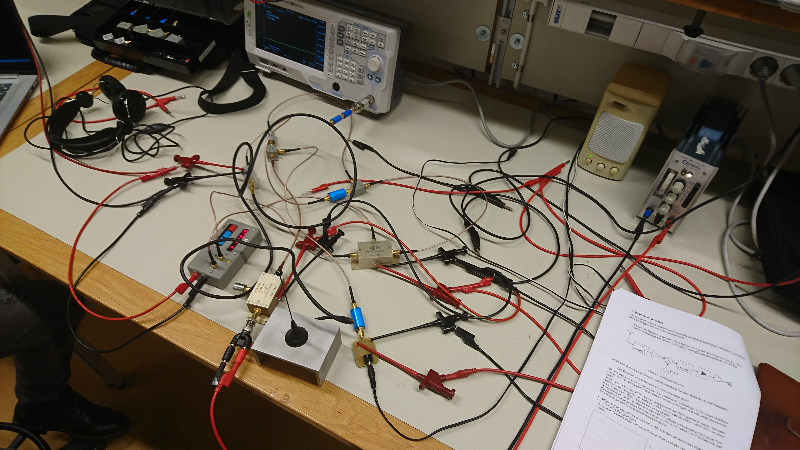
This course aims at familiarizing the student with modern radio electronic devices, circuits and systems and to provide a relevant background to the common mobile applications standards of today. A focus will be put on knowledge of integrated radio circuit building blocks so that at the student at end of the course is well equipped to pursue either an industrial or academic career in the area. The course will prepare the student for diploma thesis work in the area of Radio Electronics, as he will be further trained in circuit design beyond the knowledge gained in analog courses. The most important CMOS and bipolar techniques for low power applications will be studied for radio applications and modern design tools will be used.
Choose semester and course offering
Choose semester and course offering to see current information and more about the course, such as course syllabus, study period, and application information.
Application
For course offering
Spring 2025 TEBSM programme students
Application code
60810
Content and learning outcomes
Course contents
Intended learning outcomes
After passing the course, the student shall be able to
- give an account of modern radio implementations with an emphasis on radio components, radio circuits, radio systems, and special building blocks appropriate for integration on chip
in order to be prepared for degree projects in the field and furthermore industrial or academic careers.
Literature and preparations
Specific prerequisites
Knowledge in analogue electronics, 6 higher education credits, equivalent to completed course in IE1202/IE1207.
Recommended prerequisites
Equipment
Literature
Examination and completion
If the course is discontinued, students may request to be examined during the following two academic years.
Grading scale
Examination
- LAB1 - Laboratory Course, 1.5 credits, grading scale: P, F
- TEN1 - Examination, 6.0 credits, grading scale: A, B, C, D, E, FX, F
Based on recommendation from KTH’s coordinator for disabilities, the examiner will decide how to adapt an examination for students with documented disability.
The examiner may apply another examination format when re-examining individual students.
Opportunity to complete the requirements via supplementary examination
Opportunity to raise an approved grade via renewed examination
Examiner
Ethical approach
- All members of a group are responsible for the group's work.
- In any assessment, every student shall honestly disclose any help received and sources used.
- In an oral assessment, every student shall be able to present and answer questions about the entire assignment and solution.
Further information
Course room in Canvas
Offered by
Main field of study
Education cycle
Add-on studies
Contact
Supplementary information
In this course, the EECS code of honor applies, see: http://www.kth.se/en/eecs/utbildning/hederskodex.
See Social for most updated course information. https://www.kth.se/social/course/IL2219/