

Summer School on Time and Sustainability, 2026
The Summer School
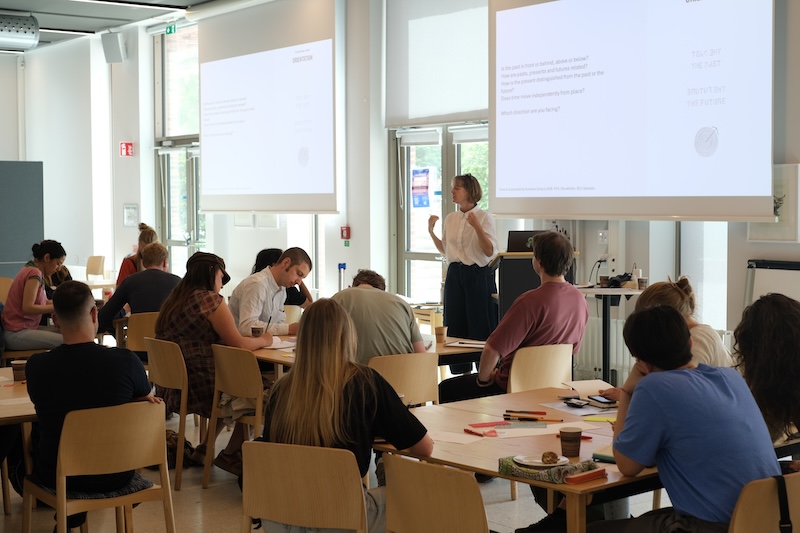
We are happy to write that the June 2026 doctoral school on Time and Sustainability at SLU and KTH recently wrapped up. 18 doctoral students participated, from both the natural and social sciences. The school ran over one week, with the aim of allowing participants engage with temporal questions in relation to their own research, and to better understand the competing time frames and rhythms of different disciplines and decision-making practices. It brought together an interdisciplinary learning community to address a rapidly growing new research topic that is becoming critically important across sustainability debates in all disciplines: the question of TIME. You can see the program here (pdf 3.4 MB)
Thanks to Keri Facer and Harriet Hand for leading the process. You can find examples of some of the creative and generative tools they work with at www.temporalimagination.com within the project Times of a Just Transition . Aså Berggren (SLU), Lakin Anderson (KTH), Anne Kathrin-Peters (KTH) and Sanna Barrineau (Uppsala University) were part of the facilitation and organising team.
The doctoral school was organised collaboratively between the Department of Ecology at the Swedish University of Agricultural Sciences (SLU), The Center for Anthropocene History at the Division of History for Science, Technology and Environment at The KTH Royal Institute of Technology, The Department of Learning at KTH, and the August T Larsson Guest Researcher Programme at SLU. A short summary of the intensive week follows below.
March 27. “Introduction to time and sustainability” Online
We began with a half-day introduction. After introductions and warm up, we established ground rules for the school, and explored our own relationships to and interpretations of time. We also discussed course literature and asked what tools we find for looking at temporality in participants different disciplines and fields. We used these to start a Time and Sustainability Glossary.

June 2. “Time and temporality, tools and techniques” at KTH
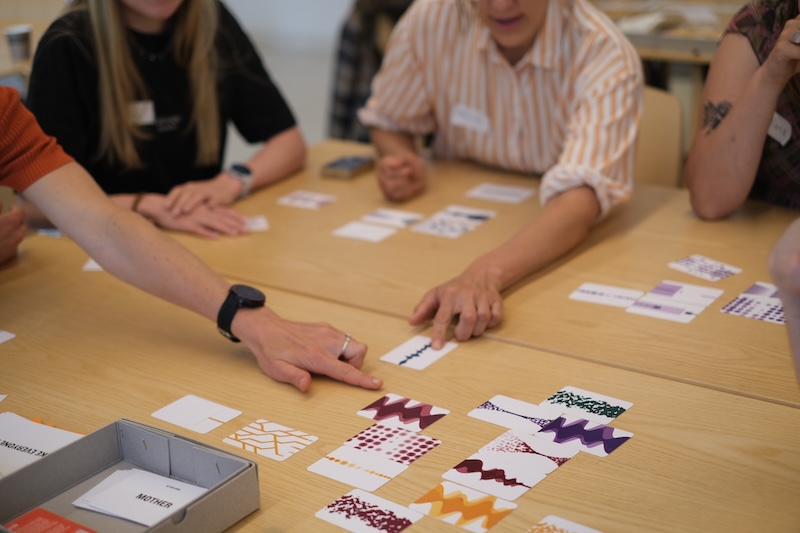
We began with an introduction to the Diagnostic Fieldguide – including the elements and shapes of time. The aim was noticing, diagnosing how time is being used in the context of participants work. And playing with these diagnostics to make sense of sustainability issues. We also explored time shapes as narratives and expectations of ‘what will happen next’ and how these arise in sustainability debates and research. Particpants were introduced to the Time Log , a systematic way of querying temporal issues in a given topic.
In the second half of the day we focused on attunement to multi-species temporalities through the When Are We Game – a playful collaborative game inviting participants to deconstruct a familiar narrative, sensing into time as a manipulable practice.
We discussed the timeline as a construct, and the deadlines and “lifelines” of participants work. We constructed, deconstructed and reconstructed key timelines in our projects, and considered the different forms deadlines can take. Participants were then introduced to the Chronoberg Chronicle, a newspaper from the temporally experimental city of Chronoberg overnight.


June 3. “Narratives and expectations; timestories and time shapes” at SLU
We began with a visit to Chronoberg and a consideration of how we might reorder time and timings, and what this means. People contributed to the next issue of the Chronoberg Chronicle.
After lunch we took a time walk through the landscape at SLU. We were each given seperate tasks that asked us to tune into rhythms, cycles and other time elements observable in the surroundings. Time seemed to slow down. Participants then crafted a shared picture of what they observed, using ink and collected natural items.


June 4. “Group work on time, Justice and Sustainability”
Particpants worked to gether to describe a temporal feature in detail – e.g. a quality of time ‘speed’, ‘slowness’; a time technology e.g. timelines, gantt charts, clocks, calendars; a timestory e.g. cyclical, linear, wavelike, branching etc.
Groups took examples – from their own research/the world of how this temporal feature is used/has effects in the world of sustainability and tried to explore this across fields. They also identified ways of resisting/challenging this temporal feature – what have people done to disrupt this in the past? What might be done? Are there alternatives? Each group prepared presentation and activity based on this topic.
June 5. “Applying temporal thematics in your research”
On our final day, participants made short presentations of the application of time in their research projects, based on key temporal thematics (e.g. slow/fast conflicts, cyclical/linear conflicts, wave patterns, etc)
In the afternoon we finished with group discussion – reflections on lessons learned from the morning presentations. The discussion turned to future directions – how could this community move forward working with these materials? What are the implications for the design and governance of research and sustainability interventions? Among other activities, a collective publication is now in process.


Thanks to all participants and organisers of Time and Sustainability, 2026.