Architects support migrants from Syria
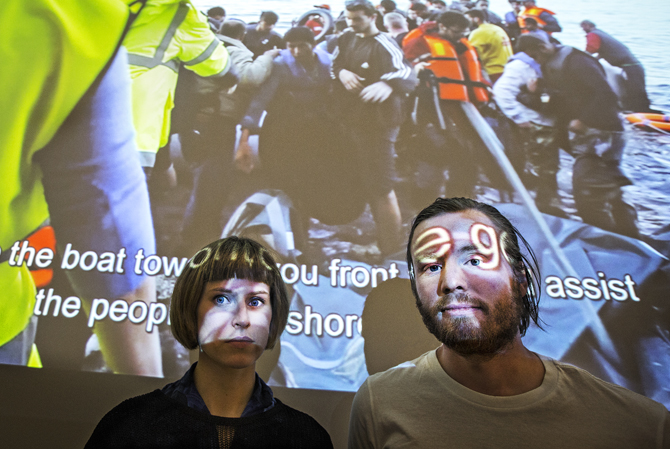
What can an architect do to help with the influx of migrants on Lesbos? And how can architecture improve the situation for refugees? These were some of the questions raised during a support event at the School of Architecture in December.
The evening seminar, Safe Spaces: for People Seeking Refuge, was organized by the Architectural League's student association at KTH in order to contribute to increased commitment.
"We would like architecture students and architects to take on greater responsibility in the current crisis," explained Felicia Liang, who along with the association's president, Sara Davin Omar, initiated the event.
The evening began with an overview of Syria's history. George Touma, a lecturer at Aleppo's Architecture Faculty, Department of Urban Development, took the audience on a journey from the early Kingdom of Ebla, around 2000 BCE, to the present day Syria.
"Damascus and Aleppo are two of the world's oldest continuously-inhabited places, Touma explained.

Touma's lecture concluded with a chronological series of images from Aleppo before and after the current war; buildings in the old town, bazaars, churches, mosques, hospitals, hotels and his own university appear in ruins or heavily damaged as the slideshow progresses.
Necessary architecture
Following the presentation, Dzenis Džihić, who graduated from KTH in the spring, spoke about his project 'Unfolded Relief', a solution for temporary hospital units that can be quickly set up during wars, disasters or other emergencies.
His buildings are collapsible, can be transported in ordinary cars and are designed for different applications such as vaccination clinics, surgery wards or field hospitals.
Sara Deurell, Jelena Mijanoivi'c and Jonathan Wahlstedt from Codesign Research Studio (CORS) introduced the studio's project, Sanctuary, which examines asylum and migration policy from an architectural perspective.
Students Maja Hedvall and Aaron Heineman contributed experiences from the beach in Lesbos. Having worked as volunteers for the reception of refugees in Stockholm, they became motivated to help on the Greek island.
"The work gives so much. We felt that we wanted to be involved and make a difference even at the refugees' arrival in Europe," Hedvall said.
Built bridges

Hedvall and Heineman made contact with the organization Lighthouse Refugee Relief, which operates a receiving station at the eastern part of the island's north coast, the area where most refugees disembark after their sea crossing. The camp has Lighthouse field kitchens, tents for overnight stays, and is able to provide emergency medical care.
"We went down as fellow human beings but realized immediately that we had also benefited from our education," Hedvall says.
During one week in Lesbos the two built a bridge, as well as a safer stairway to a hospital trolley and an outhouse for women. At the end of the year, they plan to go back for another week on Lesbos.
They also produced a short film, meant as an introduction for new volunteers. The film features volunteers talking about their work in the camp and a few interviews with the children there.
"One girl wanted first just talk about how strong she was and that she had not been crying," Hedvall said. " Then, when I said it was okay to cry, she cried for 20 minutes."
One matter taken up in the lectures concerned continuing work for the architecture faculty at Aleppo. Touma has been in Sweden as a refugee for the last six months, yet he ventured to think ahead.
"I hope for cooperation with many universities in Europe to build up Syria again in the future."
Ursula Stigzelius