
KTH played a key role in bringing ECCV back to Sweden after 32 years
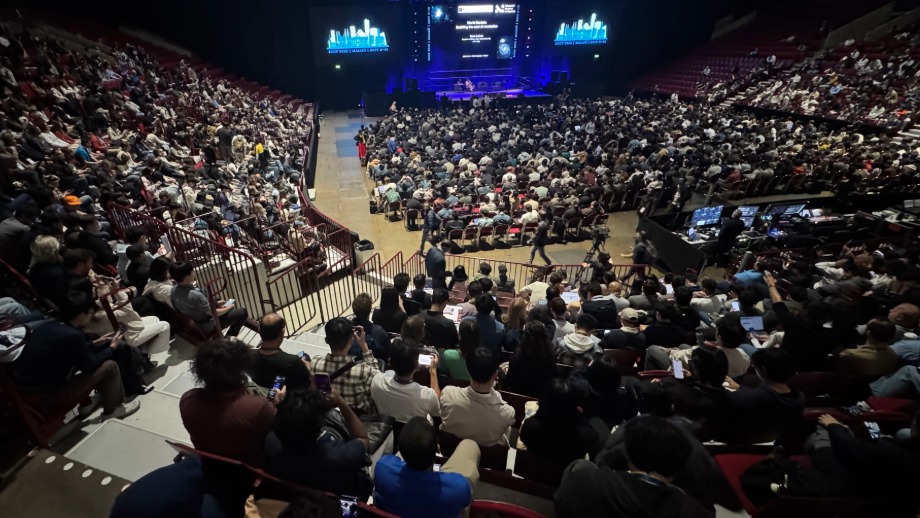
Thirty-two years after ECCV was held in Stockholm, thousands of researchers gathered in Malmö for ECCV 2026. Behind the scenes, Professor Atsuto Maki, KTH, played a key role in bringing the event back to Sweden, with KTH colleagues contributing in other organising roles.

Computer Vision is a cornerstone of modern AI and enables computers to interpret and understand images and video. The field is driving advances in areas such as robotics, autonomous vehicles, medical imaging and generative AI, making ECCV one of the most influential meeting places in the field for researchers developing the next generation of intelligent systems.
The European Conference on Computer Vision (ECCV), held on 8–12 September, is widely regarded as one of the three premier conferences in the field, alongside CVPR and ICCV. This year’s edition attracted more than 6,700 registered participants: researchers, industry experts and students from across the globe. The conference received 10,473 paper submissions, with more than 2,800 papers appearing in the main conference programme.
Leading the bid and building the team

The initiative to host ECCV in Sweden began when Atsuto Maki, Professor of Computer Science at KTH, was informally approached by a member of the European Computer Vision Association (ECVA) about bringing the conference to Sweden.
Maki later co-led the successful bid for ECCV 2026 with Serge Belongie of the University of Copenhagen and the Pioneer Centre for AI. Over the years, the wider effort involved colleagues including Paolo Favaro, Federico Tombari, and Andrea Vedaldi.
Belongie played a leading role in the conference’s overall organisation as one of its General Chairs. Maki helped assemble the international organising team, inviting the majority of the General and Program Chairs and bringing together Sweden-based chairs across a range of roles.
Helping shape the scientific programme

As one of the Program Chairs, Maki also shared responsibility for overseeing the peer-review process and shaping the scientific programme. KTH colleagues Josephine Sullivan and Mårten Björkman also served as chairs in the conference organisation.
At the opening ceremony, Maki welcomed participants on behalf of the Program Chairs and reflected on ECCV’s return to Sweden after 32 years. His remarks connected Stockholm 1994, Copenhagen 2002 and Malmö 2026, and recalled the late KTH professor Jan-Olof Eklundh, who chaired ECCV 1994.
“My heartfelt thanks go to everyone across Sweden and Denmark, throughout Europe and far beyond, who made this possible, and to all who joined us,” says Maki.