
Re-Imagine Mobility Lab: A Semester in Snapshots
An interdisciplinary student-led space for critically exploring urban mobility
The Mobility Lab was created by the KTH Global Development Hub (GDH) to be a space for students, researchers, and partners to explore how technology, creativity, and collaboration can drive societal change. With the 2026 theme “Re:imagining Mobility”, the Lab invited the KTH community to think beyond traditional boundaries of transport and movement, to imagine new ways people, ideas, and opportunities can connect across the globe or locally
Our cities are growing, technology is advancing, and people expect travel to be seamless and meaningful. At the same time, our planet needs us to reduce pollution and use resources wisely. Because the world is changing, we have the opportunity–and responsibility–to create mobility that is smarter, cleaner, and accessible to everyone.
This semester, the Lab experimented with a more outward-facing programme, deliberately incorporating a variety of approaches to Challenge-Driven Education: scenario-based design, embodied field observation, comparative analysis, site visits, and expert dialogue. The goal was to foster diverse methods of engagement, combining off-campus activities and observations with structured discussion and ideation back in the Mobility Lab.
Industry exposure: Fehmarn Belt Mini-Conference
As the inaugural event of this semester’s Mobility Lab, students attended a mini-conference on the Fehmarn Belt Fixed Link, one of Europe’s largest cross-border infrastructure projects linking northern Germany and Scandinavia. This provided direct insight into the political, environmental, and technical complexities of large-scale infrastructure development. From the conference, several questions arose amongst the students that attended: who bears the environmental and social costs of large-scale infrastructure? How do national governments and private actors collaborate, and where does governance break down? Does faster connectivity mean more sustainable mobility, or simply more of it? The visit offered a rare window into the real-world complexity behind infrastructure decisions that sometimes are presented as conclusive solutions in literature or media.
Mobility Sandbox
The Mobility Lab’s first exercise of spring 2026 involved working in what is called a sandbox, a low-stakes environment that allows for brainstorming, testing, and playing with ideas before applying them in the real world. As one of the opening activities of the Mobility Lab this year, its aim was to help students think creatively and ambitiously about urban mobility without judgment. Student groups were each assigned a mobility area and place context, then challenged to design a radical intervention for that specific setting and work backwards from a vision of the future that involved their intervention. The workshop concluded with a collective discussion assessing feasibility, impact, and implementation challenges. This exercise helped them practice scenario backcasting, which is useful for thinking beyond incremental change and imagining what transformative futures might require.
Field study: accessibility audit
In a structured field exercise, students audited several routes between KTH and T-Centralen, documenting how Stockholm’s built environment and transportation accommodates people with different physical and sensory needs. The Lab participants worked in small groups to record infrastructure conditions, public transport accessibility, and social dynamics along the commute before debriefing together later in the Mobility Lab. The findings revealed how even small design choices that most city commuters are used to can make a city feel inaccessible or isolating for those whose needs fall outside the assumed norm.
Study visit: Hammarby Sjöstad
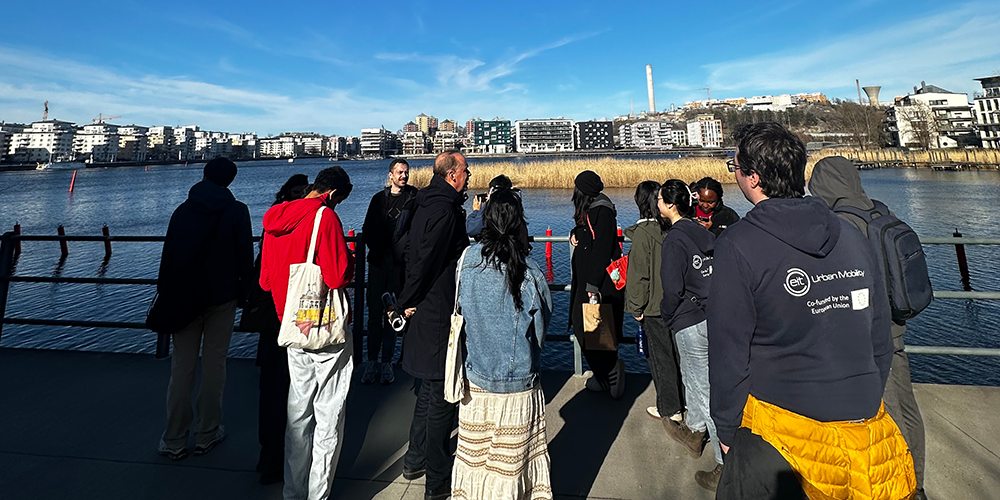
Through a democratic selection process, participants in the Mobility Lab voted on which of the city’s many urban development areas they wanted to learn more about. Ultimately, a group of about 25 students from the Lab went to Hammarby Sjöstad, one of the city’s large-scale redevelopment initiatives. Beyond its well-documented circular innovations, one of the most striking observations shared by the students was the psychological effect of the neighborhood's urban design–the boardwalk, the waterfront, and the near-absence of cars had a noticeably positive effect on residents and visitors. It was a reminder that re-imagining mobility is not only about moving people more efficiently, but about what kind of urban experience becomes possible when spatial planning centers on liveability.
Transplant Challenge
One of the Mobility Lab's approaches to challenge-driven education is equipping students with analytical frameworks to understand why mobility solutions could succeed in some contexts and struggle in others. In groups, students tested the transferability of innovations from around the world, diagnosing the enabling conditions that made a particular solution work in its original context (e.g. Superblocks in Barcelona), and mapping the transfer gap when applied to their own hometowns. The exercise asked students to identify the political, cultural, and infrastructural conditions that would need to be in place for an idea to be effective elsewhere. Understanding context-dependency is, after all, critical in any attempt to re-imagine mobility.