
From refugee camp to two degrees from KTH
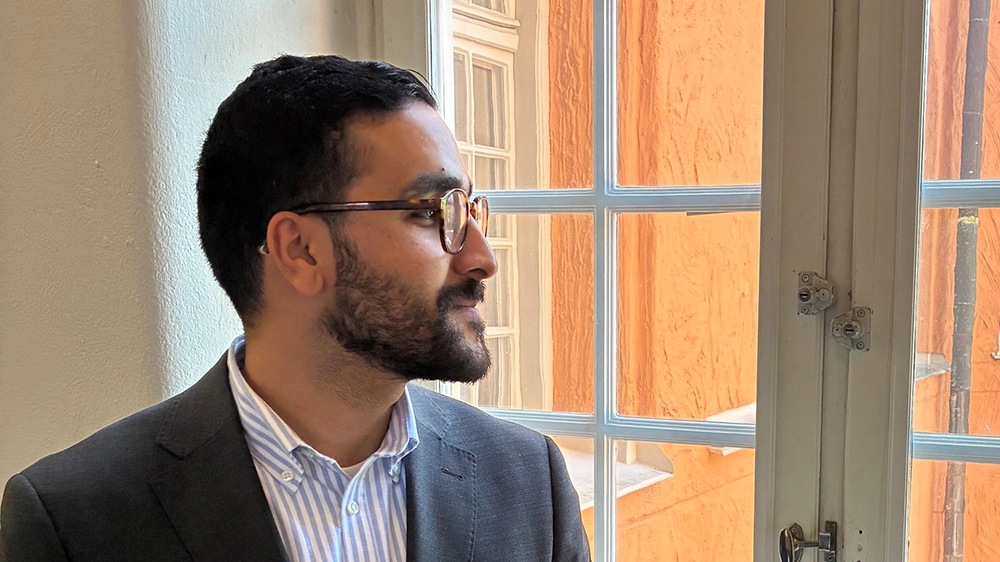
As a 17-year-old refugee from Syria, he made his way to Sweden in 2015—on foot through forests and by boat across the Mediterranean.
Since then, he has earned a Master of Science in Chemical Engineering and a degree in education at KTH in five years, and today he works as a highschool teacher of math, physics, and technology in Djursholm.
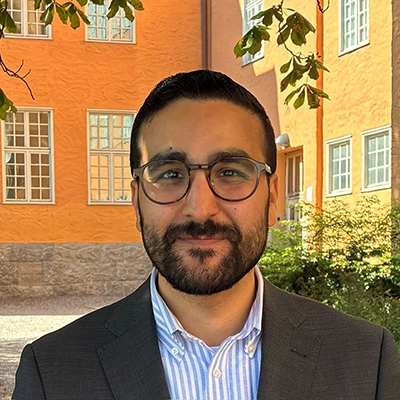
“I want to empower and inspire young people for the future,” says Fayez Hamzat.
In regime-controlled Syria, Fayez Hamzat lived with his parents and four siblings in a Palestinian refugee camp on the outskirts of Damascus. Fayez was a gifted student and participated in Syria’s Math Olympiad, and as bombs fell with increasing frequency around the city, he was urged to flee the country.
“We kept hearing about people dying on their way to Europe, and when I said goodbye to my family, my dad said, ‘I don’t know if we’ll see each other again. But heaven is the limit for you.’”
“I walked almost the entire way to Europe on foot. I rode a bike for part of the way. I joined a group of people on a rubber boat from Turkey to Greece. It was the first time I’d ever seen the sea. I’ll never forget the darkness in the middle of the Mediterranean; the boat was so crowded that we had to sit on each other’s laps—there wasn’t enough room.”
He hiked with strangers in various groups through the forests of Greece to Macedonia and Serbia, constantly gaining new companions along the way.
– People were too afraid to sleep because of the risk of being robbed. I teamed up with three fellow countrymen, and at one point we went without food or water for several days. I finally dared to trust them and said, “Don’t leave me.” “No, go ahead and sleep,” they said. It was so cold that I took off my T-shirt to cover my ears. When I woke up, I was alone and my shoes were gone. That’s when I learned that in a situation where you’re fleeing, you can’t trust anyone.”
Fayez Hamzat describes himself as “small, skinny, and fast,” and he managed to escape situations where armed guards with dogs caught up with and arrested groups of refugees.
From Denmark, he managed to secure his own seat on the train to Sweden with the help of a man who booked the train tickets for him. It was fall and cold in Malmö; he weighed about 44 kilos and was traumatized after his escape.
“I was afraid of the police, but I saw three uniformed officers at Central Station and asked them for help in English. They drove me straight to a shelter where I finally felt safe,” he says.
For the next five years, he lived in a refugee shelter and later in a rental apartment in Linköping, where he learned Swedish, completed high school, and managed to complete one year of university studies before receiving Swedish citizenship in 2021. Then it was time to move to the capital for further studies at KTH.
Handled stress during studies through cooperation
“I’ve been surrounded by such wonderful people here in Sweden, who have shown me so much warmth—teachers and friends, my friends’ parents, and their families. I usually say that if every person looks out for one other person, there would be no loneliness left in the world,” says Fayez Hamzat.
His studies at KTH were demanding; he pursued the Civil Engineering and Teaching program and completed the dual-degree program in five years.
“The pressure was intense; I felt stressed about possibly failing an exam and losing my student housing. Sometimes I’d walk home from school with a knot in my stomach, like when I had to finish two books in a week.”
“I studied organic chemistry while also reading theories by Piaget, and sometimes I’d go straight from an eight-hour lab session to lectures on programming. But math was always easy for me—I love math!”
Alongside his studies, Fayez Hamzat worked as a math tutor at KTH and as a substitute teacher at a middle school in Botkyrka. He also served as the career services coordinator for his department at KTH.
Today, he teaches students math, physics, and technology at a highschool in Djursholm, serves on two corporate boards, and is politically active as a group leader on the preschool committee and a member of the elementary and high school committee in the city of Sundbyberg.
“Now I can help my parents and my family financially on a regular basis. And every day, I hear my dad’s words. In Sweden, I’ve truly felt that ‘the world is yours.’”
Text and photo: Katarina Ahlfort