
This year’s recipients of the Göran Gustafsson Prize at KTH announced
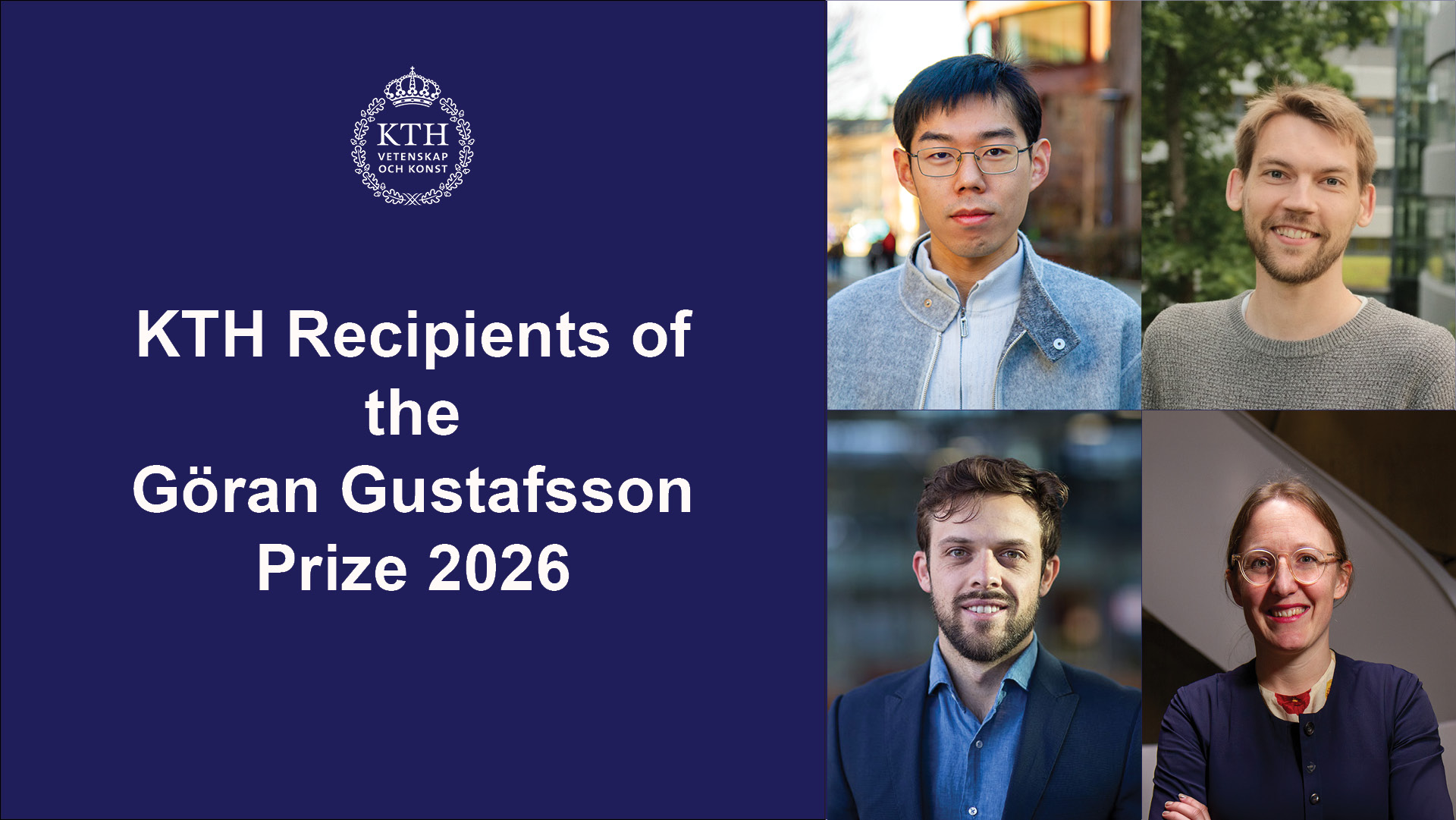
It is with great pleasure that KTH announces that the Göran Gustafsson Foundation for Research in Natural Sciences and Medicine (KTH/UU), at its most recent board meeting, has decided to award this year’s research prizes to four outstanding researchers at KTH: Giuseppe Belgioioso (EECS), Seraina Dual (CBH), Jonatan Alvelid (SCI, Physics), and Qirui Cui (SCI, Physics). The prizes recognize exceptional scientific achievements and enable continued research efforts within some of KTH’s strongest and most dynamic fields. We congratulate this year’s award recipients and look forward to celebrating their accomplishments at the award ceremony at the Nationalmuseum on 24 April.
Göran Gustafsson Foundation for Research in Natural Sciences and Medicine is one of Sweden’s most significant private research funders and has, since its inception, supported high‑quality research at KTH and Uppsala University. Each year, the foundation awards long-term research positions and major project grants in mathematics, physics, chemistry, biology, and medicine. The prizes aim to give outstanding researchers strong opportunities to deepen and advance their work, and the grant amounts are among the most generous in the country. Through its long-standing commitment, the foundation helps strengthen Sweden’s international competitiveness in science and technology.
Jonatan Alvelid
Jonatan Alvelid develops smart super-resolution fluorescence microscopy that automatically adapts to cellular activity to generate better data with minimal impact on living samples. The method enables biological processes to be studied with a level of precision that was previously difficult to achieve. The award allows Alvelid to build a new smart microscope from the ground up, combining super-resolution imaging and particle tracking to study cellular dynamics in entirely new ways. This is expected to open the door to experiments that were previously impossible.
“We let the sample guide the microscope, which makes the technique both gentler and significantly more efficient. With a system designed for smart microscopy from the start, we can perform experiments that have not been possible until now,” he explains.
Giuseppe Belgioioso
Giuseppe Belgioioso conducts research at the intersection of automatic control, optimization, and game theory, focusing on complex societal systems such as power grids and transport networks. He develops algorithms that help many actors share resources efficiently and fairly, for example in electric vehicle charging or congestion management. With the award, Giuseppe aims to move from theory to practical tools by developing new game‑theoretic solvers—software that can compute solutions to complex multi‑agent optimization problems in real time. The goal is to create open tools that can be used both in research and real‑world applications.
“I develop algorithms that make large and complex infrastructure systems more efficient, reliable, and fair,” says Giuseppe Belgioioso. “This support enables us to transform fundamental research into useful tools that can have real impact in major societal systems,” he adds.
Qirui Cui
Qirui Cui studies how electron spin in ultrathin quantum materials can be used for future energy‑efficient information processing. He investigates how spin can be generated, controlled, and transported in low‑dimensional materials to enable next‑generation spintronic components. The award allows Cui to carry out larger and more advanced simulations than before, by accessing powerful computational resources. This makes it possible to study complex magnetic materials and more quickly identify promising candidates for future spintronic technologies.
“We aim to harness spin in extremely thin materials to develop faster and more energy‑efficient technologies. This support enables us to use advanced simulations and AI to discover new spintronic materials much more efficiently,” he explains.
Seraina Dual
Seraina Dual researches how heart‑paced walking can improve circulation and fitness in older adults and individuals at risk of heart failure. Using a simple wearable device, the user walks in sync with their heartbeat, which can increase blood flow or lower blood pressure. The method has proven feasible for many older adults in home settings. The award allows Dual to investigate why the effects of heart‑paced walking vary between individuals by combining her dataset with models of cardiovascular function during walking. The goal is to understand which physiological factors influence the benefits and how the method can be best tailored to patients with cardiovascular disease.
“Our results show that heart‑paced walking using a simple wearable device can improve circulation and works well for many older adults. This support helps us identify the individual factors that influence the effect and thereby maximize the benefit for patients,” she says.