
Groundbreaking turbulence simulation may lead to more energy‑efficient engines
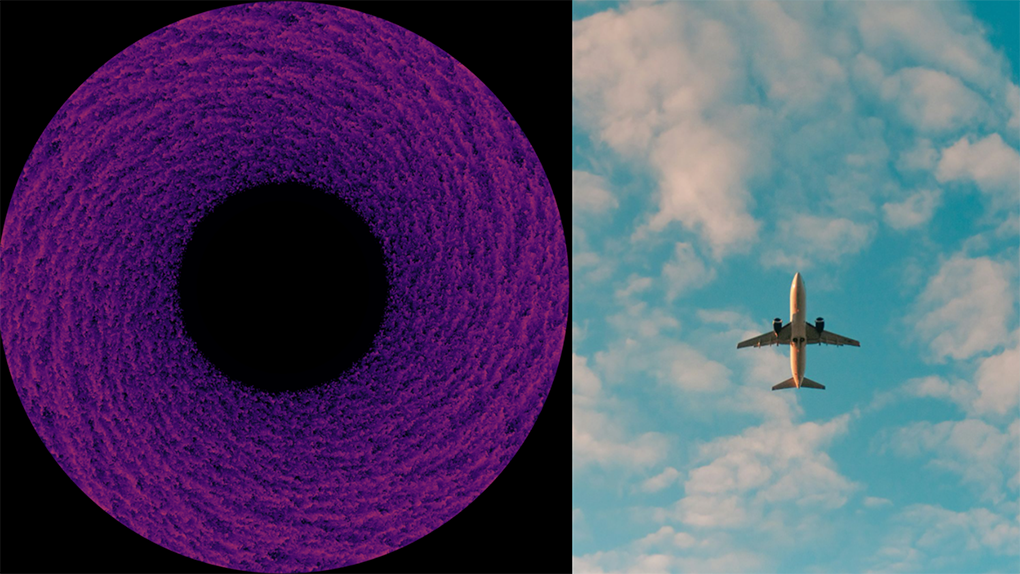
See the most the most detailed simulation to date of how air moves above a rotating disk, a classical model used to study complex turbulent flows. This is important fundamental research for developing new jet engines and aircraft surfaces.
The research is done by researchers at KTH, together with the KTH Center for Scientific Computing (KCSC), and colleagues from FAU Erlangen-Nürnberg (Germany), Forschungszentrum Jülich (Germany), Oslo Metropolitan University (OsloMet) and Lancaster University (UK).
Using Europe’s new supercomputer JUPITER and the KTH‑developed simulation software Neko, the team was able to resolve every vortex in the turbulent air, from the largest sweeping motions down to the smallest microscopic eddies.
Turbulence plays a crucial role in determining how much energy aircraft, ships and turbines consume. The new simulation shows that heat and momentum are transported in fundamentally different ways in complex flows such as on the disk, something no one has previously been able to observe in this level of detail. The simulations provide evidence that several simplified engineering assumptions do not hold for these more complex flows.
– Most of what we know about turbulence comes from the simplest case of flow over a flat wall. Our simulation lets us explore how the classical understanding of these flows breaks down when the wall rotates, says Nicholas Theiss Morse, one of the researchers at KTH.
More fuel-efficient jet engines
The detailed data can be used to improve future turbulence models, which in turn may lead to more fuel‑efficient jet engines, more effective turbines and reduced friction on ship hulls and aircraft surfaces. Such improvements could ultimately contribute to lower energy consumption and reduced emissions in the transport and energy sectors.
The simulation is the largest ever performed for this type of flow, comprising 18 billion computational points, essentially a digital grid of tiny cells where the supercomputer calculates the motion and temperature of the air. For the first time, researchers have also been able to simulate how heat is transported away from the rotating surface, a key question for many engineering applications.
VIDEO
See a video of the simulation here:
Turbulence on a turntable: Extreme-scale DNS of the rotating-disk turbulent boundary layer
CONFERENCE PAPER
Read the conference paper about the simulation for the here:
14th International Symposium on Turbulence and Shear Flow Phenomena
.