
THE MARINARIUM LAB
A small sea at KTH for research on vast oceans. Marinarium is KTH’s marine robotics test environment: a modular, self-contained facility that fills the gap between computer simulation and costly field trials. Testing at sea is expensive, risky and dependent on the weather. Simulators still struggle to reproduce hydrodynamics, acoustics and real open-water conditions. Marinarium is a controlled and fully observable middle ground, and it is far closer to real offshore conditions than a desktop simulation.
The facility
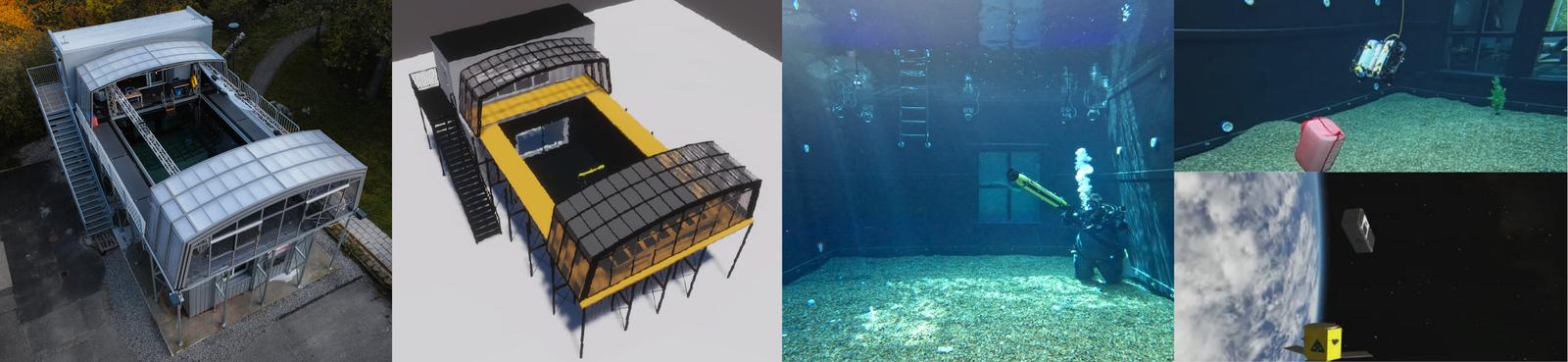
- A 9 × 5 × 3 m water basin built above ground, with a 9 × 5 × 2 m drone space above the surface
- Two motion-capture systems that track robots both underwater and in the air
- A fully retractable roof, for sheltered experiments or open-air operation in real weather
- A directly connected control room
- A digital twin of the facility in an underwater simulator, for comparing results between simulation and reality
- Direct integration with a co-located planar space robotics laboratory
Research at Marinarium
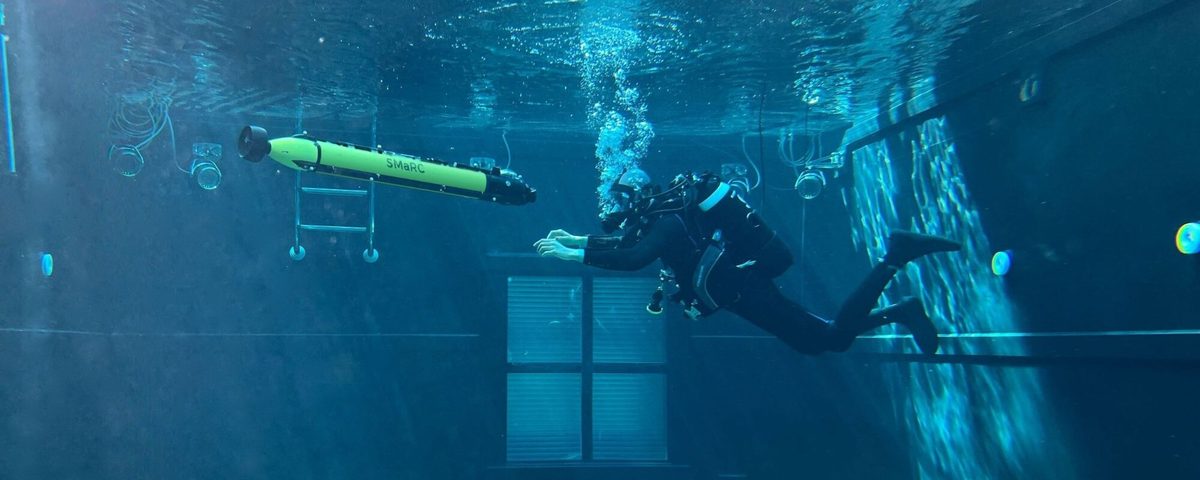
Aerial, surface and underwater robots can operate together in one instrumented volume, and divers can work alongside the vehicles. Neutral buoyancy also makes the basin a useful stand-in for microgravity. Research at the facility includes:
- Data-driven modelling of underwater vehicle dynamics
- Collaboration between robots across domains, such as rendezvous between aerial, surface and underwater vehicles
- Transferring controllers from simulation to real underwater robots using learned dynamics models
- Space robotics: validating spacecraft autonomy with underwater stand-ins