
EI2400 Applied Antenna Theory 7.5 credits
Tillämpad antennteknik
Educational level
Second cycleAcademic level (A-D)
DSubject area
Electrical Engineering
Grade scale
A, B, C, D, E, FX, F
Course offerings
Spring 13 for programme students
Periods
Spring 13 P4 (7.5 credits)
Application code
60853Start date
2013 week: 12End date
2013 week: 22Language of instruction
EnglishCampus
KTH CampusNumber of lectures
15 (preliminary)Number of exercises
Tutoring time
DaytimeForm of study
NormalNumber of places
No limitationSchedule
Schedule (new window)Course responsible
Peter Fuks <peter@kth.se>
Teacher
Peter Fuks <peter@kth.se>
Martin Norgren <mnorgren@kth.se>
Target group
Open for all master programs.
Part of programme
- Master (Two Years), Electrophysics, year 1, Conditionally Elective
- Master (Two Years), Research on Information and Communication Technologies, year 1, Recommended
- Master (Two Years), Research on Information and Communication Technologies, year 2, Recommended
- Master (Two Years), Wireless Systems, year 1, Recommended
- Master (Two Years), Wireless Systems, year 2, Recommended
Spring 14 for programme students
Periods
Spring 14 P4 (7.5 credits)
Application code
60536Start date
2014 week: 13End date
2014 week: 23Language of instruction
EnglishCampus
KTH CampusNumber of lectures
15 (preliminary)Number of exercises
Tutoring time
DaytimeForm of study
NormalNumber of places *
Min. 15*) The Course date may be cancelled if number of admitted are less than minimum of places.
Course responsible
Peter Fuks <peter@kth.se>
Teacher
Martin Norgren <mnorgren@kth.se>
Peter Fuks <peter@kth.se>
Target group
Open for all master programs.
Part of programme
- Master (Two Years), Electrophysics, year 1, Conditionally Elective
- Master (Two Years), Research on Information and Communication Technologies, year 1, Recommended
- Master (Two Years), Research on Information and Communication Technologies, year 2, Recommended
- Master (Two Years), Wireless Systems, year 1, Recommended
- Master (Two Years), Wireless Systems, year 2, Recommended
Learning outcomes
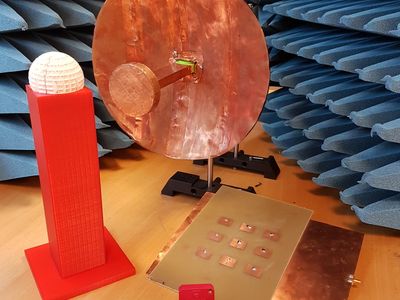
Applied Antenna Theory is a course where theory is put to practice. As a student you will learn how to classify, design, build, and evaluate antennas, e.g. at the end of the course the student will have designed and built a highly directive Wi-Fi-antenna.
Students should at the end of the course be able to:
- Explain the basic function of a given antenna based on the geometry and give a general description of the performance, e.g. the approximate shape of radiation pattern, bandwidth, and polarization.
- Create an antenna specification for a given application.
- Design an antenna from a given specification and be able to judge, by using physical constraints, if it is possible to fulfill the goals of a specification.
- Use measurement equipment, e.g. network analyzers and spectrum analyzers, to measure antenna performance. The students should also be able to use numerical software, e.g. FEM- and MOM-codes, to design and evaluate antennas.
- To find and use relevant technical literature to solve antenna problems.
- To present orally and in written format their results, and be able to give appropriate feedback to fellow students.
Course main content
Lectures
The course takes a “hands on” approach. Projects and laboratory work are the principal parts. The student will design antennas, build them and measure their properties. The lectures discusses antenna types, antenna synthesis, system aspects on “transmitter – to – receiver” problems, propagation, numerical methods and different aspects of antenna measurements.
Exercises:
Problem solving related to the various parts of the course.
Eligibility
150 university credits (hp) in engineering or natural sciences including 10 hp electromagnetic theory and documented proficiency in English corresponding to English B.
Prerequisites
EI1210 Wave propagation and antennas
Literature
Balanis: Antenna Theory. Analysis and Design.
Examination
- LAB1 - Laboratory Work, 3.5 credits, grade scale: A, B, C, D, E, FX, F
- PRO1 - Project, 4.0 credits, grade scale: A, B, C, D, E, FX, F
Requirements for final grade
Laborations (LAB1; 3,5 cr.)
Projects (PRO1; 4 cr)
Offered by
EES/Electromagnetic Engineering
Examiner
Martin Norgren <mnorgren@kth.se>
Add-on studies
EI2405 Classical Electrodynamics
EI2410 Field Theory for Guided Waves
EI2420 Electromagnetic Wave Propagation
EI252X Diploma Work in Electromagnetic Theory
Version
Course plan valid from:
Spring 11.
Examination information valid from:
Autumn 07.
