

Particle dynamics in accelerating systems. Particle system and rigid body mechanics.
SG1140 Mechanics II 6.0 credits
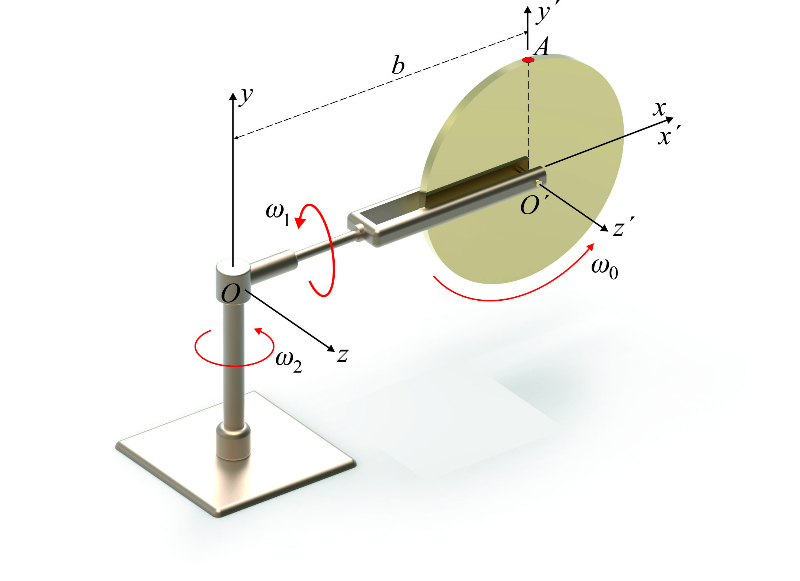
Particle kinematics and dynamics in accelerating non-inertial reference frames. Basic dynamic equations of motion for a system of particles and rigid body. Rigid body kinematics and dynamics in two and three dimensions.
Choose semester and course offering
Choose semester and course offering to see current information and more about the course, such as course syllabus, study period, and application information.
Application
For course offering
Autumn 2024 CFATE programme students
Application code
50180
Headings with content from the Course syllabus SG1140 (Spring 2019–) are denoted with an asterisk ( )
Content and learning outcomes
Course contents
Intended learning outcomes
After completing the course the student should be able to:
- identify a concrete mechanical problem, and choose suitable mechanical models based on a problem description,
- translate the mechanical model into a mathematical model,
- mathematically treat the problem and critically analyze the significance of the result,
in order to use a physical mindset and communicate this within the framework of engineering science contexts.
Literature and preparations
Specific prerequisites
Completed course SG1120 Mechanics I, SG1130 Mechanics I or SG1132 Mechanics I with project.
Recommended prerequisites
No information inserted
Equipment
No information inserted
Literature
Nicholas Apazidis: Mekanik II, Studentlitteratur, Lund.
Examination and completion
If the course is discontinued, students may request to be examined during the following two academic years.
Grading scale
A, B, C, D, E, FX, F
Examination
- INL1 - Assignments, 1.5 credits, grading scale: P, F
- TEN1 - Examination, 1.5 credits, grading scale: A, B, C, D, E, FX, F
- TEN2 - Examination, 3.0 credits, grading scale: A, B, C, D, E, FX, F
Based on recommendation from KTH’s coordinator for disabilities, the examiner will decide how to adapt an examination for students with documented disability.
The examiner may apply another examination format when re-examining individual students.
The examiner, in consultation with the KTH coordinator for disability (Funka), decides on any adapted examination for students with documented, permanent disability. The examiner may allow another examination form when re-examining individual students.
Other requirements for final grade
INL1 - Assignment, 1.5, grade scale: P, F
TENA - Theory/KS, 1.5, grade scale: A, B, C, D, E, FX, F
TENB - Problem exam, 3.0, grade scale: A, B, C, D, E, FX, F
Opportunity to complete the requirements via supplementary examination
No information inserted
Opportunity to raise an approved grade via renewed examination
No information inserted
Examiner
Ethical approach
- All members of a group are responsible for the group's work.
- In any assessment, every student shall honestly disclose any help received and sources used.
- In an oral assessment, every student shall be able to present and answer questions about the entire assignment and solution.
Further information
Course room in Canvas
Registered students find further information about the implementation of the course in the course room in Canvas. A link to the course room can be found under the tab Studies in the Personal menu at the start of the course.
Offered by
Main field of study
Technology
Education cycle
First cycle
Add-on studies
No information inserted
Contact
Outi Tammisola (outi@kth.se)