
Work Plan
The work in FUNLAB is divided into one management work package and four technical work packages. Each is described below, with its sub-projects and contact person.
The work package leaders (WPL) of FUNLAB are:
- WP1: Pär Olsson, KTH
- WP2: Xiaoqing Li, KTH
- WP3: Farid Akhtar, Luleå University of Technology
- WP4: Christophe Duwig, KTH
- WP5: Jan Dufek, KTH
WP1: Management
WP1 establishes and maintains the work structure of the project. It handles staffing and recruitment, project meetings, guidelines for external researcher access, dissemination and management of intellectual property. The WP1 group consists of the coordinator, one person per partner and two junior researchers, and meets monthly. Project-wide meetings are held in person once per semester, alternating between the academic and industrial partners. An advisory board with industrial and societal partners follows the project and advises on its future direction.
Contact: Pär Olsson
WP2: Advanced materials modeling
WP2 develops predictive models for innovative alloys, compounds and composites, with a focus on radiation damage. Models are validated against ion beam irradiation and electron microscopy at Uppsala University.
- Direct damage evolution in complex alloys and composites. The quantum formulation of the creation-relaxation method is extended to alloys and composites to predict how microstructure evolves under irradiation.
- Dynamics of defect creation. A machine-learning-driven coupling of classical and quantum solvers for atomic dynamics refines the modelling of radiation damage in complex materials.
- Creep and fracture models. Creep is tested with a modified Spark Plasma Sintering heating element and nano-indentation. The physics-based fracture model is extended from transgranular to intergranular fracture, with parameters from first-principles alloy theory.
- Heat and transport modelling. Thermal and electrical transport in advanced nuclear fuels, including nitrides and multi-component materials, is modelled and compared with Laser Flash Analysis measurements.
Contact: Xiaoqing Li

WP3: Advanced manufacture and characterization
WP3 develops and evaluates monolithic, composite and multi-material systems for advanced reactors through integrated design, fabrication, testing and microstructural characterisation.
- Novel structural, functional and fuel materials and components. Additively manufactured specimens are designed, built and tested. The work covers cladding and coated-fuel concepts, multi-material structures, and atomised powder feedstock from surrogate fuel materials and selected nuclear alloys.
- Self-healing materials. Materials capable of controlled microstructural cycling are developed and tested under thermal and mechanical cycling, to improve radiation tolerance and resistance to embrittlement, swelling and creep.
- Composite materials and interface cohesion. Prototypical interfaces are studied with ion beam irradiation and electron microscopy, focusing on differential swelling, flaking and embrittlement, in collaboration with the Royce Institute in Manchester and Uppsala University.
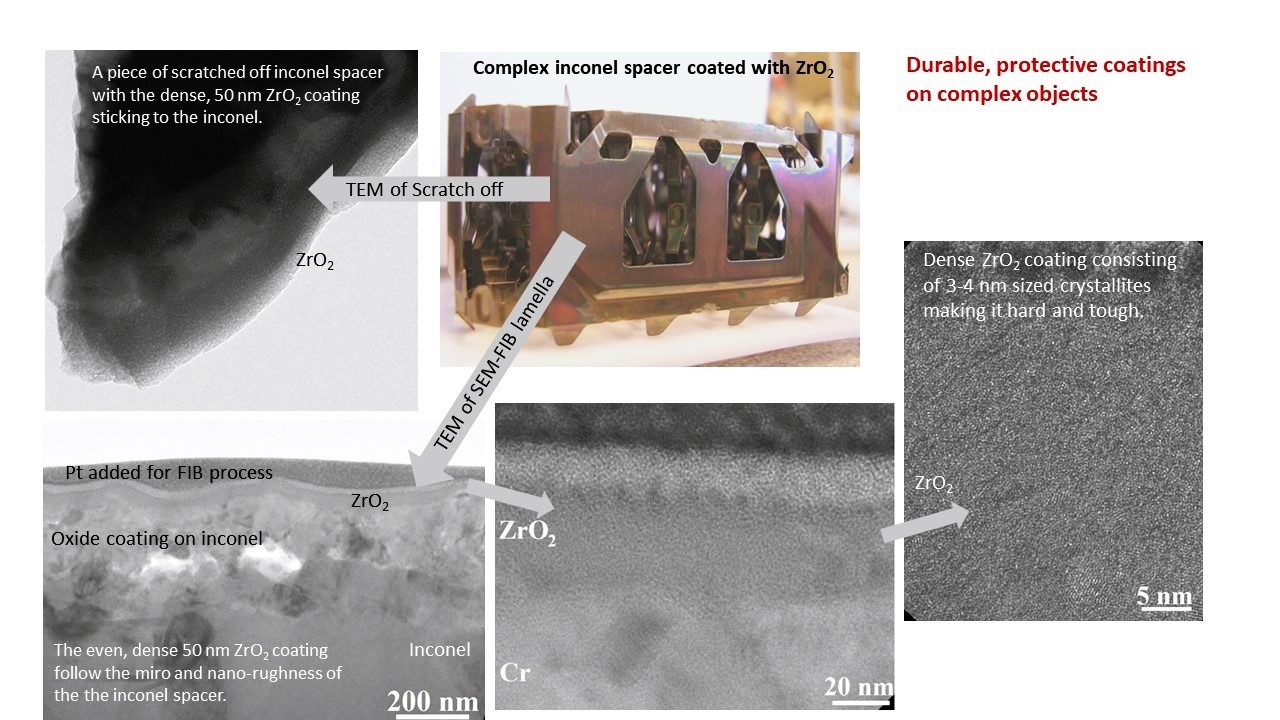
- Solution-based coatings. Oxidation-, corrosion- and wear-resistant coatings are deposited on flat and complex-shaped objects using solution chemistry.
Contact: Farid Akhtar
WP4: Thermal properties, simulations and processes
WP4 covers heat transfer modelling, high-performance simulation and the thermal properties of the materials and components made in the project.
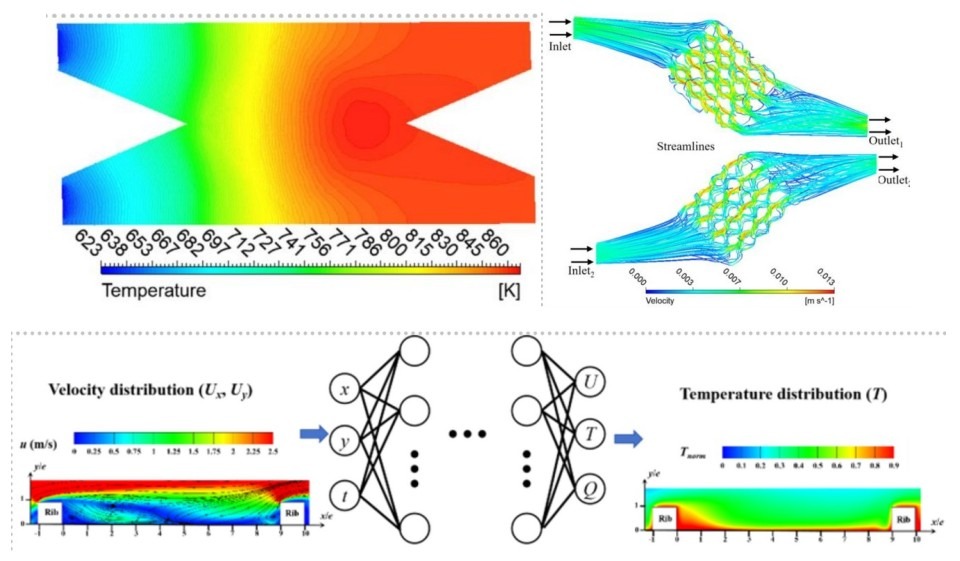
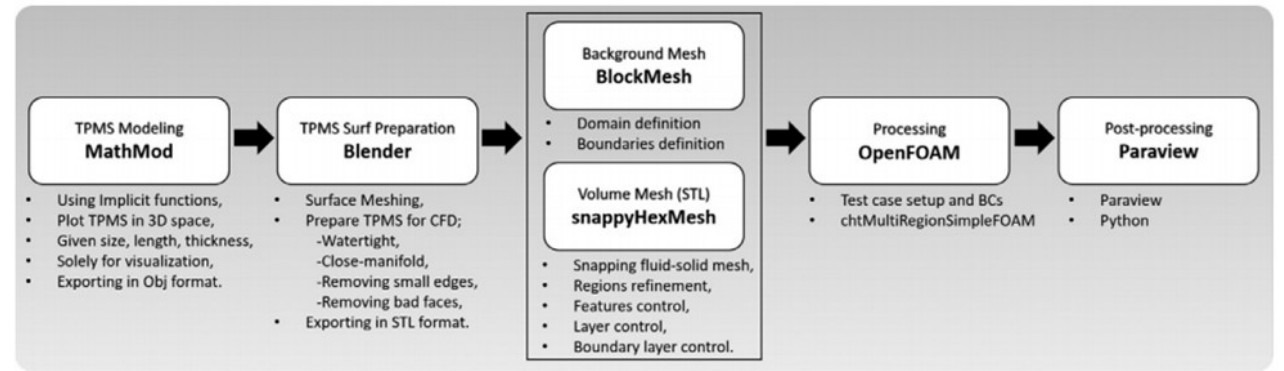
- Virtual design and thermal simulations. A conjugate heat-transfer workflow that links fluid dynamics simulation directly to files for additive manufacturing is extended to nuclear fuel heat sources and complex geometries such as triply periodic minimal surfaces.
- Physical and digital twins. A 3D-printed surrogate fuel with resistive heating and water cooling provides validation data for the simulations.
- Machine learning for reduced order modelling and optimisation. Variational autoencoders and physics-informed neural networks are trained on simulation data to predict heat transfer without computing the full fluid flow, giving reactor designers a fast tool for optimisation.
- Coupling to neutronics. Full and reduced order models of the coupled heat transfer and neutronics system are built together with WP5.
Contact: Christophe Duwig
WP5: Neutronics and design
WP5 develops neutronic methods and codes for complex geometries, coupled to design, heat transfer and materials choices.
- Massively parallel coupling schemes. Monte Carlo neutron transport and computational fluid dynamics are coupled in a scheme that uses supercomputers efficiently, which serial coupling schemes cannot do.
- Monte Carlo and CFD surrogate models. Machine-learning surrogates are trained independently on each cluster node and then combined, so that steady-state conditions for many design options can be iterated with minimal computing time.
- Coupled simulations of complex geometries. The scheme is applied with established solvers such as Serpent 2 and OpenFOAM on NAISS and PDC supercomputers.
Contact: Jan Dufek
The FUNLAB core
The work packages come together in a common demonstrator. The FUNLAB core is a complex 3D geometry with optimised heat transfer, neutronics and materials performance. It will be additively manufactured from a uranium alloy or compound, surface treated using solution chemistry, and coupled to a high-power electric current source for resistive heating experiments. Steady-state and transient tests with different coolants (water, liquid metal and helium gas) will validate the models and assess reactor design options.