Background
In our Swedish academic environment, our projects are, for the most part, funded by government agencies (such as Energimyndigheten, Vinnova, Stiftelsen för Strategisk Forskning, and similar agencies, as well as the EU Commission), with mandatory industrial in-kind support in man-hours or laboratory equipment. Rarely, but not impossibly, these projects run with direct industrial funds without intermediary agencies. Using KTH internal funds to run an entire project is essentially not possible.
In other words, there is no space for projects that do not respond to a direct call from the agencies or a request from the industry. Luckily, we can usually shape our ideas and beliefs within the framework of a funding call. Still, the idea that academia is free to conduct any type of research activity is completely baseless and offensive to the work we put into securing funding.
However, we are not a weathervane that turns to align with the wind. Some things are worth pursuing in the name of technology development and environmental conservation, when they are not mutually exclusive. There are two crucial staples in our EMD team:
- We are searchers and not re-searchers. In other words, we search for scientific solutions to a problem, and we do not re-search it. When we find a solution, we publish it. We leave re-search and the corresponding acts of journalism or histrionic speech performances to someone else.
- We develop people of science who can understand the scientific area they work in, feel its development, read trends in the multi-faceted industrial landscape, and be proactive with scientific roadmaps. We do not develop monkeys for the infinite monkey theorem.

Current search focus
In the latest development of the EMD team, we have five main search areas with people actively working in them:
- Analysis and control of variable phase-pole drives;
- Condition monitoring of electric drives;
- Design of electric machines for hydrofoil electric boats;
- Design of high-voltage electric machines for heavy-duty electric vehicles.
- Automatic commissioning of electric drive parameters.
These areas are dynamically changing, partly because people come and go, and partly because of the ongoing trends.
A brief description of the five areas is given here below.
Analysis and control of variable phase-pole drives
Sometimes you stumble on something that shakes your understanding of electric machines and drives. Variable phase-pole drives are one such example.
What are variable phase-pole drives?
Essentially, electric machines changing the number of pole pairs (and phases as a probable consequence) during real-time operation by means of electronic switching.
…and why would you do that?
There is a class of applications where the requirements on torque and speed are pretty wide. Take electric traction for example. You would like a vehicle with strong acceleration features at low speeds, which turns out to be a high torque requirement for the propulsive motor(s). At the same time, once you are running at cruising speed on the highway, the desire is to have motors that deliver the required low torque at high speed with the least electric losses.
Such requirements are very hard to fulfill with conventional electric machine design with fixed numbers of pole pairs. You can stretch out the performance of certain machine topologies, trying to cover the whole torque-speed map. However, the typical high pole number required for high torque at low speeds decreases the energy efficiency at cruising speed. You can certainly design and manufacture an electric machine that delivers the torque-speed map you desire, but there is always the feeling that the blanket is too short: some parts of the map are not well covered.
If you pass the streets of Stockholm, you will certainly notice the advent of electric cars. In many ways, it is a commendable development because it improves the local air quality and reduces the emission of greenhouse gases. Most car and truck manufacturers have turned their heads towards the permanent-magnet synchronous machine (PMSM) to “fill” the torque-speed maps using a small machine capable of delivering high continuous power. This appears all good at first glance, but when scratching the surface, some concerns emerge. First, new drive cycles such as the WLTP, spend more time at low torques and high speed. This is unfortunately the area of the torque-speed map where the efficiency of the PMSM suffers. Second, permanent magnets are not just any material and as the main actor of the show, they are both quite sensitive, unfriendly, and expensive artists. Demagnetization of the permanent magnets due to faults and excessive temperatures is a real issue that, at the very least, irreversibly degrades the machine’s performance and, at worst, could bring you to a halt. Moreover, extracting ores for the strongest magnets is a dirty process resulting in loads of chemical waste and air pollution. On top of that, procurement managers are having nightmares about the supply situation with very limited options of suppliers available.
Among the different attempts that people around the world are looking into to solve these issue, we have embarked on this variable phase-pole approach. These are the ingredients:
- An induction machine with a cage rotor;
- A stator winding split in many independent windings. How many? It depends on the pole change you want to achieve.
- A frequency converter with as many legs as the number of independent windings. Half-bridge legs are sufficient.
The machine is operated in this way. The magnetomotive force generated by the currents in the independent windings is controlled in order to generate the waveforms with the required number of pole pairs while fulfilling the torque and speed references. That is all.
Between the switchings of the different pole-pair configurations, the current distribution in the stator slot might look something like the pictures below. When your windings are connected to guarantee the same current in slots belonging to the same phase, controlling the phase currents is a piece of cake. On the other hand, your hardware simply won’t let you choose between configurations in most cases. If each slot would be individually supplied, things get a bit trickier, but your smorgasbord of options becomes ever so tasty.
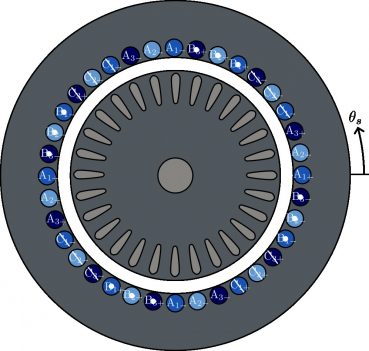

It sounds easy, but if you dig into it, you will discover that you need to learn multiphase machines and drives theory, and that would not be enough. You need to lay down another theory on top of that, to understand how to switch the number of pole pairs in real time.
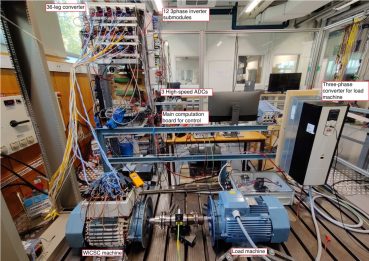
We have done that and built a bench like the one shown in the picture here below. This bench is an extreme example of independent windings since we have chosen to have one independent current for each slot in the stator (in our case, 36 slots and thus 36 independent currents). We can accomplish a controlled switch of pole pair numbers in a myriad of combinations and you would not hear anything if you are beside the bench.
Enjoy our seminal publications on the following topics if you want to know more about this exciting topic: