Science for a secure society
Hydro-climatic hazard, risk, and crisis management in Sweden (CrisAct)
CrisAct aims at providing a comprehensive science-based framework for monitoring and managing hydroclimatically driven natural hazard crisis and disaster response, in order to protect society against droughts, floods, and heat waves, occurring separately or in combination or sequence. The research results will provide essential scientific underpinning and support for decision-making on management of such disasters and mitigation of their risks, with focus on exploring the potential of various adaptive solutions/actions in Sweden. We will develop an innovative online system for monitoring and risk quantification of droughts, floods, heatwaves, and their spatiotemporal relationships across Sweden. The system development will be combined with consideration and assessment of opportunities for climate-change adaptation and disaster risk mitigation in a preventive and responsive crisis management framework. The monitoring system will build on advancement of scientific understanding of current conditions and future projections of drought, flood, and heat wave (co-)occurrence, along with societal vulnerability to these - often compound - hazards. Project results will form a basis for suggesting preparatory, preventive, and responsive solutions to their (co-)occurrences, considering the Swedish context for such hydro-climatic risk mitigation and crisis management. Project outcomes will be communicated with stakeholders to ensure application of developed tools and action roadmap.
Project description
CrisAct aims at providing a comprehensive science-based framework for monitoring and managing hydro-climatically driven natural hazard crisis and disaster response, in order to protect society against droughts, floods, and heat waves, occurring separately or in combination or sequence. The research results will provide essential scientific underpinning and support for decision-making on management of such disasters and mitigation of their risks, with focus on exploring the potential of various adaptive solutions/actions in Sweden. With this aim, we will develop an innovative online system for monitoring and risk quantification of droughts, floods, heat waves, and their spatiotemporal relationships across Sweden. The system development will be combined with consideration and assessment of opportunities for climate-change adaptation and disaster risk mitigation in a preventive and responsive crisis management framework. The monitoring system will build on the advancement of scientific understanding of current conditions and future projections of drought, flood, and heat wave (co-)occurrence, along with societal vulnerability to these - often compound - hazards. Project results will form a basis for suggesting preparatory, preventive, and responsive solutions to their (co-)occurrences, considering the Swedish context for such hydro-climatic risk mitigation and crisis management. Specific objectives are to:
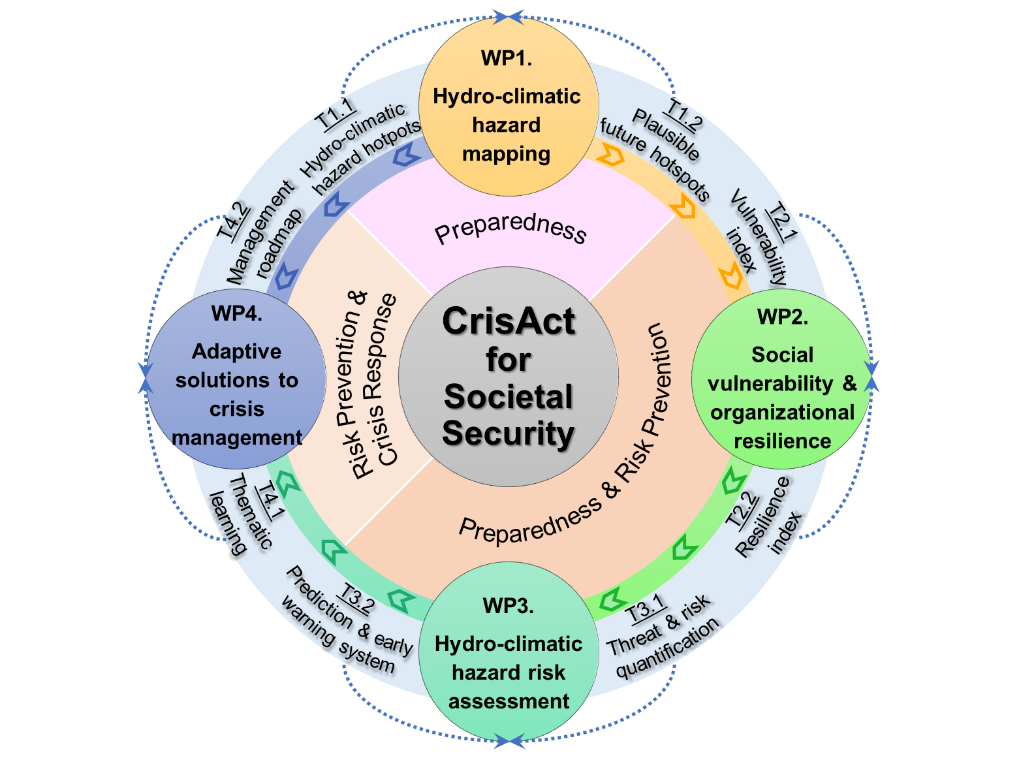
- Identify hotspots of droughts, floods, heat waves and their co-occurrences in Sweden under past, present, and projected future hydro-climate conditions and changes.
- Map the vulnerability of different Swedish regions to droughts, floods, and heat waves, by assessing and identifying societal and environmental consequences and community groups exposed to the highest threats from these hazards.
- Develop a prediction and early warning system (1-6 month horizon) for risk monitoring and assessment of the range of droughts, floods, heat waves, and their possible co-occurrences emerging from data for Swedish hydro-climatic conditions.
- Formulate an action roadmap for hydro-climatic hazard and crisis management in Sweden and the various hydro-climatic and societal conditions spanned along it’s steep climate gradient. The roadmap will consider and assess integrated and synergistic strategies to enhance societal preparedness, prevent and mitigate risks, and respond to emerging crises.
Four work packages (WPs) will pursue these objectives in a way that moves beyond the current state-of-the-art to generate concrete recommendations with tangible benefits for Swedish societal security. Project outcomes will be systematically communicated with relevant stakeholders, including policy and decision makers, to ensure relevant development directions and promote the application of developed tools and action roadmap. All project outcomes will also be made available to the broad scientific community through open-access scientific publications in high-impact journals, and to a wider readership through popular science and media publications.