
KTH students win award for AI-powered robot
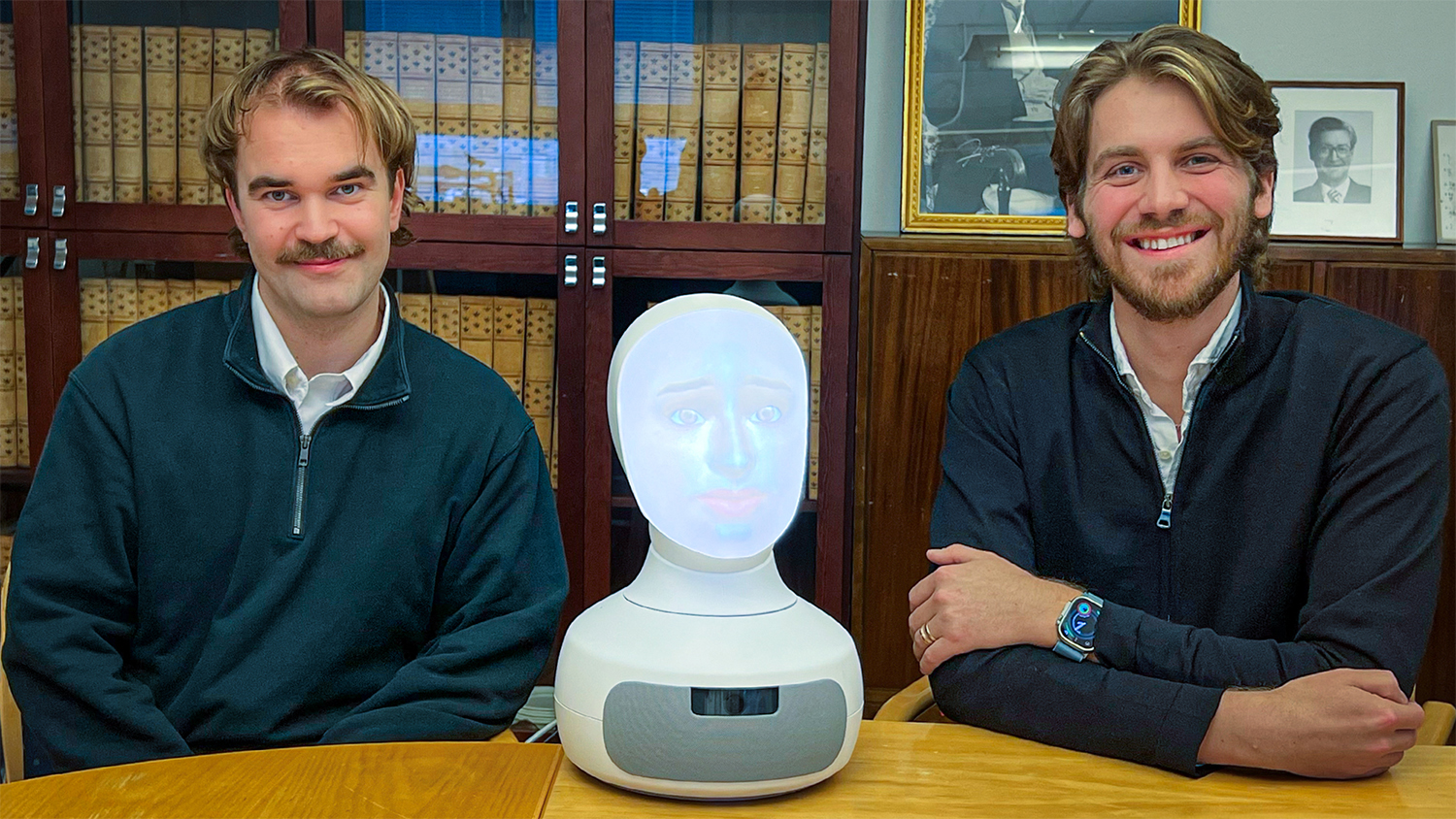
Two KTH students have developed a social robot that helps medical students practise clinical conversations with patients. William Ivegren and Jonathan Schiött have now been awarded the Swedish Association of Graduate Engineers' prize for the best degree project in an engineering programme.
“What brings you here today? Can you tell me more about your symptoms? Is there anything in particular you're worried about?”
Clinical reasoning – gathering, assessing and using medical information to arrive at the correct diagnosis – is one of the most important skills in medicine. At the same time, opportunities to practise these skills are limited by the availability of supervisors and patients.
With William Ivegren and Jonathan Schiött's innovation, medical students can practise conversations with a robot that plays the role of a patient. The robot, Furhat, developed at KTH, has a face, can make eye contact with the student and responds verbally based on a prepared patient profile. By asking questions and listening, the student tries to understand the patient's symptoms.
“The new part of our innovation is the AI-based assessment afterwards. The system analyses the conversation based on the course assessment criteria and provides personalised feedback on what went well and what the student could improve,” says William Ivegren.
The aim is to give students more opportunities to practise and identify areas for improvement, as a complement to regular teaching and supervision.
Ensure quality
To ensure the quality of the feedback, Ivegren and Schiött compared the model's assessments with those made by experienced rheumatologists. The results were at the same level.
“This made us confident that the feedback was grounded in what the students are actually expected to learn,” says Jonathan Schiött.
The system was tested on 136 medical students at Karolinska Institutet. The AI models' assessments were as accurate as those of experienced rheumatologists, and the feedback improved students' performance both in the patient dialogues and in the final exam. The students also found the feedback credible and useful for their learning.
“We expected the system to help, but not to this extent. The fact that it made such a clear difference shows that it really adds value to the course,” says Jonathan Schiött.
Valuable for doctors
The two KTH students received the award for best degree project in competition with around 4,600 degree projects completed each year in engineering programmes.
“We chose this project because we wanted to contribute to something that could make a difference to people's lives. So it means a lot that others also recognise its value,” says William Ivegren.
The system is still being used in teaching at Karolinska Institutet. The work is also continuing through Jonathan Schiött, who is now pursuing a PhD at the institute in this field.
“My research focuses on how this type of technology can help students in healthcare professions become better prepared for their future careers. Among other things, we will continue to develop the assessment of the dialogues and investigate how virtual patients can promote collaboration between medical and nursing students,” he says.
Could your innovation also be useful for practising doctors in the future?
“Absolutely. At its core, it's about being able to review your own conversations and understand what you did well and what you could have done better. That's valuable for doctors throughout their careers,” says Jonathan Schiött.
Text: Christer Gummeson ( gummeson@kth.se )