Till KTH:s startsida

AF270X Degree Project in Architectural Lighting Design, Second Cycle 15.0 credits

Information per course offering

Course offerings are missing for current or upcoming semesters.

Course syllabus as PDF

Please note: all information from the Course syllabus is available on this page in an accessible format.

Course syllabus AF270X (Spring 2026–)
Headings with content from the Course syllabus AF270X (Spring 2026–) are denoted with an asterisk ( )

Content and learning outcomes

Course disposition

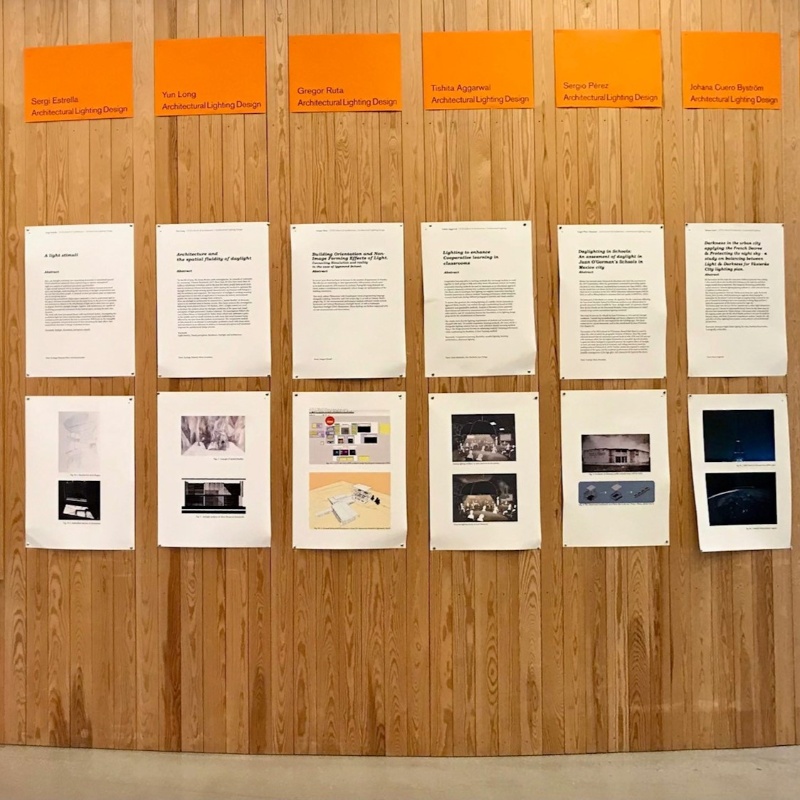
The course is designed as a delineated research project.

The thesis process includes project description, midterm presentation, draft delivery, final paper submission and final presentation.

The course structure may include, among other things, literature studies, problem formulation, collection and compilation of data and analysis.

The degree project should be presented at a final seminar. The degree project should be written and presented in English.

The degree project will be checked for plagiarism.

Course contents

The degree project should constitute a part of a specialisation within the main field of study at the second-cycle level to satisfy the requirements for the degree.  This implies that the degree project should be carried out within Architectural Lighting Design.

Exemptions may be granted.

Intended learning outcomes

After a completed degree project, the student should be able to

  • Show knowledge of the disciplinary foundation of the chosen subject area within the field of Architectural Lighting Design and best practice, an advanced understanding of current research and development work and advanced knowledge of methods.
  • Demonstrate the ability to search for, collect and integrate knowledge in a comprehensive, critical, and systematic way and to identify his or her needs for further knowledge.
  • Demonstrate the ability to identify, analyse, assess and handle complex phenomena, issues and situations, even with limited information.
  • Demonstrate the ability to plan, and with adequate methods, carry out high-quality assignments within given time frames, as well as to evaluate this work.
  • Demonstrate the ability to develop and evaluate products, processes, systems, methods or technical solutions, taking into consideration people's abilities and needs, and society's goals for economic, social and ecological sustainable development.
  • Demonstrate orally and in writing the ability to, in dialogue with different groups, clearly account for and discuss his or her conclusions, including the knowledge and arguments that are the basis of such conclusions.
  • Demonstrate the ability to exercise judgement, considering the relevant scientific, social and ethical aspects.
  • Demonstrate the skills required to participate in research and development work or to independently work in other advanced contexts.
  • Demonstrate the capacity to follow and go through the stages of a specific working process in a given time frame.

Literature and preparations

Specific prerequisites

A main part of the studies, at least 30 credits of which 15 credits with specialisation should be completed before the degree project may be started for second-cycle studies within the main field of study. It falls on examiner to ensure that the student has the specialisation that is intended above. Exemption can after assessment be granted by the director of first and second cycle education.

Literature

You can find information about course literature either in the course memo for the course offering or in the course room in Canvas.

Examination and completion

Grading scale

P, F

Examination

  • XUPP - Examination, 15.0 credits, grading scale: P, F

Based on recommendation from KTH’s coordinator for disabilities, the examiner will decide how to adapt an examination for students with documented disability.

The examiner may apply another examination format when re-examining individual students.

If the course is discontinued, students may request to be examined during the following two academic years.

Other requirements for final grade

To receive a final grade in this course, students must attend at least 80% of scheduled course activities.

The overall course grade will be awarded on a Pass–Fail (P–F) scale.

The degree project should be connected to sustainable development.

Regardless of the type of work, whether theoretical, design-based, or experiment-based, students are expected to include a practical component based on first-hand source material produced for the project. Examples include, but are not limited to: experiments, interviews, photographic documentation of a space, and lighting measurements.

Examiner

Ethical approach

  • All members of a group are responsible for the group's work.
  • In any assessment, every student shall honestly disclose any help received and sources used.
  • In an oral assessment, every student shall be able to present and answer questions about the entire assignment and solution.

Further information

Course room in Canvas

Registered students find further information about the implementation of the course in the course room in Canvas. A link to the course room can be found under the tab Studies in the Personal menu at the start of the course.

Offered by

Main field of study

Architecture, The Built Environment, Technology and Health

Education cycle

Second cycle