
Navier-Stoke's equations, Euler's equations, existence of exact solution, weak solution, finite element methods, energy estimates, perturbation growth, stability, duality, a posteriori error estimate and adaptivity.
Boundary conditions, separation, generation of drag and lift.
DD2365 Advanced Computation in Fluid Mechanics 7.5 credits
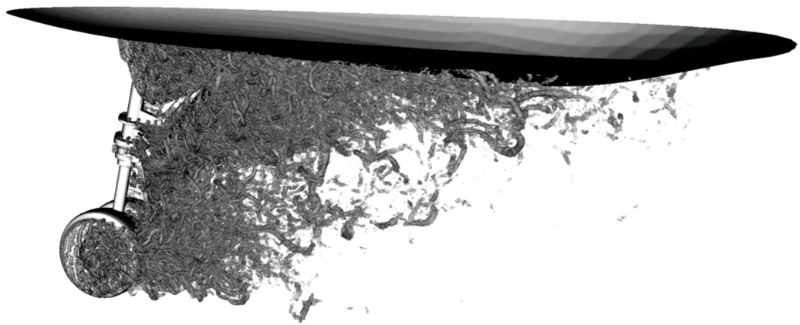
The goal of the course is to develop an understanding for computational methods in fluid mechanics, with a focus on adaptive finite element methods and how to apply these computational methods to real world fluid mechanics problems. Research challenges in the field are highlighted, e.g. with respect to high performance computing and simulation of turbulent flow. The first part of the course presents a theoretical background and gives an introduction to computational tools, which are used in the second part of the course focused on project work.
Information per course offering
Information for Spring 2027 aflum27 programme students
- Course location
KTH Campus
- Duration
- 15 Mar 2027 - 31 May 2027
- Periods
Spring 2027: P4 (7.5 hp)
- Pace of study
50%
- Application code
11776
- Form of study
Normal Daytime
- Language of instruction
English
- Course memo
- Course memo is not published
- Number of places
Min: 1
- Target group
- Open to students admitted to a master's programme as long as it can be included in your programme.
- Planned modular schedule
- [object Object]
- Schedule
Contact
Course syllabus as PDF
Please note: all information from the Course syllabus is available on this page in an accessible format.
Course syllabus DD2365 (Spring 2027–)Headings with content from the Course syllabus DD2365 (Spring 2027–) are denoted with an asterisk ( )
Content and learning outcomes
Course contents
Intended learning outcomes
After passing the course, the student should be able to
- apply concepts and methods, as well as solve computational problems, within computational fluid dynamics, with a focus on the areas of viscous flow, unsteady flow, adaptive mesh refinement, and fluid-structure interaction
- plan, carry out, and present, both orally and in writing, a project related to a research problem or an engineering problem
in order to get theoretical and practical skills in computational fluid dynamics, and applying these skills to real-world fluid mechanics problems.
Literature and preparations
Specific prerequisites
- Knowledge and skills in programming corresponding to completed course DD1337/DD1310-DD1319/DD1321/DD1331/DD1333/DD100N/DD100V/ID1018/ID1022.
- Knowledge in one-variable analysis, 7.5 credits, corresponding to completed course SF1625/SF1673/SF1685.
- Knowledge in multivariable calculus, 7,5 hp, corresponding to completed course SF1626/SF1674/SF1686.
- Knowledge in linear algebra, 7.5 credits, corresponding to completed course SF1624/SF1672/SF1684.
- Knowledge in probability theory and statistics, 6 hp, corresponding to completed course SF1910-SF1925/SF1935 or completed exam element TEN1 in SF1910/SF1925/SF1935.
Literature
You can find information about course literature either in the course memo for the course offering or in the course room in Canvas.
Examination and completion
Grading scale
A, B, C, D, E, FX, F
Examination
- PRO1 - Project, 4.0 credits, grading scale: P, F
- TEN1 - Examination, 3.5 credits, grading scale: A, B, C, D, E, FX, F
Based on recommendation from KTH’s coordinator for disabilities, the examiner will decide how to adapt an examination for students with documented disability.
The examiner may apply another examination format when re-examining individual students.
If the course is discontinued, students may request to be examined during the following two academic years.
TEN1 consists of a project report that is also presented orally.
Other requirements for final grade
Compulsory attendance in seminars including preparation of literature review.
Examiner
Ethical approach
- All members of a group are responsible for the group's work.
- In any assessment, every student shall honestly disclose any help received and sources used.
- In an oral assessment, every student shall be able to present and answer questions about the entire assignment and solution.
Further information
Course room in Canvas
Registered students find further information about the implementation of the course in the course room in Canvas. A link to the course room can be found under the tab Studies in the Personal menu at the start of the course.
Offered by
Main field of study
Computer Science and Engineering
Education cycle
Second cycle
Supplementary information
In this course, the EECS code of honor applies, see:
http://www.kth.se/en/eecs/utbildning/hederskodex