
- The bases of generative artificial intelligence, AI (historical, theoretical, conceptual and practical).
- Common applications of generative AI (including trends).
- Application programming interfaces for generative AI.
- Creativity and generative AI (views on creativity, art and artistic work and related applications of generative AI).
- Generative production in media, generative design and art.
- Education and generative AI (challenges, possibilities and risks).
- Ethical perspectives on use of generative AI (for example values, independence and ownership).
- Gender equality, diversity and equally conditions perspectives and problems for generative AI (for example gender partiality).
- The future for generative AI (the development we can expect).
DM2588 Generative AI for Media Technology and Interaction Design 7.5 credits
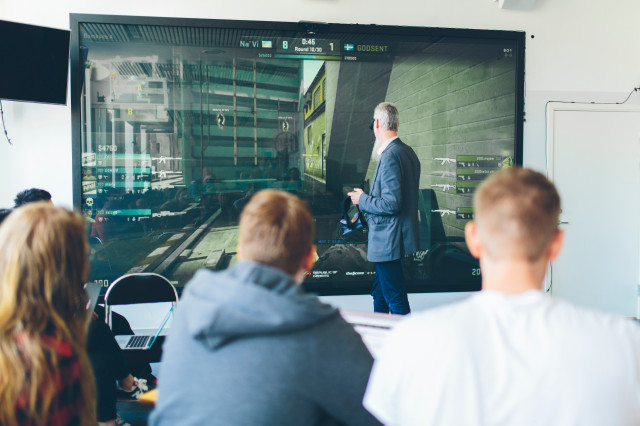
The course gives a media technology and interaction-design oriented introduction to generative AI with practical applications.
Information per course offering
Choose semester and course offering to see current information and more about the course, such as course syllabus, study period, and application information.
Course syllabus as PDF
Please note: all information from the Course syllabus is available on this page in an accessible format.
Course syllabus DM2588 (Autumn 2026–)Headings with content from the Course syllabus DM2588 (Autumn 2026–) are denoted with an asterisk ( )
Content and learning outcomes
Course contents
Intended learning outcomes
After passing the course, the student should be able to
- describe the fundamental theoretical and conceptual bases of generative AI
- describe how generative AI has been developed historically
- describe the application space for generative AI
- analyse and describe possibilities and limitations to create texts and other content with generative AI
- use generative AI to create content as texts, images, number, music and video
- use application programming interfaces for generative AI
- analyse the possibilities about how generative AI should be able to support creativity
- analyse ethical challenges and risks with generative AI as for instance ownership and independence related to digital content that partly or completely has been generated with AI
- analyse and discuss possibilities with generative AI in relation to sustainability
- assess and discuss questions around equal opportunities, diversity and equal conditions related to generative AI
in order to be able to use generative AI for media technology and human computer interaction from human, ethical and sustainable perspectives.
Literature and preparations
Specific prerequisites
Knowledge and skills in programming, 6 credits, equivalent to completed course DD1337/DD1310-DD1319/DD1321/DD1331/DD1333/DD100N/ID1018/ID1022.
Skills in scientific thinking and writing through any of the following:
- a university degree of at least 180 credits
- a completed or begun degree project aiming at a university degree of at least 180 credits
- a completed course in research methodology/theory of science, 6 credits.
Knowledge in English corresponding to the upper secondary course English B/English 6.
Literature
You can find information about course literature either in the course memo for the course offering or in the course room in Canvas.
Examination and completion
Grading scale
P, F
Examination
- LIT1 - Literature Assignment, 2.5 credits, grading scale: P, F
- PRO1 - Project Work, 5.0 credits, grading scale: P, F
Based on recommendation from KTH’s coordinator for disabilities, the examiner will decide how to adapt an examination for students with documented disability. The examiner may apply another examination format when re-examining individual students. If the course is discontinued, students may request to be examined during the following two academic years.
Examiner
Ethical approach
- All members of a group are responsible for the group's work.
- In any assessment, every student shall honestly disclose any help received and sources used.
- In an oral assessment, every student shall be able to present and answer questions about the entire assignment and solution.
Further information
Course room in Canvas
Registered students find further information about the implementation of the course in the course room in Canvas. A link to the course room can be found under the tab Studies in the Personal menu at the start of the course.
Offered by
Main field of study
Computer Science and Engineering
Education cycle
Second cycle
Supplementary information
Overlaps with DM2586 Generative AI for Media Technology and Interaction Design.