
MF2025 Project Work in Mechatronics 6.0 credits
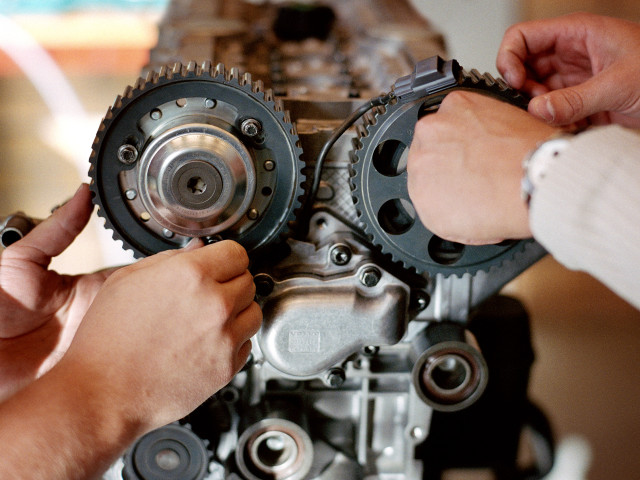
Confronting students with research work in limited projects, defined within ongoing research.
Information per course offering
Choose semester and course offering to see current information and more about the course, such as course syllabus, study period, and application information.
Course syllabus as PDF
Please note: all information from the Course syllabus is available on this page in an accessible format.
Course syllabus MF2025 (Spring 2026–)Headings with content from the Course syllabus MF2025 (Spring 2026–) are denoted with an asterisk ( )
Content and learning outcomes
Course contents
Studenterna kommer att utveckla sin förmåga att designa, analysera och utvärdera mekatroniska system i verkliga projektkontexter.
Särskild tonvikt läggs på att integrera kunskap från mekanik, elektronik, mjukvara och reglerteknik för att skapa innovativa lösningar.
Kursen främjar färdigheter i problemformulering, kravspecifikation, systemtänkande, verifiering av funktionalitet samt analys av prestanda, säkerhet och hållbarhet.
Studenterna får praktisk erfarenhet av att tillämpa ingenjörsmetoder och samarbeta i tvärdisciplinära team.
Vetenskaplig kommunikation, inklusive teknisk rapportering, visualisering av data och muntlig presentation, övas kontinuerligt under projektets gång.
Detaljerad information om interna och externa projektupplägg, inklusive ansökningsförfaranden, handledning och budgetar, finns i kurs-PM samt i kursrummet i Canvas.
Intended learning outcomes
After completing the course, students should be able to
1\. Apply relevant knowledge in at least two core areas of mechatronics (mechanics, electronics, software and/or control engineering) to design and implement a mechatronic system.
2\. Contribute to the planning, coordination and implementation of a team-based engineering project by demonstrating the ability to break down the work into appropriate tasks, motivate time management and bring together diverse, multidisciplinary knowledge to achieve the project goals.
3\. Produce technical documentation that clearly explains design choices, system architecture and validation methods.
4\. Give an oral presentation that demonstrates the functionality of the system, explains important technical decisions and communicates its relevance in a mechatronic engineering context.
5\. Describe and justify the connection between the project work and ongoing research in mechatronics, and carry out an analysis of safety and sustainability.
Literature and preparations
Specific prerequisites
Good knowledge of mechanical design, mechatronics and electrical engineering, corresponding content in course MF1016 Basic Electrical Engineering and MF1045
Product realization - Engineering Design.
Recommended prerequisites
Good knowledge in machine design and electrical engineering plus specified in each project.
Literature
You can find information about course literature either in the course memo for the course offering or in the course room in Canvas.
Examination and completion
Grading scale
P, F
Examination
- ANN1 - Project Work, 6.0 credits, grading scale: P, F
Based on recommendation from KTH’s coordinator for disabilities, the examiner will decide how to adapt an examination for students with documented disability.
The examiner may apply another examination format when re-examining individual students.
If the course is discontinued, students may request to be examined during the following two academic years.
Other requirements for final grade
The course is examined through a written project report and an oral presentation (ANN1; 6 credits).
The presentation includes a demonstration of the developed mechatronic system, where applicable, depending on the scope and objectives of the project.
Both the report and the presentation are assessed on the basis of technical quality, clarity of communication, system functionality and the integration of mechatronic components.
Examiner
Ethical approach
- All members of a group are responsible for the group's work.
- In any assessment, every student shall honestly disclose any help received and sources used.
- In an oral assessment, every student shall be able to present and answer questions about the entire assignment and solution.
Further information
Course room in Canvas
Registered students find further information about the implementation of the course in the course room in Canvas. A link to the course room can be found under the tab Studies in the Personal menu at the start of the course.
Offered by
Main field of study
Mechanical Engineering
Education cycle
Second cycle
Supplementary information
Limitted admittance due to available projects.