
The course focuses primarily on training various skills in product design. The content revolves around an individual design project where background studies are conducted in groups. In the project, the various parts must then be balanced and shaped into a whole. The sustainability aspect is included in that the product is designed to function in a product-service system in a circular economy. The course also discusses current research in the field of design in seminar form for research preparation purposes and as theoretical deepening.
In the first part of the course, students learn various theories, concepts and methods in user-centred design and apply them in project work. Here, the user's needs and preferences are examined, as well as the desired handling and functionality of the product through several different complementary methods. The knowledge is also examined in a written exam.
The next part deals with the importance of the brand, strategies for brand development and how this affects the design of products and services.
In the final module, the parts are brought together by designing and visualising a product individually, taking into account both user studies and brand development.
The course is conducted in project form, which is a practical module that requires attendance and active engagement from students. It includes interaction with teachers through active participation in supervision and exercises.
MF2112 Advanced Product Design 12.0 credits
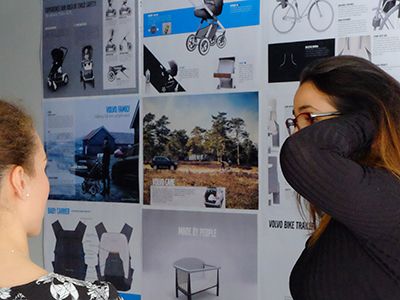
This course is a combination of four course elements, all tied together by an overarching design project. Each student will in the end make an individual design of a product, but this design will be informed by several other investigations made in groups of various constellations. The four course elements are; 1) Human Centred Design, 2) Research Seminars, 3) Branding and 4) Individual Design Project.
The product design project are different each year, we alternate between children products, carpenting tools, cooking equipment and gardening tools. An extra dimension is given by the products being provided as a service instead of individually owned products.
In the human centred design module you will make a deep investigation of the usability aspects of the product, as well as the context of use. In the brand module you will go deep into your brand to understand the DNA of the brand and create a brand platform that will guide you in the individual design work.
Information per course offering
Information for Spring 2027 Start 12 Jan 2027 programme students
- Course location
KTH Campus
- Duration
- 12 Jan 2027 - 31 May 2027
- Periods
Spring 2027: P3 (6 hp), P4 (6 hp)
- Pace of study
33%
- Application code
10673
- Form of study
Normal Daytime
- Language of instruction
English
- Course memo
- Course memo is not published
- Number of places
Min: 15
- Target group
- Mandatory for TIPDM IPDC2.
- Planned modular schedule
- [object Object]
- Schedule
- Part of programme
Contact
Course syllabus as PDF
Please note: all information from the Course syllabus is available on this page in an accessible format.
Course syllabus MF2112 (Spring 2026–)Content and learning outcomes
Course contents
Intended learning outcomes
1. Plan and conduct a user study in Human-Centered Design (HCD), analyse the results and generate insights that are relevant to the design of products and services.
2. Describe and reflect on current theories, methods and approaches in HCD, branding and design research and relate these to the course's design project.
3. Analyse a brand and develop Product Design Guidelines intended to support the design of products and services.
4. Design a product concept that demonstrates a well-balanced combination of insights from Human-Centered Design, application of Product Design Guidelines, and consideration of sustainable development.
5. Relate to the advantages and challenges of circular economy and creatively apply these insights in a system of products and services.
Literature and preparations
Specific prerequisites
MF2038 Service Design or the equivalent.
Literature
Examination and completion
Grading scale
Examination
- PRO2 - Project, 3.0 credits, grading scale: A, B, C, D, E, FX, F
- INLA - Hand-in assignments, 3.0 credits, grading scale: A, B, C, D, E, FX, F
- PRO3 - Project, 3.0 credits, grading scale: A, B, C, D, E, FX, F
- INLC - Hand-in assignments, 1.5 credits, grading scale: A, B, C, D, E, FX, F
- TENA - Written examination, 1.5 credits, grading scale: A, B, C, D, E, FX, F
Based on recommendation from KTH’s coordinator for disabilities, the examiner will decide how to adapt an examination for students with documented disability.
The examiner may apply another examination format when re-examining individual students.
If the course is discontinued, students may request to be examined during the following two academic years.
Examiner
Ethical approach
- All members of a group are responsible for the group's work.
- In any assessment, every student shall honestly disclose any help received and sources used.
- In an oral assessment, every student shall be able to present and answer questions about the entire assignment and solution.