
- User- and application-adapted lighting technologies (including daylight optimization) and lighting quality in buildings
- Building acoustics and acoustic comfort in buildings
- Building automation and control technologies
- Impact of building service and energy systems on profitability
- Building service and energy system design for high-performance buildings (such as passive, near-zero-energy and positive energy buildings)
- Methods and tools for evaluating and visualising the indoor climate and energy performance of buildings
- Use of simulation tools (e g IDA ICE) for evaluating the indoor climate and energy performance of buildings in relation to certification schemes such as LEED, BREEAM and Miljöbyggnad.
AF2511 Building Service Technologies and Systems, Applied Course 7.5 credits
COURSE CONTENT
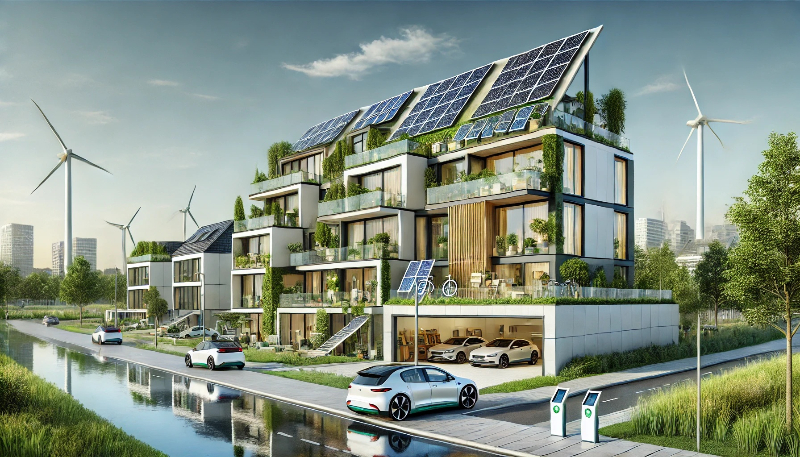
Future-proofing buildings and assessing their performance throughout the life cycle are essential for addressing climate change while meeting requirements for resilience, energy efficiency, environmental performance and occupant benefits. Building certification provides a structured framework for assessing these qualities, with particular emphasis on sustainability and operational performance.
This applied course focuses on methodologies for future-proofing and certifying buildings in accordance with the Miljöbyggnad certification scheme. These methods are applied in a Modelling Assignment, where different building types are future-proofed and assessed for certification using state-of-the-art simulation tools, including IDA ICE.
Particular emphasis is placed on high energy performance and indoor environmental quality, including thermal comfort, indoor air quality, lighting and daylight, and acoustic conditions. The course provides an integrated approach to sustainable, resilient and high-performance building design.
The course builds on AF2508 Building Service Technologies and Systems, 7.5 credits, and AF2507 Sustainable Buildings – Concept, Design, Construction and Operation, 7.5 credits.
LEARNING OUTCOMES
Upon successful completion of the course, students should be able to:
-
Evaluate how thermal comfort, indoor air quality, lighting/daylight and acoustic conditions affect occupant comfort and satisfaction;
-
Assess indoor environmental quality and building energy performance using advanced simulation tools such as IDA ICE;
-
Future-proof buildings and HVAC systems to maintain high indoor environmental quality and energy performance under changing climatic conditions;
-
Select and specify appropriate building components, building services systems and control strategies for new construction and retrofit projects in accordance with Miljöbyggnad requirements; and
-
Assess and certify buildings in accordance with the Miljöbyggnad certification scheme.
Information per course offering
Information for Spring 2027 Start 12 Jan 2027 programme students
- Course location
KTH Campus
- Duration
- 12 Jan 2027 - 12 Mar 2027
- Periods
Spring 2027: P3 (7.5 hp)
- Pace of study
50%
- Application code
12125
- Form of study
Normal Daytime
- Language of instruction
English
- Course memo
- Course memo is not published
- Number of places
Min: 10
- Target group
- No information inserted
- Planned modular schedule
- [object Object]
- Schedule
- Part of programme
Contact
Course syllabus as PDF
Please note: all information from the Course syllabus is available on this page in an accessible format.
Course syllabus AF2511 (Autumn 2021–)Headings with content from the Course syllabus AF2511 (Autumn 2021–) are denoted with an asterisk ( )
Content and learning outcomes
Course contents
Intended learning outcomes
The main goal for this course is to create an understanding at system level around the relationships between indoor climate, occupant satisfaction, building energy performance, environmental impact and building economy (profitability).
On completion of the course, students are expected to:
- Be able to explain how thermal comfort, air quality, lighting quality and acoustic quality influence the overall perceived comfort and productivity of users.
- Be able to analyse and explain the relationships between the indoor climate, energy efficiency, environmental impact and profitability of buildings.
- Have a good understanding of advanced building service and energy systems for high-performance buildings (such as passive, near-zero-energy and positive energy buildings)
- Evaluate the indoor climate and energy performance of buildings by means of advanced simulation tools.
- Explore by means of advanced simulation tools the indoor climate and energy performance of buildings in relation to building certification schemes such as LEED, BREEAM and Miljöbyggnad.
Literature and preparations
Specific prerequisites
Documented knowledge in service and energy systems equivalent to at least 7,5 ECTS corresponding to the content in course AF2508.
Eng B/6 according to the Swedish upper secondary school system.
Recommended prerequisites
Building physics 7,5 ECTS corresponding to the content in course AF1402.
Literature
You can find information about course literature either in the course memo for the course offering or in the course room in Canvas.
Examination and completion
Grading scale
A, B, C, D, E, FX, F
Examination
- PRO1 - Project Assignment, 5.0 credits, grading scale: A, B, C, D, E, FX, F
- TEN1 - Exam, 2.5 credits, grading scale: A, B, C, D, E, FX, F
Based on recommendation from KTH’s coordinator for disabilities, the examiner will decide how to adapt an examination for students with documented disability.
The examiner may apply another examination format when re-examining individual students.
If the course is discontinued, students may request to be examined during the following two academic years.
Other requirements for final grade
Passed components PRO1 and TEN1
Examiner
Ethical approach
- All members of a group are responsible for the group's work.
- In any assessment, every student shall honestly disclose any help received and sources used.
- In an oral assessment, every student shall be able to present and answer questions about the entire assignment and solution.
Further information
Course room in Canvas
Registered students find further information about the implementation of the course in the course room in Canvas. A link to the course room can be found under the tab Studies in the Personal menu at the start of the course.
Offered by
Main field of study
The Built Environment
Education cycle
Second cycle