
- Statistical mechanics I: distribution functions, the Liouville equation, the classical BBGKY hierarchy, thermodynamic equilibrium, thermodynamic ensembles and partition functions, distribution functions versus partition functions, reduced distribution functions, reduced densities, microscopic densities, correlation functions, van Hove functions, dynamic structure factor, static structure factor;
- Statistical mechanics II: basic model systems, phase diagrams of one-component systems, energy route, virial route, compressibility route, triple thermodynamic consistency, hypervirial theorem, computation of the entropy and the chemical potential, YBG hierarchy, Kirkwood superposition approximation, Born-Green equation;
- Integral equation theory of liquids I: theoretical basis, classical density functional theory, Ornstein-Zernike equation, direct correlation function, exact closure equation, bridge functions, extraction from computer simulations (Monte Carlo and Molecular Dynamics), asymptotic decay of correlations;
- Integral equation theory of liquids II: the hypernetted-chain approximation (HNC), the Percus-Yevick approach (PY), the soft mean spherical approximation (SMSA), the Verlet Modified approach (VM), the Martynov-Sarkisov approach (MS), approaches that impose thermodynamic consistency (BPGG, BB, CG, ZSEP), approaches that interpolate between theories (RY, HMSA, cross-over), approaches based on the bridge function universality ansatz (RHNC, VMHNC, FMDFT);
- Dynamic theories: time-correlation functions, classical frequency moment sum rules, classical Kubo formula, Green-Kubo relations, Einstein relations, quasi-localized charge approximation, generalized hydrodynamics, sum rule approach, continued fraction approach, mode coupling theory, replica theory, metastability and the glass transition;
- Isomorph theory: R-simple systems, strong W-U correlations, rigorous definition, basic properties, invariant quantities, Rosenfeld-Tarazona decomposition, excess entropy scaling of transport coefficients, isentropic lines in the phase diagram, isomorph invariance of bridge functions, isomorph based empirically modified HNC approach (IEMHNC);
- Strongly coupled plasma realizations: Complex plasmas, Ultra-cold neutral plasmas, High energy density matter;
- Strongly coupled plasma model systems: One-component plasmas (OCP), Yukawa one-component plasmas (YOCP), biYukawa one-component plasmas (biYOCP), OCP & YOCP at two dimensions, binary Coulomb mixtures, binary Yukawa mixtures.
FEF3380 Strongly coupled plasmas 8.0 credits
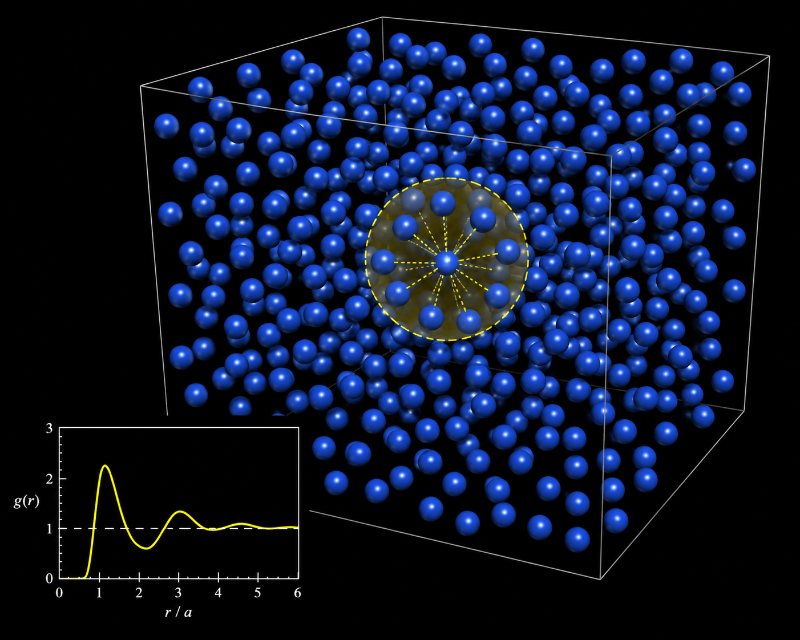
Strongly coupled plasmas are plasmas in which interactions between charged particles become so important that the particles no longer behave as an almost ideal gas, but instead exhibit non-trivial thermodynamic and structural properties. Strong correlations emerge, giving rise to phenomena reminiscent of ordinary liquids and solids, including short-range order, local-field effects, transverse waves, melting and crystallization. Such conditions can be realized in remarkably different systems, ranging from dusty plasmas to ultracold neutral plasmas. The course introduces the fundamental concepts and theoretical tools needed to understand these classical strongly coupled systems, connecting plasma physics with statistical mechanics and liquid-state physics, and exploring how microscopic particle interactions give rise to macroscopic collective behaviour.
Information per course offering
Information for Autumn 2026 Start 24 Aug 2026 programme students
- Course location
KTH Campus
- Duration
- 24 Aug 2026 - 11 Jan 2027
- Periods
Autumn 2026: P1 (4 hp), P2 (4 hp)
- Pace of study
25%
- Application code
12873
- Form of study
Normal Daytime
- Language of instruction
English
- Course memo
- Course memo is not published
- Number of places
Places are not limited
- Target group
- No information inserted
- Planned modular schedule
- [object Object]
- Schedule
- Part of programme
- No information inserted
Contact
Course syllabus as PDF
Please note: all information from the Course syllabus is available on this page in an accessible format.
Course syllabus FEF3380 (Autumn 2026–)Headings with content from the Course syllabus FEF3380 (Autumn 2026–) are denoted with an asterisk ( )
Content and learning outcomes
Course contents
Intended learning outcomes
After the course the student shall be able to
- explain concepts that are employed for the theoretical description of the liquid state;
- apply approaches that are employed for the theoretical description of the liquid state;
- demonstrate the statistical mechanics background of liquid state theories;
- estimate the thermodynamic, static, dynamic and phase transition properties of strongly coupled plasmas;
- apply the integral equation theory to Coulomb and Yukawa one-component plasmas and expand it to other model systems of the liquid state (Lennard-Jones etc);
- appraise the isomorph theory of R-simple systems and apply it to different model systems of the liquid state.
Literature and preparations
Specific prerequisites
- Plasma physics (EF2215 Plasma Physics II or equivalent)
- Complex plasmas (FEF3360 Complex Plasmas or equivalent)
- Statistical mechanics (SI1162 Statistical Physics or SI2510 Statistical Mechanics or equivalent)
Literature
You can find information about course literature either in the course memo for the course offering or in the course room in Canvas.
Examination and completion
Grading scale
P, F
Examination
- INL1 - Statistical mechanics of liquids, 1.5 credits, grading scale: P, F
- INL2 - Integral equation theory of liquids, 2.0 credits, grading scale: P, F
- INL3 - Dynamic theories of liquids, 1.5 credits, grading scale: P, F
- SEM1 - Selected topics on strongly coupled plasmas, 3.0 credits, grading scale: P, F
Based on recommendation from KTH’s coordinator for disabilities, the examiner will decide how to adapt an examination for students with documented disability. The examiner may apply another examination format when re-examining individual students. If the course is discontinued, students may request to be examined during the following two academic years.
Seminar presentations (3hp)
- Individual or in groups of two (student's choice).
- Peer grading.
Home assignments (5hp)
- Theoretical and numerical assignments.
- Individual and group work.
- Solutions discussed with teacher.
Examiner
Ethical approach
- All members of a group are responsible for the group's work.
- In any assessment, every student shall honestly disclose any help received and sources used.
- In an oral assessment, every student shall be able to present and answer questions about the entire assignment and solution.
Further information
Course room in Canvas
Registered students find further information about the implementation of the course in the course room in Canvas. A link to the course room can be found under the tab Studies in the Personal menu at the start of the course.
Offered by
Main field of study
This course does not belong to any Main field of study.
Education cycle
Third cycle