



eSMART Dynamic Electrified Traffic Systems
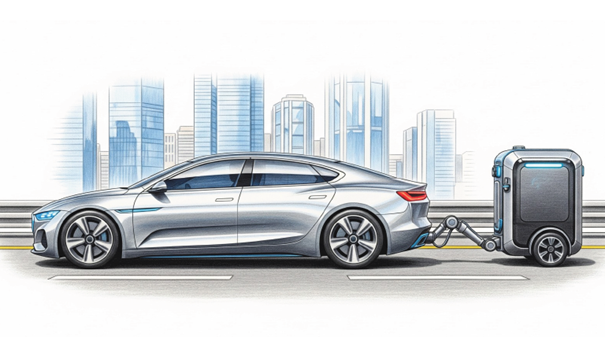
Electrification of road transport is accelerating, but today’s static charging infrastructure requires large, expensive batteries and puts high peak loads on the grid. eSMART investigates how mobile autonomous charging stations (MACS) – self-driving battery vehicles that charge buses and trucks where and when needed – can complement static chargers and electric roads. Using traffic simulation and optimisation, the project evaluates how MACS can reduce battery size, costs and grid impact for electric buses and heavy trucks in Greater Stockholm and beyond.
Electrification, digitalisation and automation are strong trends in the road transport system. The automotive industry, road operators and authorities have high expectations that these technologies will increase safety, efficiency and sustainability. However, knowledge of their real-world impacts is limited, as is the infrastructure for full electrification.
Electric buses can reduce operating costs by up to 70% according to international studies, but require large batteries and costly static charging infrastructure, limiting their effectiveness. Similar challenges exist for electric trucks, where battery size reduces load capacity and drives up costs. Both electric buses and electric lorries have high power demands on the electricity grid.
The project aims to finance the continuation of a PhD student that started within the SMART-3 project and to further develop traffic models for future electric and automated traffic systems. The focus is on analysing how dynamic solutions such as mobile autonomous charging stations (MACS) can be used to improve charging infrastructure coverage and enable smaller batteries. MACS are autonomous battery vehicles that offer dynamic vehicle-to-vehicle (V2V) charging and can be flexibly positioned where needed. In the short term, MACS can act as temporary chargers at bus stops and car parks, and in the longer term charge vehicles en route and act as an integral part of the transport system. The research questions focus on potential gains in weight, cost and battery requirements for electric buses (RQ1) and electric lorries (RQ2), as well as optimal deployment in, for example, Greater Stockholm (RQ3).
Furthermore, the research investigates how MACS can be combined with static charging solutions and electric roads (RQ4) and how they can be used to reinforce the infrastructure when needed (RQ5). The research will be conducted in three steps: initially with limited autonomy (TRL 4), then with higher autonomy (SAE 4, TRL 2), and finally with fully autonomous scenarios (SAE 4/5) within 5-10 years. The aim is to enable a robust and flexible electric transport system for the future.
Contact: Wilco Burghout wilco@kth.se
Team:
Mohd Aiman Khan – PhD student (KTH)
Erik Jenelius – Professor (KTH)
Matej Cebecauer (Researcher KTH)
Oded Cats Professor (TU Delft / KTH)
Time period: September 2025 – March 2028
Financing: Swedish Transport Administration (Trafikverket)