
The course is conducted online and mixes synchronous interactive online webinars with asynchronous home assignments. All course information, zoom links to the webinars, etc. are provided before the start of the course via the course's learning platform Canvas. Since you should be an experienced teacher to participate in this course, and since CDE is a relatively new concept that is still under development, you as a participant will be considered a co-creator of this course and co-developer of the CDE concept. A well-prepared and active participation in the webinars is therefore required for your own learning as well as for your contribution to the learning of the other participants and our common process. The course corresponds to 3 ECTS credits, which means that you are expected to spend about 80 hours completing the course in total, including webinars and home assignments. The course is examined based on active participation in six webinars, home assignments, and a final report where you present your project.
LH233V Teaching and Learning for Challenge Driven Education in a Global Context 3.0 credits
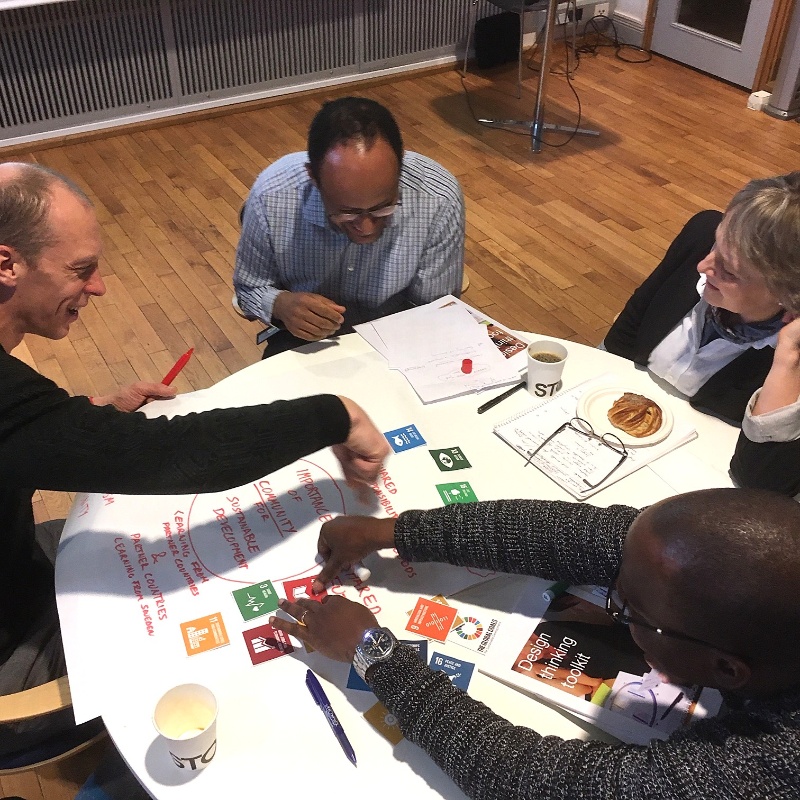
The purpose of this course is to support teachers in higher education in developing and implementing Challenge-Driven Education (CDE) and other forms of project-based and problem-based teaching and learning. It is built around a number of aspects that are characteristic for CDE, for example: societal challenges; wicked problems; sustainable development; key sustainability competencies; design methodologies; frugal innovation; external stakeholders in student projects; facilitation, supervision, and assessment, of student teams.
The course is project-based where you are expected to work with a course/module development project in parallel with actively participating in a series of online webinars. Your project can for example be about: infusing some elements of project-based or challenge-driven learning in an existing ‘conventional’ course/module; or improving some parts of an existing project-based or challenge-driven course/module; or developing a completely new challenge-driven course/module. Your project can either be aiming for being implemented in a near future or be more visionary or something in between. It is up to you to come up with an initial idea of a development project that suits your contexts, teaching practices, and aims, and then you will get support in further developing that idea and project from experts and peers through the course.
Information per course offering
Information for Spring 2027 Start 11 Jan 2027 course for KTH staff
- Course location
KTH Campus
- Duration
- 11 Jan 2027 - 31 May 2027
- Periods
- Pace of study
10%
- Application code
13016
- Form of study
Normal Daytime
- Language of instruction
English
- Course memo
- Course memo is not published
- Number of places
10 - 40
- Target group
- No information inserted
- Planned modular schedule
- [object Object]
- Schedule
- Part of programme
- No information inserted
Contact
Course syllabus as PDF
Please note: all information from the Course syllabus is available on this page in an accessible format.
Course syllabus LH233V (Spring 2019–)Content and learning outcomes
Course disposition
Course contents
The course is built around a number of aspects that are crucial in challenge driven education, for example: design methods & creativity; facilitation and supervision of student teams; assessment and grading of students teams; engagement of external stakeholders in student projects; sustainable development concepts and methods. Through the course the participants are working with designing their own challenge driven project courses supported by a number of seminars, hands-on workshops on key topics, and collaboration with fellow course participants.
Intended learning outcomes
The objective is that the participants after finishing the course should be able to design, plan and implement challenge driven project courses. This implies that the participants should be able to:
1. explain and discuss the concepts challenge driven education, sustainable development, innovation, key competencies, and implement these concepts in learning activities;
2. identify and analyze societal challenges and solutions in relation to UN’s Sustainable Development Goals;
3. describe, apply and introduce students to specific design methods and creativity methods suitable for open ended socio-technical projects;
4. formulate relevant learning objectives for challenge-driven learning processes and plan for and perform appropriate assessment and grading of individual students in team projects;
5. apply methods for engaging external stakeholders in challenge-driven projects;
6. plan for and assess the impact of challenge-driven projects;
7. select, apply, and motivate methodologies and exercises facilitating collaboration and innovativeness in multi-disciplinary student projects.
Literature and preparations
Specific prerequisites
LH231V Teaching and Learning in Higher Education 7.5 credits or equivalent course from KTH or other university.
Literature
Will be handed out at the start of the course.
Examination and completion
Grading scale
Examination
- INL1 - Assignment, 3.0 credits, grading scale: P, F
Based on recommendation from KTH’s coordinator for disabilities, the examiner will decide how to adapt an examination for students with documented disability.
The examiner may apply another examination format when re-examining individual students.
If the course is discontinued, students may request to be examined during the following two academic years.
Examiner
Ethical approach
- All members of a group are responsible for the group's work.
- In any assessment, every student shall honestly disclose any help received and sources used.
- In an oral assessment, every student shall be able to present and answer questions about the entire assignment and solution.
Further information
Course room in Canvas
Offered by
Main field of study
Education cycle
Supplementary information
Prerequisite is the course LH231V or equivalent from KTH or another university or college.
The course is tailored for teachers at KTH. It is included in course offerings that meetKTH´s requirement of 15 credits in academic teaching teaching for employment or promotion to a teaching position.
Teachers from other universities are welcome subject to availability.