
- terminology and basic theory for modelling and simulation of part manufacturing
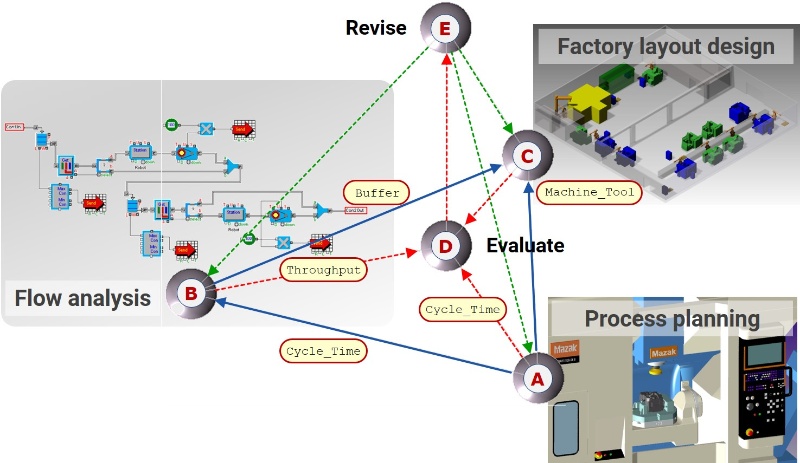
- process planning – design and simulation of the manufacturing process in a CAM progra
- flow analysis for estimating production capacity and lead times, identify bottlenecks and decide buffer sizes, using a software for discrete event-driven simulation
- planning of a manufacturing plant in a factory layout system
- interaction between process planning, flow simulation and factory layout during development and analysis of a manufacturing system
- modelling and simulation of a complex part manufacturing system, based on given preconditions
MG2130 Modelling and Simulation of Industrial Processes 9.0 credits
In this course you will learn about theories, methods and tools used in development of factories.
Information per course offering
Information for Autumn 2026 Start 26 Oct 2026 programme students
- Course location
KTH Campus
- Duration
- 26 Oct 2026 - 12 Mar 2027
- Periods
Autumn 2026: P2 (4.5 hp)
Spring 2027: P3 (4.5 hp)
- Pace of study
33%
- Application code
10420
- Form of study
Normal Daytime
- Language of instruction
English
- Course memo
- Course memo is not published
- Number of places
Min: 1
- Target group
- Compulsory for TPRMM, year 1 Elective for all other Master programmes as long as it can be included in your programme. CMAST4, CDEPR4 course within technical profile. Open for exchange students.
- Planned modular schedule
- [object Object]
- Schedule
Contact
Course syllabus as PDF
Please note: all information from the Course syllabus is available on this page in an accessible format.
Course syllabus MG2130 (Autumn 2019–)Headings with content from the Course syllabus MG2130 (Autumn 2019–) are denoted with an asterisk ( )
Content and learning outcomes
Course contents
Intended learning outcomes
After passing the course, the student will be able to:
- describe different types of models used for model-based development and analysis of manufacturing systems
- design and analyse operations for a certain manufacturing process, using a CAM system
- develop and implement a model for discrete event simulation of material flows, when designing and analysing a manufacturing system to be
- use specific factory layout software to plan a manufacturing plant, based on given preconditions and requirements
- analyse interaction and mutual influence between manufacturing process, material flow and the layout of the manufacturing system, during model-based development
- develop a model of a system for manufacturing a given number of an advanced industrial product, including design of process, material flow and layout, based on given manufacturing preconditions
Literature and preparations
Specific prerequisites
MG1016/MG1026 Manufacturing Technology, MG1024 Production,
or the equivalent
Recommended prerequisites
MG1024 Production
or the corresponding
Literature
You can find information about course literature either in the course memo for the course offering or in the course room in Canvas.
Examination and completion
Grading scale
A, B, C, D, E, FX, F
Examination
- PROJ - Project Assignment, 4.5 credits, grading scale: P, F
- TENA - Written Examination, 3.0 credits, grading scale: A, B, C, D, E, FX, F
- LABB - Laboratory Exercises, 1.0 credits, grading scale: P, F
- LITT - Log Book Writing, 0.5 credits, grading scale: P, F
Based on recommendation from KTH’s coordinator for disabilities, the examiner will decide how to adapt an examination for students with documented disability.
The examiner may apply another examination format when re-examining individual students.
If the course is discontinued, students may request to be examined during the following two academic years.
Examiner
Ethical approach
- All members of a group are responsible for the group's work.
- In any assessment, every student shall honestly disclose any help received and sources used.
- In an oral assessment, every student shall be able to present and answer questions about the entire assignment and solution.
Further information
Course room in Canvas
Registered students find further information about the implementation of the course in the course room in Canvas. A link to the course room can be found under the tab Studies in the Personal menu at the start of the course.
Offered by
Main field of study
Mechanical Engineering
Education cycle
Second cycle