
Overview of the most important sound and vibration sources with wave propagation paths in road vehicles. Methodology for integration of sound and vibration properties from a system and subsystem perspective in product development projects. Strategies for sound and vibration control in road vehicles. Analysis of structure-borne sound with fluid-structure interaction. Acoustic materials in road vehicles. Modeling and wave propagation analysis. Methodology for technical requirements with decomposition into subsystems and components. Analysis of tonal sound - sound quality. Legal requirements - external noise. Overview of methods for computer-based analysis of sound and vibration in road vehicles.
SD2190 Vehicle Acoustics and Vibration 6.0 credits
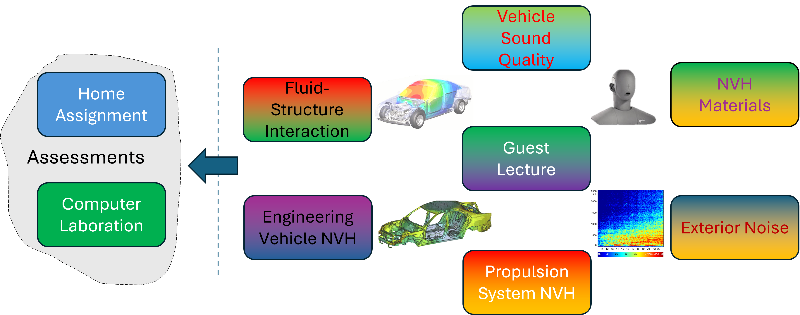
The course gives an introduction to vehicle design with respect to Noise and Vibration Harshness (NVH) and an overview of modern, industrial state-of-the-art tools.
Information per course offering
Information for Autumn 2026 Start 26 Oct 2026 programme students
- Course location
KTH Campus
- Duration
- 26 Oct 2026 - 11 Jan 2027
- Periods
Autumn 2026: P2 (6 hp)
- Pace of study
33%
- Application code
11193
- Form of study
Normal Daytime
- Language of instruction
English
- Course memo
- Course memo is not published
- Number of places
Places are not limited
- Target group
- Open for CDEPR, CFATE,CMAST,CMATD, CTFYS from year 3 och alla Master students as long as it can be included in your programme.
- Planned modular schedule
- [object Object]
- Schedule
- Schedule is not published
Contact
Course syllabus as PDF
Please note: all information from the Course syllabus is available on this page in an accessible format.
Course syllabus SD2190 (Autumn 2026–)Headings with content from the Course syllabus SD2190 (Autumn 2026–) are denoted with an asterisk ( )
Content and learning outcomes
Course contents
Intended learning outcomes
After completing the course, the student will:
- Summarize the most important sound and vibration sources in road vehicles and their wave propagation paths in different frequency ranges depending on the vehicle's operating conditions.
- Explain and be able to apply basic principles for the integration of sound and vibration properties from a system and subsystem perspective in product development projects.
- Explain and be able to apply strategies for sound and vibration attenuation in road vehicles.
- Explain legal requirements for road vehicles and the impact of noise from road vehicles on society.
- Explain and calculate uncoupled and coupled structure-acoustic eigenmodes and frequency response system responses and summarize the results in the form of design parameters.
- Explain the overall perspective in product development of road vehicles with regard to sound and vibration in relation to other properties such as crash safety and vehicle dynamics.
- Explain and analyze tonal noise for driveline systems from a customer perspective.
- Apply computer-based analysis methods for sound and vibration in vehicle systems.
- Define and design acoustic materials for road vehicles.
Literature and preparations
Specific prerequisites
Completed undergraduate degree project in the main field of engineering
Completed course in differential equations
Completed course in solid mechanics
English B/ English 6
Literature
You can find information about course literature either in the course memo for the course offering or in the course room in Canvas.
Examination and completion
Grading scale
P, F
Examination
- INL1 - Assignments, 6.0 credits, grading scale: P, F
Based on recommendation from KTH’s coordinator for disabilities, the examiner will decide how to adapt an examination for students with documented disability.
The examiner may apply another examination format when re-examining individual students.
If the course is discontinued, students may request to be examined during the following two academic years.
Other requirements for final grade
Project assignments (INL1; 6 university credits).
Examiner
Ethical approach
- All members of a group are responsible for the group's work.
- In any assessment, every student shall honestly disclose any help received and sources used.
- In an oral assessment, every student shall be able to present and answer questions about the entire assignment and solution.
Further information
Course room in Canvas
Registered students find further information about the implementation of the course in the course room in Canvas. A link to the course room can be found under the tab Studies in the Personal menu at the start of the course.
Offered by
Main field of study
Mechanical Engineering
Education cycle
Second cycle