
FMH3704 Quantum Metallurgy- First- Principles Computational Tools for Materials Science 6.0 credits
Materials science is a very fast developing subject. The ever increasing computer power allows a detailed study of materials at different spatial and temporal scales. In such a hierarchical modeling, one scale is certainly special: an atomic scale at the electronic structure level. This is the starting point for all the other scales and this is where accurate physical theory can be applied to learn what happens in materials in details, not accessible by other theoretical and experimental tools.
First-principles methods are not only standard tools for a deep-level investigation in materials science nowadays, but they are becoming an important component of an intelligent design of new materials in industry.
This course is to be considered as an INTRODUCTION into the field of first-principles calculations, with the purpose of spreading knowledge (not legends) about this type of computational tools.
The main concentration is on understanding the general idea behind first-principles methods, their weak and strong sides, solved and unsolved problems. Student will learn what kind of materials science problems can be tackled using first-principles methods and how such methods can be used.What is possible and trustable, and what is still not.
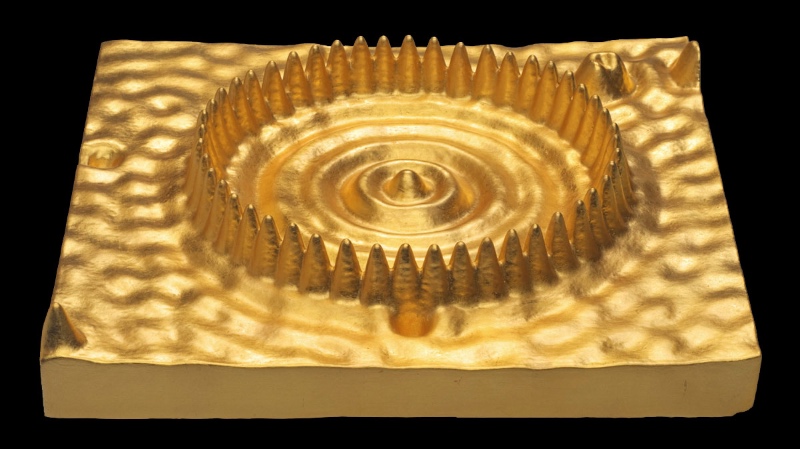
(The picture is the art-work "Quantum corral" by Julian Vass-Andrea, representing electron density wave of Fe atoms on Cu surface. Credit: www.JulianVossAndreae.com)
Information per course offering
Course offerings are missing for current or upcoming semesters.
Course syllabus as PDF
Please note: all information from the Course syllabus is available on this page in an accessible format.
Course syllabus FMH3704 (Spring 2019–)Content and learning outcomes
Course contents
Intended learning outcomes
Literature and preparations
Specific prerequisites
Recommended prerequisites
Physics, at least 6 credits (SK1117), or equivalent
Materials Physics, or equivalent
Basic engineering mathematics including differential equations.
Literature
Examination and completion
Grading scale
Examination
- INL1 - Assignment, 6.0 credits, grading scale: P, F
Based on recommendation from KTH’s coordinator for disabilities, the examiner will decide how to adapt an examination for students with documented disability.
The examiner may apply another examination format when re-examining individual students.
If the course is discontinued, students may request to be examined during the following two academic years.
Examiner
Ethical approach
- All members of a group are responsible for the group's work.
- In any assessment, every student shall honestly disclose any help received and sources used.
- In an oral assessment, every student shall be able to present and answer questions about the entire assignment and solution.