
To KTH's start page

Spaces – a makerspace at KTH Flemingsberg
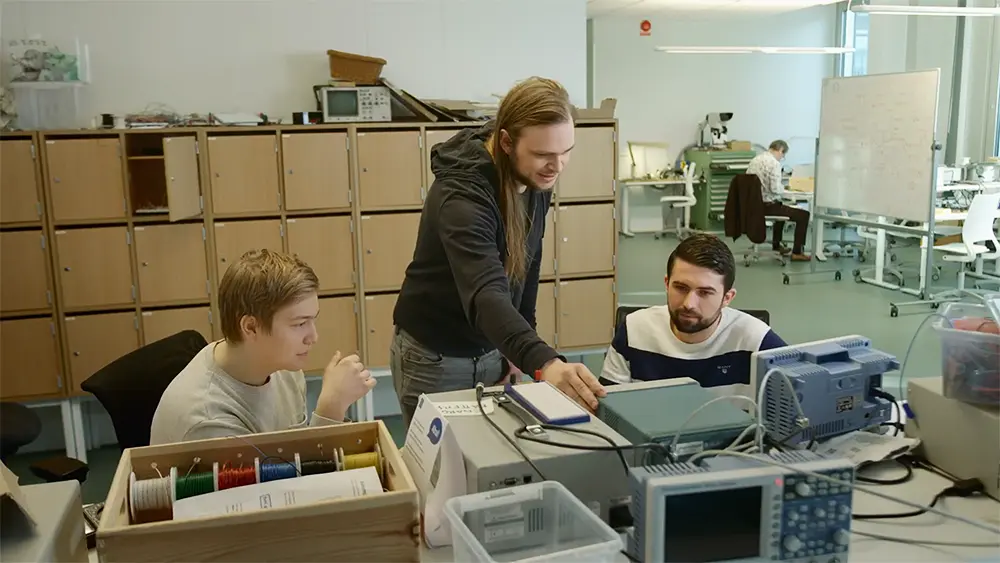
Two students and a teacher working in Spaces makerspace
Two students and mentor Linus Remahl working in Spaces.

Spaces is a makerspace at KTH Flemingsberg for developing and prototyping your ideas. Here you will find tools and spaces to create the next generation of sensors, embedded systems and software solution mainly targeting tomorrow's health technology solutions. Spaces is open for students studying at KTH Flemingsberg.

📍 Location: Hälsovägen 11, floor 7 (Google Maps)

Opening hours: 7:00–22:00, all working days

🧑 Size: ~440 m2, max 80 visitors at once (usually around 10, peak hours 30+, rarely empty)

Spaces (stylized as []spaces) at KTH Flemingsberg is a dynamic and experimental learning environment where creativity, innovation, and hands-on exploration are in focus. Here you can find tools necessary to develop cyber-physical systems, usually based on Spaces' own flexible RISC-V platform. It's a place where students, industry, researchers and teachers meet to collaborate on real-life challenges.

At every programme at KTH Flemingsberg, almost every academic year ends with a project course where students get to address real world challenges. Spaces is an important part of these projects, providing the space and tools needed to create tangible results.

Spaces is part of KTH's innovative ecosystem, and collaborates with KTH Innovation  that provides advice, coaching, evaluation, support, promotion and sometimes seed funding to entrepreneurial and innovative efforts with KTH.

Get access to Spaces, KTH Flemingsberg

All students studying programmes at KTH Flemingsberg is given access to Spaces at the end of their first study year.

If you want to access Spaces before then and you are situated at KTH Flemingsberg, contact Linus Remahl . If you are situated at other KTH locations, please contact Anders Cajander  with your needs.

Equipment and tools at Spaces, KTH Flemingsberg

At Spaces you can find a variety of equipment related to medical technology.

Spaces is split into several rooms and areas for different uses and parts of the creative process. There are ten general purpose workplaces all fitted with integrated tools suitable for embedded system development, and an additional four workplaces with higher end equipment. There are also two soldering stations, a PCB-mill and a reflow oven which allows you to quickly iterate on circuits. 3D-printers, along with a laser cutter allows those circuits to be turned into professional working prototypes. Finished efforts can be presented using the poster printer or through several projectors.

Tools and equipment include:

  • Embedded system development stations (ten available for bookings, four available for drop-in).
  • High end mix-mode development stations (two available, requires booking).

  • Soldering stations (two available).
  • Microscope to surface mount items.
  • Basic components, passive and active.
  • Whiteboards (four available).
  • Projector.
  • Project tables (four available).
  • Large screens with keyboard and mouse (eight available).
  • 3D printers (two available).
  • PCB mill.
  • Sensors, actuators and microcrontroller units.
  • Laser cutter.
  • Assemply oven for surface mounted PCB.
  • Mac workstations.
  • Large wood and plastic x/y mill.
  • Small CNC cutter.
  • Hand tools for wood, plastic and metal.
  • Air paint tool.
  • Various exercise equipment.

Map of Spaces, KTH Flemingsberg

Spaces at KTH Flemingsberg consists of several different learning environments (spaces) designed for various needs and functions. Here is a floor plan to visualize where the different spaces are located. Also see each space described below.

Floor plan of Spaces makerspace

Thirteen areas at Spaces

Spaces makerspace at KTH Flemingsberg is split into thirteen areas for different parts of the creative process.

Makerspace: Main area for embedded system development, mainly drop-in.

Ideation space: Whiteboards/tables to explore, immerse and ideate.

Cyber space: Main area for software development, drop-in.

Mentor space: Spaces' mentor office (and additional hardware storage).

Surface space: Laser cutter, oven to solder surface mounted parts.

Codesign space: Room for advanced mixed-mode/codesign embedded system development.

Social space: Kitchen (five microwave ovens, coffee/tea, refrigerator) with room for 20 visitors as well as a small reading corner.

Flow space: Primarily a research lab, offers a 3D-printer capable of printing implants.

Entrepreneurial space: Space for embedded systems efforts that have reached some maturity, often in collaboration with industry, researchers or KTH Innovation.

Mechanical space: CNC machine and hand tools for wood, plastic and metal work (need special training for access).

Cloud space: Space for software development efforts that have reached some maturity, often in collaboration with industry, researchers or KTH Innovation.

Sport/body space: Facility to primarily test borne embedded systems prior to field testing.

Pitch space: Work on your elevator pitch in the two elevators.

Project case studies from Spaces, KTH Flemingsberg

How do students utilize makerspaces? Watch interviews with students talking about their projects at Spaces.

They tested Bluetooth in a makerspace

Joel and Johan are in their first year of Electrical Engineering, 180 credits. Hear them talk about a project at KTH Spaces in Flemingsberg where they are testing Bluetooth connectivity.

Watch the interview with Joel and Johan in KTH Play

This doctoral student uses a makerspace for her research

Maria is a doctoral student and talks about how she uses equipment at Spaces, KTH Flemingsberg, for her research.

Watch the interview with Maria in KTH Play

Contact Spaces at KTH Flemingsberg

If you want to know more about Spaces at KTH Flemingsberg, contact Head of Division Anders Cajander. You can also contact Linus Remahl, mentor and manager at Spaces.

Lars Johan Anders Cajander
Lars Johan Anders Cajander Head of Division
Linus Remahl
Linus Remahl Mentor at Spaces