Past projects
|
1992-1995 |
The Waxholm project was initiated in 1992 as a research effort for building spoken dialogue systems. In this project, new dialogue management and parsing modules were developed and combined with TMH’s existing speech synthesis and recognition. |
|
|
1996 (CTT) |
A System for Teaching Spoken Dialogue Systems Technology. The aim of this work was to put a fully functioning spoken dialogue system into the hands of the students as an instructional aid. |
|
|
1998-1999 (CTT) |
August was a animated conversational agent called August, whose persona was inspired by August Strindberg, the famous Swedish 19th century author. The August project was initiated as a way to promote speech technology and KTH in connection with Stockholm being the Cultural Capital of Europe in 1998. The system was available for the general public at the Culture Center in Stockholm, daily from August 1998 to March 1999. |
|
|
1999-2002 (CTT) |
The AdApt project had as its goal to be the foundation for the development and evaluation of advanced multimodala spoken dialogue systems. Within the project, a spoken dialogue system was developed in which a user could cooperate with an animated talking agent to solve more complex problems than what had previously been achieved in our systems. | |
 |
2002-2003 (TeliaResearch)
|
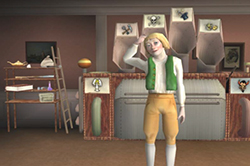
In the TänkOm project, visitors at the telecom museum could enter an apartment of the future and interact with the animated agent Pixie. The syste was available to the public for more than two years, resulting in a large corpus of human-computer interactions. |
 |
2002-2005 (EU) |
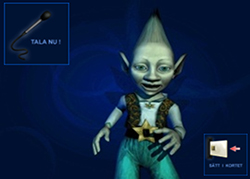
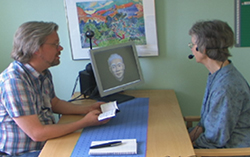
The EU funded project NICE, had the goal of this project was to build a speech enabled computer game where children could interact with animated 3D game characters. |
 |
2006-2009 (EU) |
The overall objective of MonAMI is to mainstream accessibility in consumer goods and services, including public services, through applied research and development, using advanced technologies to ensure equal access, independent living and participation for all in the Information Society. |
 |
2010-2012 (EU) |
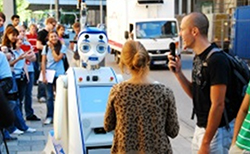
The purpose of the IURO project is to explore how robots can be endowed with capabilities for extracting missing information from humans through spoken interaction. The test scenario for the project is to build a robot that can autonomously navigate in a real urban environment and enquire human passers-by for route directions |
|
2010-2013 (SRA/TNG) |
The projects investigate how a robot can improve its visual scene understanding by engaging in spoken dialogue with a human. The goal of the project is to build a research platform which combines spoken dialogue technology with visual object recognition in a robot. |
|
|
SamSynt 2010-2013 (VR/NT) |
The projects investigate how toiIntroduce interactional phenomena like backchannels into speech synthesis. |
|
 |
2011-2014 (EU) |
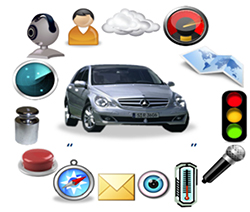
The aim of the project was to develop a system for safe information access and communication while driving. The aim of the proposed project is to develop a system for safe information access (search, navigation, point of interest) and communication (texting) while driving. |
|
InkSynt 2014-2018 (EU) |
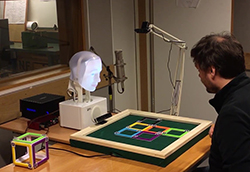
The aim of the proposed project is to develop a system for Incremental Text-To-Speech Conversion. |
|
 |
16-18 (EU) |
Our main goal is to create robots that analyze and track human behavior over time in the context of their surroundings (situational) using audio-visual monitoring in order to establish common ground and mind-reading capabilities. On BabyRobot we focus on the typically developing and autistic spectrum children user population. |
 |
Wikispeech 16-17, 19-21 (PTS) |
The goal was to make wiki-pages available through speech synthesis. It also had the goal of developing an infrastructure for user to donate their |
|
OpenUp 2020-2021 (Vinnova) |
Facilitating the Reopening of Visitor Spaces in the Wake of the COVID-19 Pandemic. | |
 |
2016-2021 (SSF) |
Facilitating the Reopening of Visitor Spaces in the Wake of the COVID-19 Pandemic. |
 |
2016-2021 (SSF) |
Facilitating the Reopening of Visitor Spaces in the Wake of the COVID-19 Pandemic. |
|
|
2020-2025 (Digital Futures) |
Advanced Adaptive Intelligent Systems, where the aim is to develop social robots that can assist elderly in everyday tasks, e.g. giving sitation-dependent cooking directions. |
|
|
2020-2025 (VR/NT) |
Context-aware speech synthesis for conversational AI, that developed a spontaneous speech synthesizer that uses breath and disfluencies as an implicit control of the manner of speaking |
 |
2021-2025 (RJ) |
Comparative Analysis of Public speaking with Text-to-speech, perceptual studies using the spontaneous TTS developed in CONNECTED. |
|
|
2021-2025 (VR/HS) |
Perception of speaker stance using spontaneous speech synthesis, perceptual studies using the spontaneous TTS developed in CONNECTED. |
|
|
EmpowerMe 2023-2025 (PTS) |
The focus was to make use of large language models to help people with cognitive disabilites to understand and answer to mail from authorities. |
 |
FoodTalk 2024-2025 (Vinnova) |
The project aimed to investigate how intelligent assistants could be used to promote sustainable cooking. In the recorded 6 elderly that cooked an omelette with the help of an AI cooking assistant in our Interaction and Robotics Lab. |