
Metallic Hydrogen
Hillert Materials Modeling Colloquium series XXII
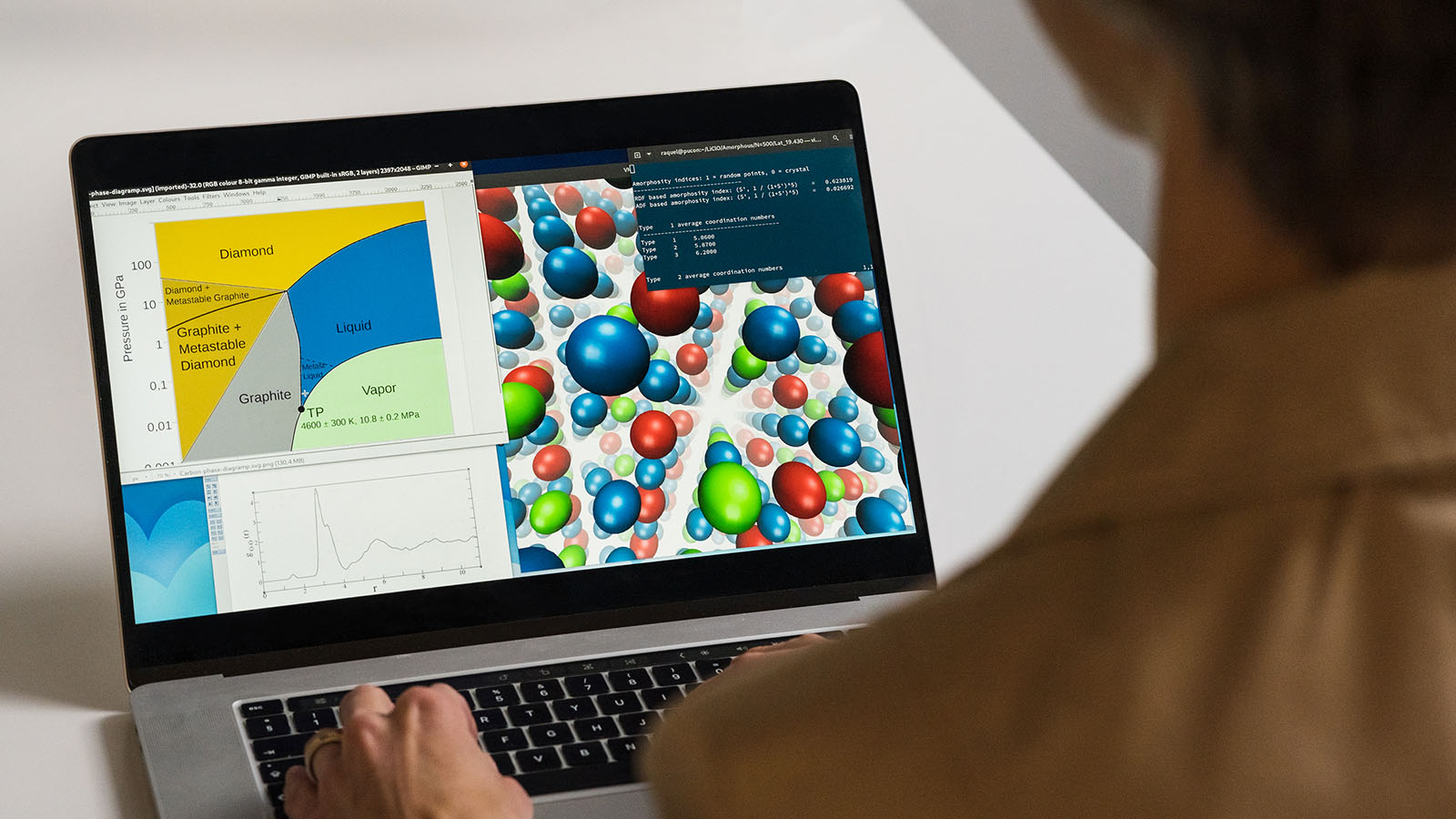
Graeme Ackland, Professor of Computer Simulation at the University of Edinburgh, will discuss the methodology and findings related to metallic hydrogen, superconductors, and novel organic chemistry. His research involves modeling how carbon-based organic compounds behave in a metallic hydrogen environment, using advanced techniques like density functional theory (DFT) and path integral molecular dynamics (PIMD).
Time: Tue 2024-10-08 15.00 - 16.00
Video link: https://kth-se.zoom.us/j/69389952925 Meeting ID: 693 8995 2925
Participating: Professor Graeme Ackland
As the first element in the periodic table, the behaviour of hydrogen might be expected to be simple. It isn't. Hydrogen forms H2 molecules, but under about 500 GPa pressure the electrons are squeezed out of the covalent bond to form a metal. Surprisingly, metallic hydrogen is not a simple metal: the crystal structure is far from close packed. Liquid metallic hydrogen forms at lower pressures: the temperature helps to break the bonds, but there is also a large effect from zero point vibrations, shaking the bonds apart. This has been measured experimentally as a large isotope effect - hydrogen molecules, with their higher zero point energy, are much easier to break than deuterium - a rare example of quantum mechanics being essential at thousands of Kelvins.
Moreover, metallic hydrogen is calculated to be a superconductor: this has not been made experimentally, but hydrogen-rich alloys with superconducting temperatures approaching room temperature are known and pressures around 200 GPa. These superconductors are described by DFT using standard BCS theory. The role of the alloying element is to provide electrons to disrupt the covalent bonding.
Metallic hydrogen is commonplace in the solar system, comprising much of Jupiter and Saturn. Very recently we predicted that there is an entire organic chemistry based on carbon compounds in a metallic hydrogen environment. All this modelling is done using density functional theory and path integral molecular dynamics - the "Many Worlds" formulation of quantum mechanics. I will briefly discuss this methodology, and our results for metallic hydrogen, superconductors, and the new organic chemistry.