
Hillert Materials Modeling Colloquium series XXIV: Theoretical simulations of materials at extreme conditions
– towards knowledge-based design of metastable materials with advanced functionality
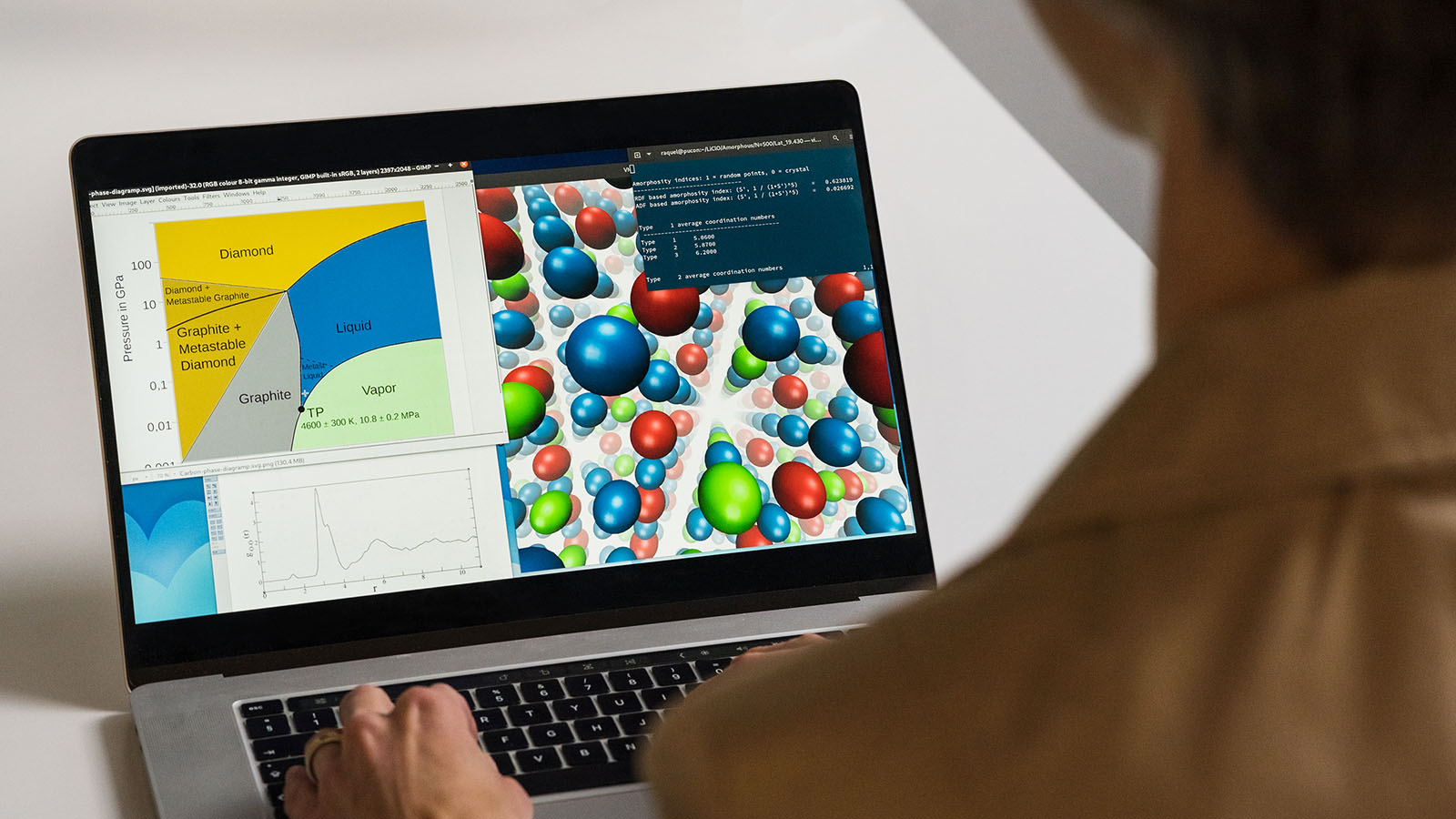
In this talk, Professor Igor Abrikosov demonstrates the capabilities of state-of-the-art theoretical simulations to verify the crystal structure of compounds discovered in HPHT experiments, predict their (meta-)stability under ambient conditions, and disclose materials properties that are attractive for applications. These simulations can, for instance, be useful for material synthesis under TPa compression and temperatures above 2000 K, as well as for the development of new materials with exciting crystal chemistry and physical properties.
Time: Tue 2025-01-21 15.00 - 16.00
Video link: https://kth-se.zoom.us/j/68682407627
Language: English
Participating: Professor Igor Abrikosov
Recent advances in high-pressure high-temperature (HPHT) experiments allow for materials synthesis at TPa compression and temperature above 2000 K [1], paving the way towards discoveries of new materials with exciting crystal chemistry [2] and physical properties [3]. The main challenge in going from the discoveries towards applications is a need to characterize functionalities of the synthesized materials and retain them at the conditions of the operation in devices and tools. Unfortunately, experiments at HPHT conditions are very demanding, time- and resources consuming, with limited possibilities to perform in situ characterization. In this talk we demonstrate capabilities of state-of-the-art theoretical simulations to verify crystal structure of compounds discovered in HPHT experiments, to predict their (meta-)stability at ambient conditions and to disclose materials properties attractive for applications. We review recent advances in theoretical description of materials at extreme conditions, which combines first-principles electronic structure theory with machine learning (ML) tools [4,5]. We demonstrate feasibility of discovering metastable materials with advanced functionalities in HPHT synthesis followed by decompression to ambient conditions [6,7]. Moreover, we show that decompression of materials synthesized at HPHT conditions could lead to phase transitions to metastable polymorphs with properties even more exciting than those of the original HPHT phases [3].
[1] L. Dubrovinsky, et al., Nature 605, 274 (2022).
[2] D. Laniel, et al., Nature Chem. 15, 641 (2023).
[3] M. Bykov, et al., Phys. Rev. Lett. 126, 175501 (2021); ACS Nano 15, 13539 (2021).
[4] A. V. Shapeev, et al., New J. Phys. 22, 113005 (2020).
[5] H. Levämäki, et al., NPJ Comp. Mater. 8, 17 (2022).
[6] M. Bykov, et al., Nature Commun. 10, 2994 (2019).
[7] D. Laniel, et al., Adv. Mater. (2023); Adv. Funct. Mater. 2416892 (2024).