
Polaris – autonomous platform for soft-matter science
Polaris strengthens KTH’s position in soft-matter science by providing an autonomous platform that integrates experiment, modelling, and AI. The initiative will enable AI-driven materials development and promote sustainability through bio-based inputs, lower environmental impact, and improved recyclability.
Autonomous labs and materials-acceleration platforms are becoming essential for competitive materials research. Polaris (Platform for Orchestrated Learning & Autonomous Research in Sustainable Materials) is a strategic initiative spanning six KTH departments, creating a validated, accessible ”closed-loop system” that shortens the development time for prototypes and improves success rates for new materials and its building blocks.
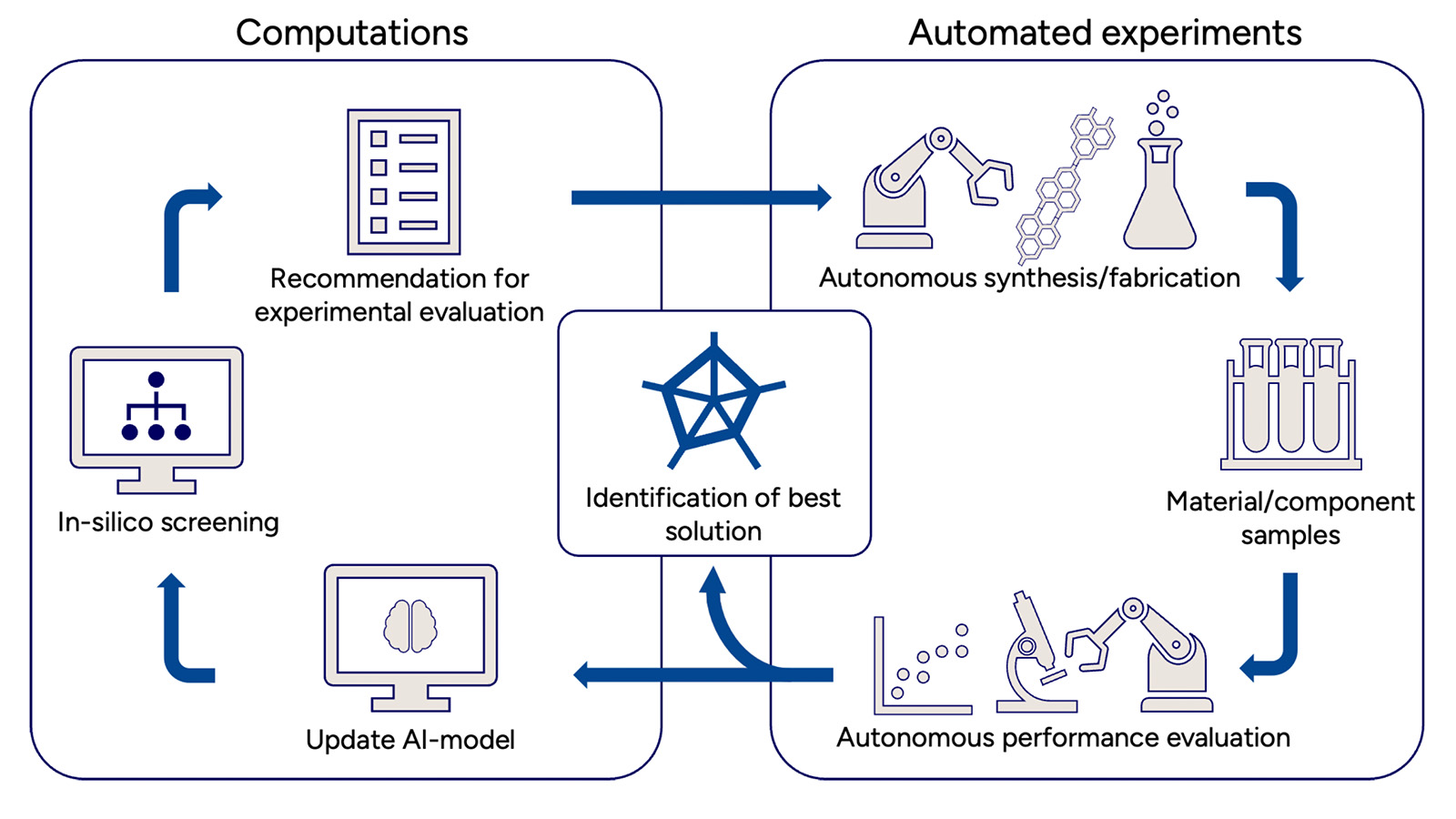
An autonomous system can perform much of the materials development process with minimal human intervention by closing the loop between experiments, modelling, and AI. It can plan, execute, analyse, and learn from experiments, effectively accelerating materials discovery and reducing trial-and-error.
With few platforms of this kind currently in existence, Polaris, as an early initiative, can strengthen KTH’s position in the field. The platform can, for example, contribute to producing sufficient material quantities for real performance testing and leverage strong industrial collaborations. It will integrate with research, collaborations, and education across KTH.
Polaris supports the development of advanced multifunctional soft materials and its building blocks across classes such as organic synthesis, dispersions, thin films, gels, porous media, and composites, using both wet and dry processing. The system combines experiment recommendations, autonomous fabrication, automated performance evaluation, and continuous model updates to efficiently identify optimal solutions.
KTH's contribution
Polaris is an initiative from a group of departments and represents KTH’s expertise in processes, materials, chemistry, biotechnology, mechanics, and advanced characterisation. Combined with industrial partnerships in forestry/bio, energy, automotive, aerospace/defence, and medtech, it provides a strong foundation for the initiative.
Research team
The team, from CBH and SCI, covers synthesis/biotech, processing/mechanics, multiscale characterisation, and modelling/AI. They bring experience in running large facilities and programmes, combining scientific expertise with the operational capability to manage complex shared infrastructure.




About KTH’s Strategic Initiatives
KTH Strategic Initiatives are collaborative programmes designed to support emerging research areas and teams with high potential for excellence in their fields.