
Last Higher Seminar for the Year
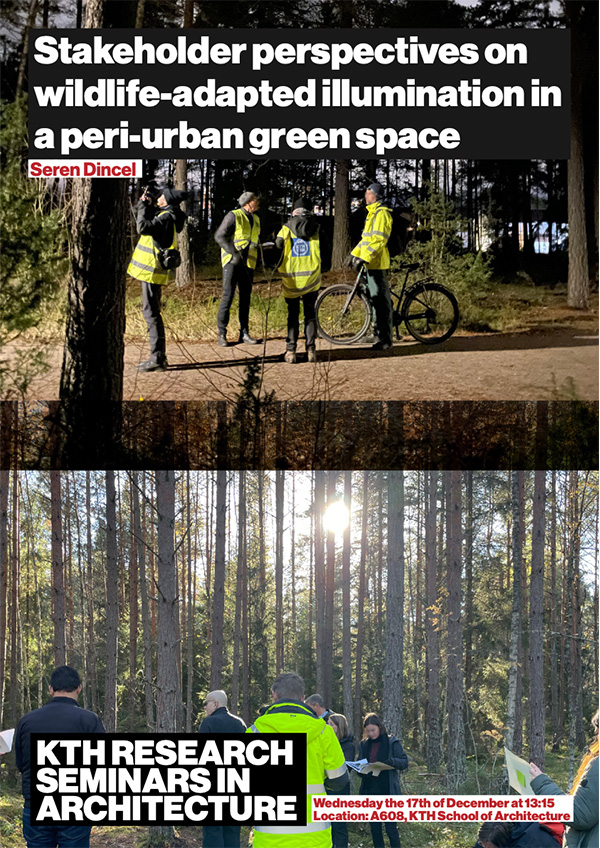
On the 17th of December, at the Research Seminars in Architecture Series, PhD candidate Seren Dincel will present a paper titled Stakeholder Perspectives on Wildlife-Adapted Illumination in a Peri-Urban Green Space.
The opponent for the session will be PhD candidate José Hernández Vargas.
Time: Wed 2025-12-17 13.15 - 16.00
Location: Conference Room 6th Floor of the Architecture School Room A608
Bio’s
Seren Dincel is a Doctoral Candidate in The Division of Architecture, Technique and Theory at the KTH School of Architecture. Trained in interior architecture and architectural lighting design, she focuses on the spatial, social, and ecological dimensions of outdoor lighting. Her doctoral project is part of the NorDark consortium and funded by NordForsk and the Swedish Energy Agency.
José Hernández Vargas is an architect trained at the Pontificia Universidad Católica de Chile (Catholic University of Chile) and a PhD candidate in Civil and Architectural Engineering at KTH, within the Division of Concrete Structures. His research investigates how 3D concrete printing enables the local manipulation of geometry, porosity, and material distribution to produce components with enhanced mechanical performance. His licentiate thesis explored spatially graded modelling and the structural implications of customised internal geometries for reducing concrete consumption while maintaining load-bearing performance. Current work extends these investigations to façade systems and adaptive porosity strategies, contributing to emerging discussions on low-carbon construction and circular use of concrete elements. By linking parametric modelling, robotic fabrication, and structural evaluation, his research aims to position 3DCP as a potential contributor to sustainability goals by reducing waste, enabling functional integration, and supporting new approaches to material efficiency in the concrete industry.