Teaching: Hands-On
Research Group Webpage Q-Photon
Photonic Quantum Computing on a Programmable Silicon Processor:
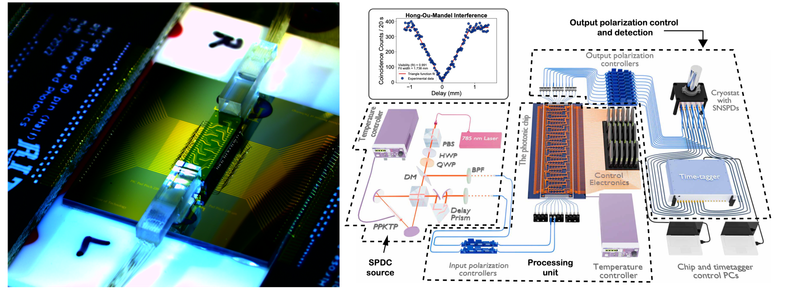
Students operate a real programmable silicon photonic processor — a chip fabricated in a commercial silicon foundry, integrating 264 tunable Mach-Zehnder interferometers on a footprint smaller than a thumbnail — to explore the foundations of linear optical quantum computing. This is not a simulation: students program real hardware using custom control software developed at KTH, inject real single photons from a PPKTP-crystal SPDC source at telecom wavelengths, and detect them with superconducting nanowire single-photon detectors operating at cryogenic temperatures.
Experiments progress from single-qubit control — scanning MZI phases to observe photonic Rabi oscillations and interference fringes — through source characterization via a Hanbury Brown-Twiss g(2)(0) measurement performed directly on the chip, to the culminating Hong-Ou-Mandel experiment. There, two indistinguishable photons meet at a balanced beam splitter and bunch into the same output port, causing coincidence counts to vanish. Students scan the optical delay, observe the HOM dip emerge, and measure its visibility as a direct quantitative benchmark of photon indistinguishability — the fundamental resource that makes photonic quantum computing possible.
Courses
Quantum Photonics Third Cycle FSK3601
Quantum Photonics - Second Cycle SK2900
WACQT Graduate Course - Third Cycle - Link
Quantum Entanglement and Bell Inequality Violation
Students generate and characterize polarization-entangled photon pairs using an entanglement demonstrator consisting of a compact optical breadboard housing a blue laser diode, two adjacent type-I BBO down-conversion crystals, fiber couplers, rotating polarizers, and a coincidence counting unit. Students perform a series of experiments that have no classical explanation. Students discriminate between ∣Φ+⟩ and ∣Φ−⟩ by measuring the full coincidence matrix in two bases, before performing a complete CHSH Bell inequality test: 16 coincidence rates across four polarizer-angle combinations, from which students compute the S parameter and its uncertainty from their own data. Quantum mechanics predicts S up to 2 sqrt(2); local realism requires S≤2.
Courses
Quantum Information - Second Cycle SH2381
Optical Physics - Second Cycle SK2303
WACQT Graduate Course - Third Cycle - Link

Single-Photon Detection with Superconducting Nanowire Detectors
Students characterize real superconducting nanowire single-photon detectors (SNSPDs) — nanoscale devices patterned from a 6,nm NbTiN film and cooled to 2.5,K inside a Gifford-McMahon cryocooler, the same detector technology that enabled loophole-free Bell tests and photonic quantum computational advantage. Working with four devices of varying nanowire geometry, students connect to a cryogenic system equipped with optical fiber feedthroughs and coaxial RF readout electronics, inject photons at 850,nm and 1550,nm, and measure directly how geometry and wavelength govern detector performance. Individual detection pulses are captured on an oscilloscope, and students fit the rise and decay transients to extract the kinetic inductance of each nanowire. Statistical analysis over more than 200 pulses per device connects nanowire geometry to timing performance and recovery speed.
Courses
Quantum Information - Second Cycle SK2903