

EU COMPEIT
COMPEIT is a 3-year EU 7th framework project and focuses on a web-based system for highly interactive, personalised, shared media experiences by developing technologies that A) enrich social connections, B) improve the feeling of being together in one shared space and C) enhance collaboration whilst being separated in time or space. COMPEIT takes the view that Internet-based distribution will transform traditional broadcasting towards higher levels of interactivity and integration with virtual and augmented reality, enabled by advanced web technologies and the proliferation of tangible devices.
In the following we illustrate our ongoing prototyping with COMPEIT's architectural interfaces by presenting a few scenarios developed by the KTH Smart Spaces research group. If you are interested in more information about the project as a whole, please contact Charlie Gullström, Scientific Coordinator; or Project Leader Johan Bengtsson, Luleå Technical University via our website: COMPEIT.
An online mock-up of the COMPEIT system is currently used and experimented on by our distributed research group (the KTH Smart Spaces lab is in KTH R1 on DKV51 and mediated to TU Delft). The mockup is accessible from a Web RTC-enabled browser, e.g. Chrome. The mock-up is available here: http://compeit.eu/mockup. Users click ‘allow’ to e.g. enable a local camera to broadcast. Each of the tabs on the online mock-up relate to specific components and services in the technical work packages of COMPEIT.
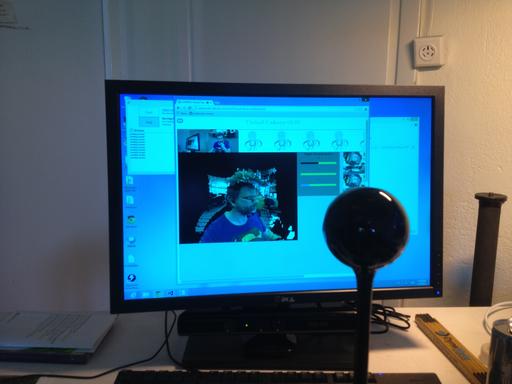
Collaborative work in the task 'Virtual Camera' by KTH and TUD on 22 May 2014, using the mock-up in real-time. Photo by Leif Handberg.
Once complete, the COMPEIT system will offer services based on a wide spectrum of mediating presence components. Depending on context and preferences, users may for example be more interested in an ambient device that supports low-key awareness, than in a highly interactive game or tool for work collaboration. The online mock-up currently serves as a platform for continued collaborative prototyping relating to the above.
ARCHITECTURAL INTERFACES
We foresee many different ways for users to come into contact with the COMPEIT system, some of which are embedded in the architectural design of buildings, or interiors, which may therefore be described as mediated spaces. For example, a small iBeacon placed in an elevator will notify an incoming visitor about nearby services or embedded functionalities in the building - by inviting the user to engage with selected actuators and sensors on different floors (See photo below). Similarly, someone subscribing to a pairing event between a parent’s smartphone and a radio beacon can evoke an action, for example alerting a child about an imminent visit.
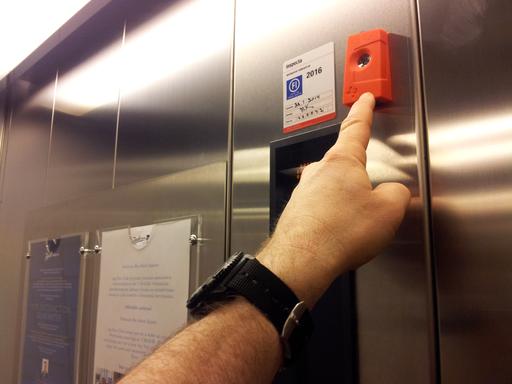
Photo: Alex Jonsson
We have formulated the following scenario to illustrate how a user may come into contact with COMPEIT services:
Scenario Activating MiCLassroom:
You enter the hospital premises and your phone informs you about various services (i.e embedded devices) you are invited to use in the building. The display now shows a floor plan with devices that you can activate by approaching them. Once nearby, your “Mocktopus Lair” interface asks you to accept/or decline...
Or...
You are back at the hospital for a two-day check-up, but you really don’t want to miss school. You have a moment between appointments and you want to activate “MIclassroom”. Shadowy live footage of your classmates appears on your screen, you don’t hear them yet, and they don’t hear you (See image below). But from the live motion you conclude there is a lesson right now that you don’t want to miss. A red blurb highlights the actuator inside the classroom. It is a Webchair, a video-window which allows you to be an active participant in class.
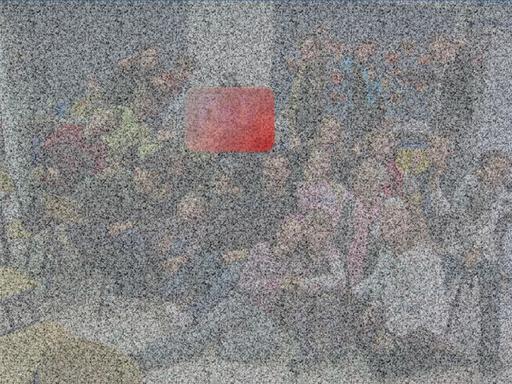
Illustration of the scenario. Before you are invited into the mediated space, the image is blurred and you just notice that there are people moving about in a remote space. Flashing in red, however, we see the actuator you can control in the remote space. (Photo montage by Charlie Gullström, based on the photo provided by Webchair.nl, below)
Your teacher then notices your wish to join and invites you in. Now you see everyone clearly! (See the picture below).
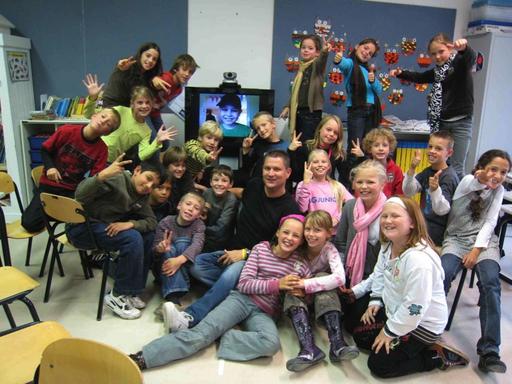
Once invited, you see everyone, and in this picture you also see yourself!
Image by Webchair.nl. Webchair is a Dutch company we collaborate with that produces Webchairs, for hospitals and schools all over the world.
A hospital context
One can imagine that e.g. a hospital will hand out a service menu to its guests, or find a way to share various embedded sensors that users are invited to use, whilst in the building (See the image below). Some of these may be tangible, allowing a user to interact directly with a sensor or an actuator embedded in, for example, a piece of furniture, or a lamp. Once activated using the user’s credentials, the chosen actuators will recognize the user on a return visit. In case of a child’s annual check-up or repeated rehabilitation in the hospital, this will facilitate the usage of various interaction services that are offered.
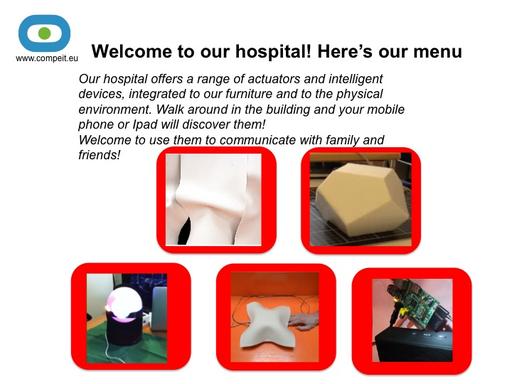
A hospital menu of embedded devices and communicating elements. Picture by Charlie Gullström
Communicating elements
Coping with excess information is generally a main cause of stress and COMPEIT seeks to help users filter information in a non-intrusive way, hopefully turning information from a cause of stress to a source of aesthetic joy. This is particularly relevant in the case of a hospital, which often involves considerable personal stress for patients, family and professionals.
Further, communication in a children’s hospital is highly asymmetric: A child/patient may be in emotionally challenging situations, ranging from boredom, habit or alienation to despair and fear. Children are temporarily, often intermittently, constrained to a hospital environment. Other actors in this setting include medical staff of different sorts and personnel at the hospital, the patient’s parents and families, as well as the other people and environments involved in a child’s life outside the hospital, such as school and friends. The needs and experience of presence, communication and information are different for each of the people involved. While a child-patient may need reassurance and familiarity from remote family, the family as such may need awareness and stress-reduction.
One may therefore use very simple physical displays as architectural interfaces to convey information between the child in the hospital and the family home. The home is an everyday, friendly environment, where information about or from the patient should be received, in an easy, non-intrusive, ambient form. This information should not correspond to or imply to convey medical information (which preferably follows established channels of communication between family and doctors) but rather information that relates general well-being aspects. Constant involvement is not essential in this context, but simply a feeling of awareness and occasional activity, as well as meaningful information.
The design logic in COMPEIT is to explore how the smallest components can provide meaningful communication, and how these can be integrated to a hospital or home environment.
One prototype, Little Polyhedron, is a small object, which can switch between two positions: lying down and standing up (see below). It can hereby inform about one of two states of a variable. For example, it can represent that a child-patient has performed some activity such as having woken up or eaten the morning medication, or other relevant information which can be described as a two-state variable: on/off, happy/sad, undone/done, etc.
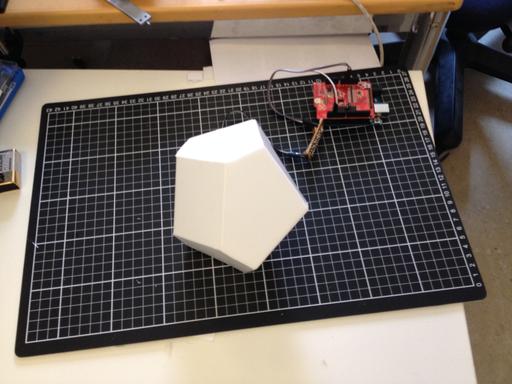
Little Polyhedron prototype, a 2-state communicating element. Picture/filmclip by Pablo Miranda Carranza. See the little Polyhedron move between 2 states here:
http://automatic.se/films/TwoStates01.m4v
http://automatic.se/films/TwoStates02.m4v
http://automatic.se/films/TwoStates03.m4v
Another example of a minimal type of information is quantity, in this case displayed by a hanging object, which changes height depending of the associated quantity (see fig 11 below). This could for example represent the amount of exercise or play that the child has carried out, measured through movement sensors or other means.
An architectural interface suitable for the hospital is the prototype Little LED Matrix on the wall in the patient’s room (Fig 12 below). This is an example of continuous communication, which could for example be connected to a camera at home. It may, in future development take different forms. Small, low-resolution images can be very expressive and often suffice to represent a source that a user is familiar with, especially if the images are moving, and live (cf. Figure 13 below).
See the Little Polyhedron by the Window filmclip: http://automatic.se/films/QuantityDisplay.m4v
Little LED Matrix filmclip: http://automatic.se/films/ConstantMovementDisplay.m4v
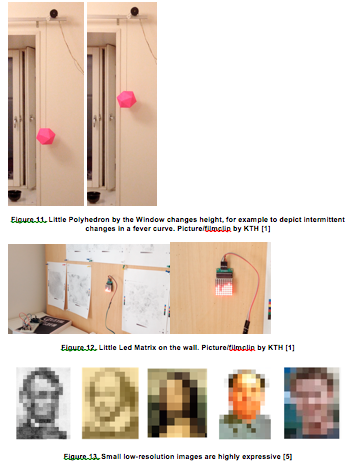
The small, low-resolution images were downloaded 150528 from Sebastian Alvarado.
For references, see the report High-fidelity Mock-up, under Publications.