

Visa version
COMPEIT
COMPEIT is a 3-year EU 7th framework project and focuses on a web-based system for highly interactive, personalised, shared media experiences by developing technologies that A) enrich social connections, B) improve the feeling of being together in one shared space and C) enhance collaboration whilst being separated in time or space. COMPEIT takes the view that Internet-based distribution will transform traditional broadcasting towards higher levels of interactivity and integration with virtual and augmented reality, enabled by advanced web technologies and the proliferation of tangible devices.
In the following we illustrate our ongoing prototyping with COMPEIT's architectural interfaces by presenting a few scenarios. If you are interested in more information about the project, please make contact.
An online mock-up of the COMPEIT system is currently used and experimented on by our distributed research group (the KTH Smart Spaces lab is in KTH R1 on DKV51 and mediated to TU Delft). The mockup is accessible from a Web RTC-enabled browser, e.g. Chrome. The mock-up is available here: http://compeit.eu/mockup
Users click ‘allow’ to e.g. enable a local camera to broadcast. Each of the tabs on the online mock-up relate to specific components and services in the technical work packages of COMPEIT.
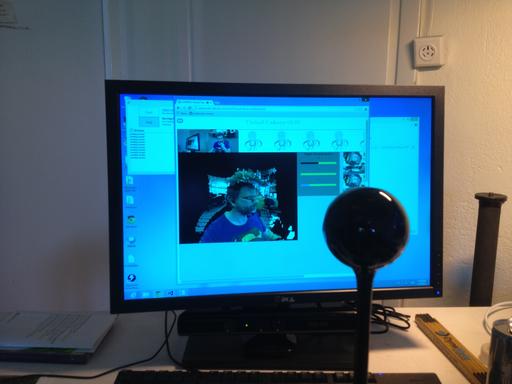
Collaborative work in T4.1 Virtual Camera by KTH and TUD on 22 May 2014, using the mock-up in real-time. Photo by KTH.
Once complete, the COMPEIT system will offer services based on a wide spectrum of mediating presence components. Depending on context and preferences, users may for example be more interested in an ambient device that supports low-key awareness, than in a highly interactive game or tool for work collaboration. The online mock-up currently serves as a platform for continued collaborative prototyping relating to the above.
ARCHITECTURAL INTERFACES
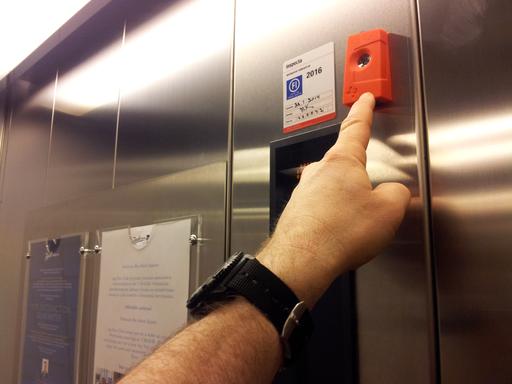
We foresee many different ways for users to come into contact with the COMPEIT system, some of which are embedded in the architectural design of buildings, or interiors, which may therefore be described as mediated spaces. For example, a small iBeacon placed in an elevator will notify an incoming visitor about nearby services or embedded functionalities in the building - by inviting the user to engage with selected actuators and sensors on different floors (See photo below). Similarly, someone subscribing to a pairing event between a parent’s smartphone and a radio beacon can evoke an action, for example alerting a child about an imminent visit.
We foresee many different ways for users to come into contact with the COMPEIT system, some of which are embedded in the architectural design of buildings, or interiors, which may therefore be described as mediated spaces. For example, a small iBeacon placed in an elevator will notify an incoming visitor about nearby services or embedded functionalities in the building - by inviting the user to engage with selected actuators and sensors on different floors (Figure 3.). Similarly, someone subscribing to a pairing event between a parent’s smartphone and a radio beacon can evoke an action, for example alerting a child about an imminent visit.