KTH Logo

Open Access to Sport, Performance and Sustainability

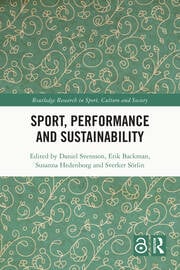
Is the strive for increasing performance and an ever-growing sports sector compatible with sustainable development? This is the key issue that the authors investigates in a new book: Sport, Performance and Sustainability, edited by Daniel Svensson, Erik Backman, Susanna Hedenborg and the Division’s Sverker Sörlin.

Sport, Performance and Sustainability examines the logic of “faster higher, and stronger” and the technoscientific revolution that has driven tremendous growth in the sports economy and in sport performance over the last 100 years.

The chapters provide valuable perspectives on the tensions between performance and sustainability. Co-authors include Sigmund Loland, Simon Beames, Itai Danielski, Andreas Isgren Karlsson, Jack Reed, Johan Carlsson, Isak Lidström, Bo Carlsson and Marie Larneby.

Sport, performance and Sustainability is publisehd by Routledge and written within MISTRA Sport and Outdoor – a research and collaboration programme to generate knowledge and solutions for increased sustainability in sport and outdoor recreation.

The book is due for printing now in May, but is also available open access online. Find it here: Sport, Performance and Sustainability

The Editors

Daniel Svensson is an Associate Senior Lecturer in Sport Management at the Department of Sport Sciences. He defended at the Division in 2016 with the thesis “Scientizing performance in endurance sports : The emergence of ‘rational training’ in cross-country skiing, 1930-1980,”.

Erik Backman is an Associate Professor and Senior Lecturer in Pedagogy and Sport Sciences at the Department of Sport Sciences, School of Health and Welfare, Dalarna University, Sweden, and Associate Professor at the Department of Primary and Secondary Teacher Education, Faculty of Education and International Studies, Oslo Metropolitan University, Norway.

Susanna Hedenborg is a Professor in Sport Sciences at Malmö University, Sweden, and the President of the Swedish Research Council for Sport Science.

Sverker Sörlin is a Professor of Environmental History at the Division  and a co-founder of the KTH Environmental Humanities Laboratory.

 

The effects of the humanities: Knowledge, collaboration, impact – new anthology with researchers from the Division

Several of the Division’s researchers have contributed to a new Swedish anthology: Humanvetenskapernas verkningar: Kunskap, samverkan, genomslag (The effects of the humanities: Knowledge, collaboration, impact). Editor, former Division postdoc, Linus Salö re-joined the Division again this year as the supervisor of Klara Müller and as researcher in the research platform Making Universities Matter. Other participating researchers from the Division in the anthology are Fredrik Bertilsson, Ulrika Bjare, and Sverker Sörlin as well as our former colleagues, with Lund University as base, Mats Benner and Eugenia Perez Vico.

The anthology is published by Dialogos Förlag, and translated from the Swedish backside of the book, this is what it is about:

In the discussion about how universities and colleges can better meet the great challenges of our time, the social sciences and humanities have begun to take an increasing place. This is not least due to the fact that a new line of research policy is taking shape, where the humanities are given greater weight than before.

This ongoing shift opens up new ideas about how academic knowledge is disseminated and used. Research collaboration is not limited to industry and business, but takes place and has always taken place with many parts of society. Innovations are not just technical or medical news and progress, but also social renewal that concerns language, media, culture, politics, economics, behavior, religion – yes, most things that people do, think and feel.

The humanities’ movements between academia and other spheres of society, not least politics, can be seen as passages through a cat door in an otherwise locked gate. This metaphor runs like a thread through the book. Who has moved through the cat door, and what kind of knowledge effects has it had? How is this activity mentioned and valued?

In the ten chapters of this anthology, a number of humanities seek to answer these questions. The participating authors are active in various fields of science at various Swedish universities. The purpose of the book is to give momentum and energy to the discussion about the effects of the humanities – and ask new questions about the universities’ goals and meaning.

You can order the anthology (in Swedish) from Dialogos homepage!