KTH Logo

NetConfEval accepted at CoNEXT 2024

Can Large Language Models facilitate network configuration? In our recently accepted CoNEXT 2024 paper, we investigate the opportunities and challenges in operating network systems using recent LLM models.

We devise a benchmark for evaluating the capabilities of different LLM models on a variety of networking tasks and show different ways of integrating such models within existing systems. Our results show that different models works better in different tasks. Translating high-level human-language requirements into formal specifications (e.g., API function calling) can be done with small models. However, generating code that controls network systems is only doable with larger LLMs, such as GPT4.

This is a first fundamental first step in our SEMLA project looking at ways to integrate LLMs into system development.

GitHub code: link

Hugging Face: link

Paper PDF: link


Massimo Girondi’s Licentiate Defense

We are happy to announce that Massimo Girondi successfully defended his licentiate thesis (licentiate is a degree at KTH half-way to a PhD)! Marco Chiesa  has done an excellent job as a co-advisor and as is customary we are very grateful to Prof. Gerald Q. Maguire Jr. for his key insights. Giuseppe Siracusano was a superb opponent at the licentiate seminar, with Amir Payberah as the examiner. Massimo’s thesis is available online:

“Toward Highly-efficient GPU-centric Networking”

A few shots from the celebration are below.

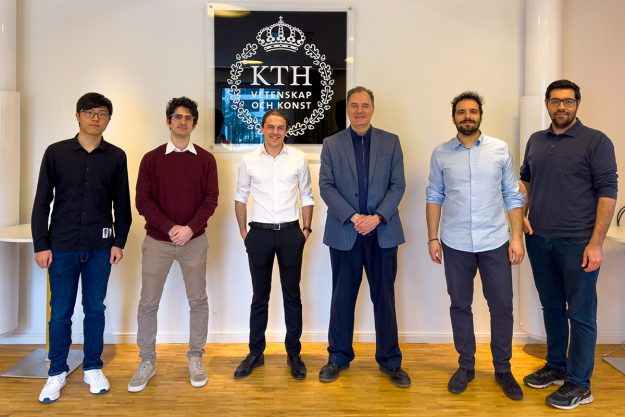
Group shot of Networked Systems Laboratory members (Massimo is beneath the KTH logo). Image taken by Voravit Tanyingyong

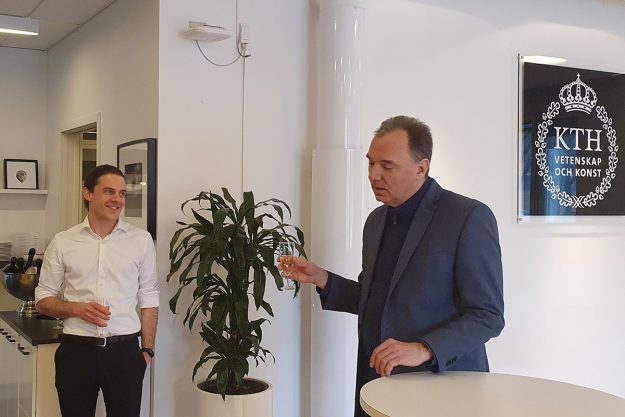
Dejan highlighting Massimo’s work (image taken by Marco Spanghero)

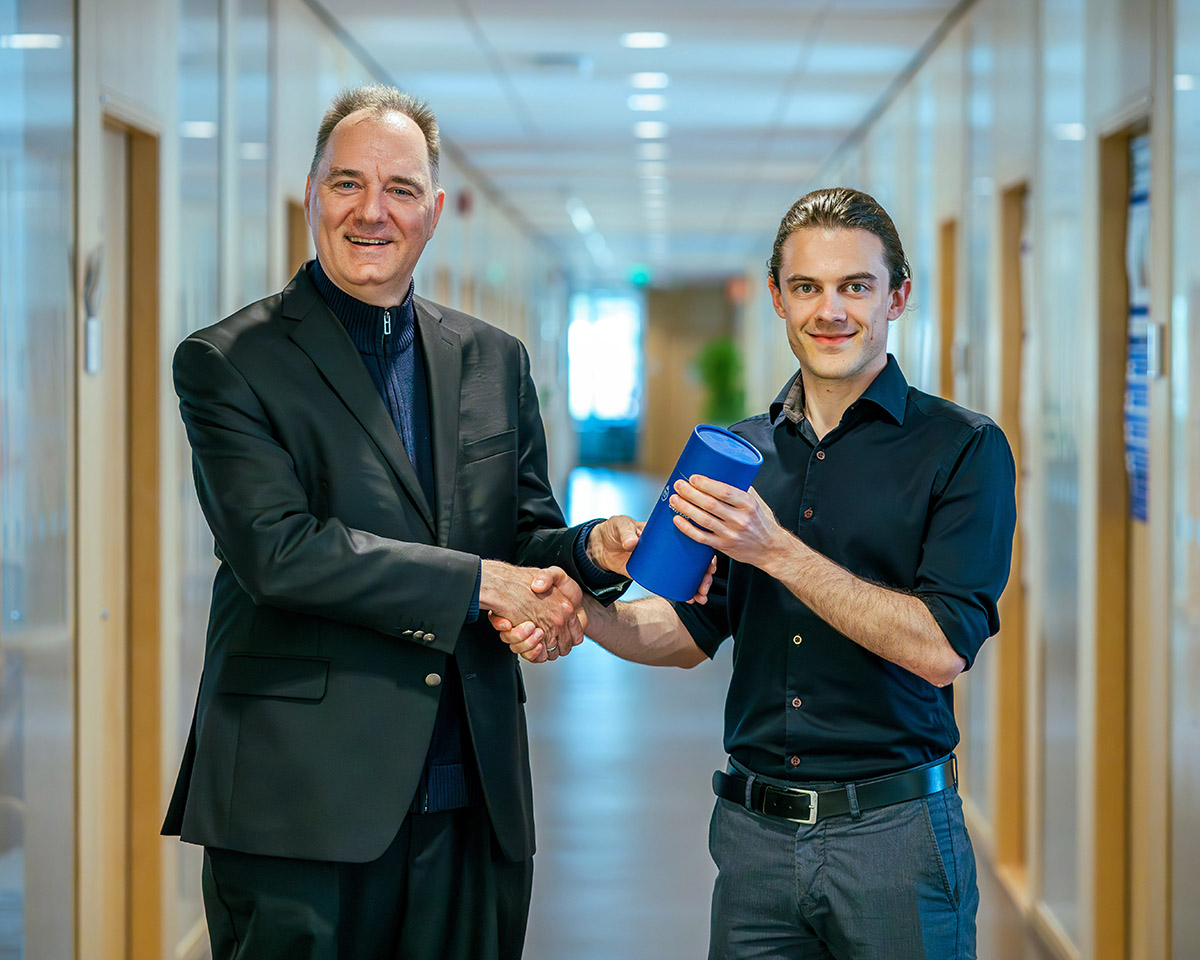
Dejan hands the gift to Massimo a few weeks later in the hallway that Massimo chose for the shot. Definitely looks better than the opposite side we used in the past! (image taken by Voravit Tanyingyong)

KTH Ceremony on November 17, 2023

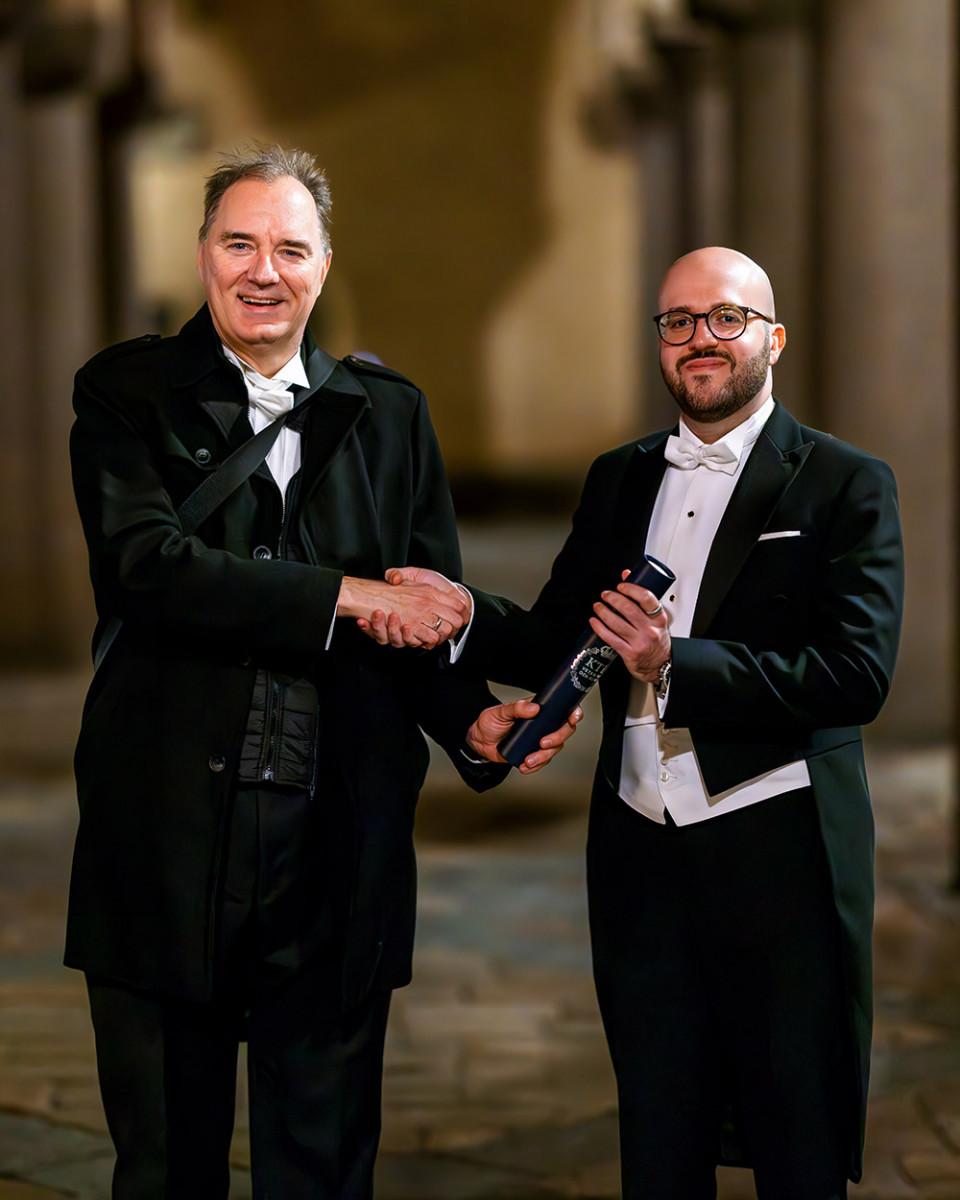
We were once again at the ceremony at which KTH is officially awarding doctoral degrees. This time it was Alireza Farshin’s time, and we used the beautiful Stockholm City Hall to recreate our favorite hallway shot!

Dejan is congratulating Alireza on his officially received PhD degree from KTH. Image taken by Ana Kostic


Daniel’s presentation at IPSN ’23 “DeepGANTT: A Scalable Deep Learning Scheduler for Backscatter Networks”

At ACM IPSN ’23 Daniel presented our work on DeepGANTT, a scheduler which demonstrates our ability to apply transformers to graph neural networks for scaling up an IoT scheduling problem 6X-11X beyond what a constraint optimization solver can solve in a reasonable time. Full abstract is below.

This is joint work with

Daniel F. Perez-Ramirez, Carlos Pérez-Penichet, Nicolas Tsiftes (RISE), Thiemo Voigt (Uppsala University and RISE), Dejan Kostić, and Magnus Boman (KTH).

Novel backscatter communication techniques enable battery-free sensor tags to interoperate with unmodified standard IoT devices, extending a sensor network’s capabilities in a scalable manner. Without requiring additional dedicated infrastructure, the battery-free tags harvest energy from the environment, while the IoT devices provide them with the unmodulated carrier they need to communicate. A schedule coordinates the provision of carriers for the communications of battery-free devices with IoT nodes. Optimal carrier scheduling is an NP-hard problem that limits the scalability of network deployments. Thus, existing solutions waste energy and other valuable resources by scheduling the carriers suboptimally. We present DeepGANTT, a deep learning scheduler that leverages graph neural networks to efficiently provide near-optimal carrier scheduling. We train our scheduler with optimal schedules of relatively small networks obtained from a constraint optimization solver, achieving a performance within 3% of the optimum. Without the need to retrain, our scheduler generalizes to networks 6 × larger in the number of nodes and 10 × larger in the number of tags than those used for training. DeepGANTT breaks the scalability limitations of the optimal scheduler and reduces carrier utilization by up to compared to the state-of-the-art heuristic. As a consequence, our scheduler efficiently reduces energy and spectrum utilization in backscatter networks.