
This blog highlights the contributions made by a group of faculty, researchers, and doctoral students working on Networked Systems aspects. For open positions, please consult our Projects.

This blog highlights the contributions made by a group of faculty, researchers, and doctoral students working on Networked Systems aspects. For open positions, please consult our Projects.
We are happy to announce that Giacomo Verardo successfully defended his doctoral thesis on May 20, 2026! As usual, Assoc. Prof. Marco Chiesa has done a great job as a co-advisor, and we are especially grateful to Prof. Gerald Q. Maguire Jr. for his continued stellar insights. Prof. Thomas Schön (Uppsala University) has done an outstanding job as the opponent, and Assoc. Prof. Artur Podobas served as the chairperson. Giacomo ’s thesis is available online:
“Optimizing and Adapting Neural Network Models for Healthcare and Federated Learning”
Below are a few images from the event.

Giacomo during the discussion with Prof. Thomas Schön, with grading board members Maxime Sermesant (Inria) and Giovanna Sannino (ICAR-CNR) participating over Zoom (photo taken by Marco Chiesa).

Giacomo during the discussion with Prof. Thomas Schön (photo taken by Marco Chiesa).

Assoc. Prof. Nicolai Spicher (TU Denmark), chair of the grading board, hands the diploma to Giacomo (Zoom screengrab)

Giacomo with the opponent, and committee plus Dejan over Zoom, celebrating the announcement that he passed (photo taken by Artur Podobas who is also visible on the screen!)
While the spring flowers were still adorning the trees at the main KTH campus last week, we were happy to welcome Mircea-Costin, a new industrial doctoral student at NVIDIA, to our NSLAB and MINDS labs!
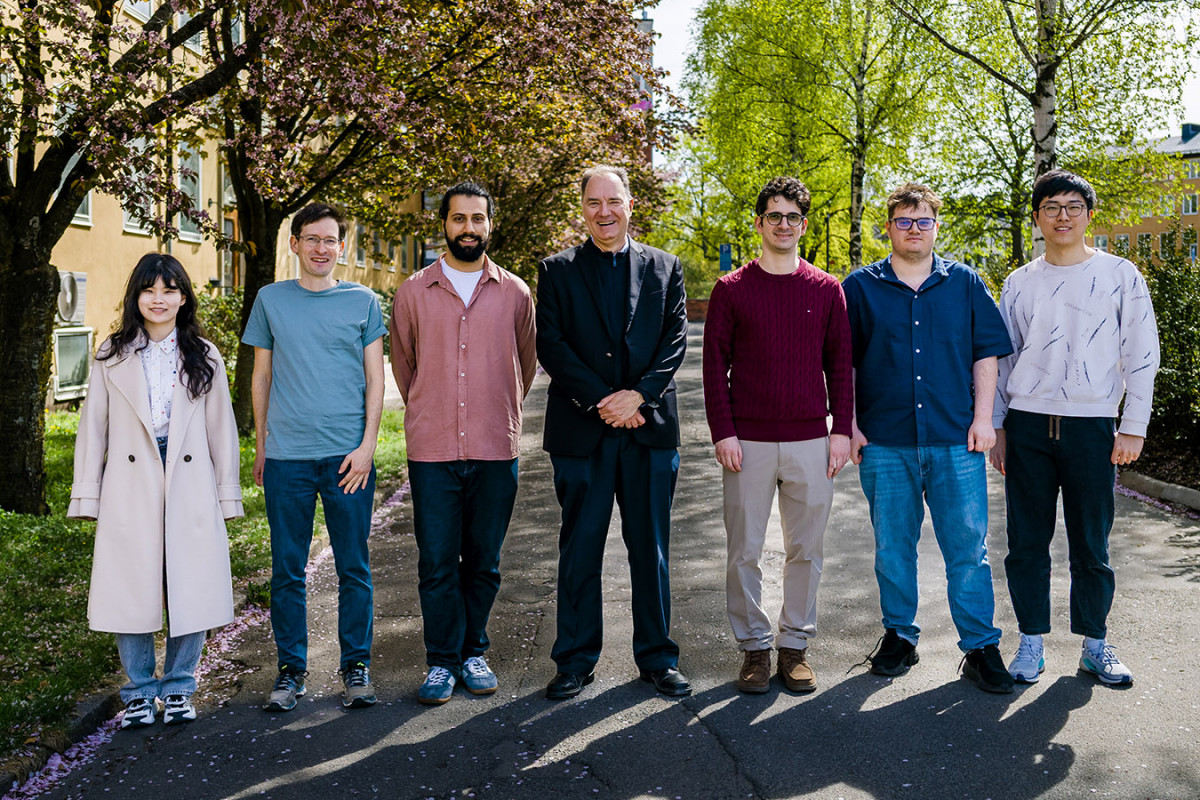
From the left: Xiwen (Sophia) Chen, Marco Chiesa, Ali Banaei, Dejan Kostic, Giacomo Verardo, Mircea-Costin Preoteasa, and Changjie Wang.
We are very happy to announce that Daniel Felipe Perez Ramirez successfully defended his PhD thesis on February 12, 2026! Prof. Magnus Boman (KI) and Nicolas Tsiftes (RISE) have done a great job as the academic co-advisor and industrial advisor, respectively. We are very grateful to Prof. Thiemo Voigt for creating a wonderful research environment for Daniel to thrive at RISE. Prof. Rui Tan was the opponent at the defense, while Assoc. Prof. Amir Payberah served as the Chair. Daniel’s thesis is available online:
This thesis explores the applicability of machine learning to solve resource allocation optimization problems. It demonstrates that GNN-based models with Transformer-like architecture trained on small 10-node networks can robustly generalize to large-scale IoT deployments with up to 1000 nodes (i.e., 100x bigger than those encountered during training), achieving up to 2× resource savings in energy and spectrum utilization while maintaining consistent performance across diverse network topologies.
A few images from the defense and the celebration are below.

 Dejan congratulates Daniel, photo credit Amir Payberah.
 Amir congratulates Daniel.
 Magnus congratulates Daniel.
We are very happy to announce that our paper will appear in the Proceedings of the Fourteenth International Conference on Learning Representation (ICLR). The paper title is “KVComm: Enabling Efficient LLM Communication through Selective KV Sharing“, and this is joint work with Xiangyu Shi, Marco Chiesa, Gerald Q. Maguire Jr., and Dejan Kostic (all from KTH). We have already released the source code.
The full abstract is below:
Large Language Models (LLMs) are increasingly deployed in multi-agent systems, where effective inter-model communication is crucial. Existing communication protocols either rely on natural language, incurring high inference costs and information loss, or on hidden states, which suffer from information concentration bias and inefficiency. To address these limitations, we propose KVComm, a novel communication framework that enables efficient communication between LLMs through selective sharing of KV pairs. KVComm leverages the rich information encoded in the KV pairs while avoiding the pitfalls of hidden states. We introduce a KV layer-wise selection strategy based on attention importance scores with a Gaussian prior to identify the most informative KV pairs for communication. Extensive experiments across diverse tasks and model pairs demonstrate that KVComm achieves comparable performance to the upper-bound method, which directly merges inputs to one model without any communication, while transmitting as few as 30% of layers’ KV pairs. Our study highlights the potential of KV pairs as an effective medium for inter-LLM communication, paving the way for scalable and efficient multi-agent systems.
At CoNEXT ’24, Mariano presented our FAJITA paper. This work shows that a commodity server running a chain of stateful network functions can process more than 170 M packets per second (equivalent of 1.4 Tbps if payloads are stored in a disaggregated fashion as in our earlier Ribosome work [NSDI ’23])! Something else that is interesting and perhaps unexpected is that, unless the number of so-called “elephant flows” is very small, spreading incoming packets among the cores using plain Receive Side Scaling (RSS) outperforms existing approaches that perform fine-grained flow accounting and load-balancing. This happens because possible gains get dwarfed by slowdowns in accessing memory.
This is joint work with Hamid Ghasemirahni, Alireza Farshin (now at Nvidia), Mariano Scazzariello (now at RISE), Gerald Q. Maguire Jr., Dejan Kostić, and Marco Chiesa.
Our recording of Mariano’s talk is below:
Data centers increasingly utilize commodity servers to deploy low-latency Network Functions (NFs). However, the emergence of multi-hundred-gigabit-per-second network interface cards (NICs) has drastically increased the performance expected from commodity servers. Additionally, recently introduced systems that store packet payloads in temporary off-CPU locations (e.g., programmable switches, NICs, and RDMA servers) further increase the load on NF servers, making packet processing even more challenging.
This paper demonstrates existing bottlenecks and challenges of state-of-the-art stateful packet processing frameworks and proposes a system, called FAJITA, to tackle these challenges & accelerate stateful packet processing on commodity hardware. FAJITA proposes an optimized processing pipeline for stateful network functions to minimize memory accesses and overcome the overheads of accessing shared data structures while ensuring efficient batch processing at every stage of the pipeline. Furthermore, FAJITA provides a performant architecture to deploy high-performance network functions service chains containing stateful elements with different state granularities. FAJITA improves the throughput and latency of high-speed stateful network functions by ~2.43x compared to the most performant state-of-the-art solutions, enabling commodity hardware to process up to ~178 Million 64-B packets per second (pps) using 16 cores.