To KTH's start page

Development of a comprehensive system model for Phase Change Material Thermal Energy Storage Integrated with a Heat Pump for Nordic Residential Applications in KTH Live-in-Lab

Introduction and Project Background

Phase change materials (PCMs) offer significant potential for thermal energy storage (TES) applications in residential heating systems, particularly when integrated with heat pumps for flexible sector coupling. In Nordic climates, where space heating accounts for approximately 57% of household energy consumption (IEA, 2025), PCM-TES systems can store thermal energy during low electricity-price periods and discharge during peak demand, potentially reducing operational costs by 10% (Zhou et al., 2025) and shifting of peak loads peak loads by 25-45% (Erdemir & Dincer, 2019).

This thesis project builds upon the already installed system in Live-In-Lab, where a hierarchical control framework was developed for a 42 kWh PCM-TES system integrated with an 18 kW ground-source heat pump at KTH Live-in-Lab (LIL). The system utilises RT57HC, a bio-based PCM with a melting point around 57°C, contained in 515 encapsulated capsules with a void fraction of 0.56.

The current research gap lies in the lack of integrated system models that capture the full dynamics of PCM-TES heat pump systems across different operating conditions. Existing models typically focus on individual components, missing critical interactions among PCM storage, the heat pump, and control systems. Without comprehensive models, control strategies cannot be thoroughly tested across diverse operating scenarios, limiting optimisation potential and hindering broader deployment.

This project, conducted within the Horizon Europe HYSTORE project framework (Grant Agreement N. 101096789), aims to develop and experimentally validate a thermal energy storage system at pilot scale, serving as a platform for control strategy development and system optimisation.

Project Description

This thesis project focuses on developing a comprehensive, experimentally validated model of the integrated PCM-TES heat pump system installed at KTH Live-in-Lab. The student will work closely with the supervision team to create a dynamic system model framework that captures all relevant system dynamics and interactions.

The project begins with developing detailed thermodynamic models of each system component. For the PCM-TES, this includes implementing enthalpy-based methods for phase-change modelling and heat transfer within the encapsulated capsules. The heat pump model will incorporate performance maps. Building and HVAC components will be modelled, including the air handling unit, hydraulic networks with pumps and valves, and the shunt heat exchanger system, also illustrated in Figure 1.
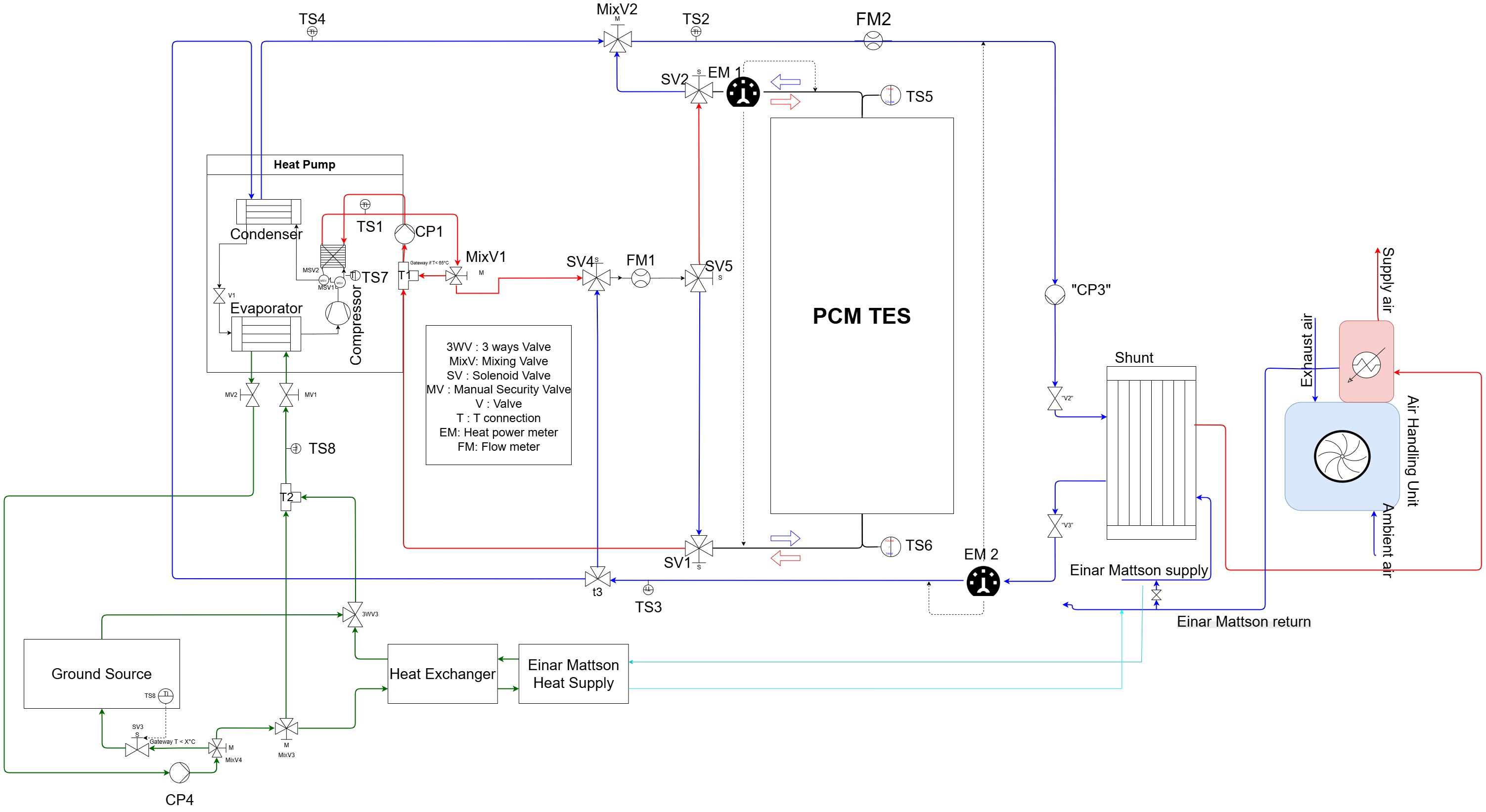
Figure 1 to be published

A key outcome is a model that researchers and engineers can use for PCM-TES system design and control development. The model will include both detailed versions for analysis and simplified versions suitable for real-time control applications.

This project work is to be implemented by 1-2 thesis students

Project Learning Objectives

After the project is completed, the student should be able to/should be:

  • Knowledgeable in PCM-TES systems , understanding phase change phenomena, heat transfer in encapsulated PCMs, thermal stratification effects, and integration with heat pump systems

  • Capable of multi-objective optimisation, formulating optimization problems, implementing solution algorithms, and analysing trade-offs between competing objectives

  • Competent in scientific programming using e.g., TRNSYS or Python (or similar) for system simulation, data analysis, and visualisation

  • Critically analyse model predictions versus experimental data, perform uncertainty analysis, and identify model limitations and improvement opportunities

  • Communicate complex technical concepts through comprehensive report writing, scientific publications, and technical documentation

  • Contribute to developing sustainable energy solutions through understanding of sector coupling, demand response strategies, and renewable energy integration

Methodology

The proposed methodology consists of creating a system-level model and then using different operating parameters (flow rate, inlet temperature, return temperature to the condenser) to test different operating strategies for the real system.

System Modelling Development:

- Create a system model framework in e.g., TRNSYS, Python or similar.

- Develop component models for PCM-TES, heat pump, and building/HVAC (thermal networks, AHU).

- Implement flexible interfaces for integrating control strategies and exchanging data between components

Pre-requisites

  • Strong foundation in thermodynamics and heat transfer

  • Programming skills in TRNSYS, Python or similar (suitable for the task in hand)

  • Understanding of control systems and optimisation

  • Good technical writing skills in English

  • Knowledge of building energy systems (advantageous)

Advantages of Being Engaged in the Project

  • Hands-on experience with state-of-the-art PCM-TES system at KTH Live-in-Lab

  • Development of advanced modeling skills applicable to various energy systems

  • Collaboration with international HYSTORE project team

  • Interaction with industry partners (Rubitherm PCM supplier, NIBE heat pump manufacturer)

  • Opportunity to contribute to scientific publications (journal and conference papers)

  • Development of open-source tools benefiting the research community

Main Supervisor and contact person

Aditya Singh Suswal
Aditya Singh Suswal doctoral student

Examiner and co-supervisor

Saman Nimali Gunasekara
Saman Nimali Gunasekara assistant professor, researcher

Project Co-supervision/Collaboration Team

Justin Chiu
Justin Chiu associate professor
Björn Palm
Björn Palm senior professor
Page responsible:Oxana Samoteeva
Belongs to: Energy Technology
Last changed: Dec 18, 2025
Development of a comprehensive system model for Phase Change Material Thermal Energy Storage Integrated with a Heat Pump for Nordic Residential Applications in KTH Live-in-Lab
Thermo-physical Characterisation of Solid Media and Insulation for Solid-Media Thermal Energy Storage (SMTES) for GeoSUSTAIN project
Analysis of advanced power conversion systems for flexible nuclear energy applications
Battery thermal management system for Electric Vehicles – A CFD based scoping study of various liquid cooling configurations
Real-Time Optimization for Predictive Thermal Management of Electric Vehicles
LCA-based Environmental Impact Assessment of Industrial Decarbonisation Systems via Development of Scalable Life-Cycle Inventory (LCI) Models
Occupancy Detection of a Residential Building using Machine Learning and Integration with IDA ICE on Real-Time
Vill du verkligen göra skillnad? Då är det här projektet för dig!
Energy Mapping and Waste Heat Utilization Potential in Industrial Drying: A Gypsum Board Production Facility
Definition and evaluation of control objectives for predictive thermal management of electric vehicles
Techno-economic analysis of integrated energy systems for spray drying applications
Techno-economic evaluation: Industrial waste heat export using heat pumps
Experimental characterization of a molten salt based thermal energy storage systems for industrial process heating
Quantifying Energy Recovery Potential from Organic Food Waste in Food Processing Facilities
Mapping Energy Use and Implementing Energy Efficiency Measures in a Food Processing Facility
2D CFD investigation of diagonal flow and thermal stratification in a packed-bed PCM thermal storage tank
Smart Sharing: Optimizing Borehole Use Between a Supermarket and Residential Building
Design Optimization of Heat Pump Impellers for Sustainable Refrigerants
Experimental study on heat transfer effects of AM printed cooling channels
Experimental and numerical study on surface roughness on external surfaces by AM printed blades
Influence of Surface Roughness on Methane Pyrolysis Stability in Rocket Cooling Channels
Energy use optimization of vertical farming systems
Techno-economic analysis and experimental pre-study of hydrogen production with improved catalytic process
Development of a Comparative Battery Chemistry Test Rig for Charge–Discharge Characterization and Efficiency Analysis
Development and Experimental Validation of a Compact I–V Curve Tracer and PWM/MPPT Load Simulator for PV Systems
Battery and Electric Vehicle Integration for Peak Power Reduction in Aging Ground Source Heat Pump Systems
Life Cycle Environmental Assessment of Renovation Strategies for Aging Ground Source Heat Pump Systems
Surface Roughness Effects in TPMS Solar Heat Exchangers: Experiments and CFD
CFD and experimental based study of TPMS based heat exchanger for solar applications
Boiling inside rectangular microchannels: Investigating the use of high-speed IR camera for temperature readings
Grid Planning for Sustainable Harbour Electrification in Oskarshamn
Experimental Investigation and Optimisation of Granular Flow Dynamics in Gravity-Driven Moving Bed Electric Heaters for CSP and Energy Storage Applications
Experimental Investigation of a Vertical Electric Heater Concept for Powder Particles in CSP and Energy Storage Applications
Techno-Economic Analysis of Transport Cooling Technologies in the Nordic and European Cold Chain
Design and Techno-economic Analysis of a Cold Storage for an innovative Cooling System from IceHeart AB
Evaluation of Temperature-Based Occupancy Detection in Residential Buildings: An Experimental Study in a Lab Environment
Towards Zero-Waste through a Circular Recovery Model – Lessons for Managing Municipal Solid Waste in cities
Predicting Occupant Behavior in Fully Automated Energy Communities
Feasibility study on Component Test Bed for Cryogenic Renewable Fuels (CTB-cryo)
Techno-economic analysis and experimental pre-study of hydrogen production with improved catalytic process
Optimal control of networks of borehole heat exchangers with machine learning
CFD analysis of an air-based waste heat recovery solution for telecommunication base stations
Experimental analysis of waste heat recovery systems for telecommunication base stations
Safe Use of Flammable Refrigerants: Evaluating Refrigerant Leakage Flow Rate in Small Heat Pumps
Development of AI-Based Data-Driven Aging Model for Li-Ion Batteries
Investigations on heat-transfer in a rotating heat-pump
Numerical Simulations of a supersonic multiphase ejector for high-temperature heat-pumps
Sodium-Ion Batteries: Building the Foundation for a Greener Future via Life-Cycle Assessment and Techno-Economic modelling
Development of remotely accessible battery laboratory exercise test rig
CFD based design study of heat exchangers for high temperature heat pump applications.
Biogas production/storage for lessened dependency on oil
Refurbishment Strategy Based on Smart Radiator Controllers
Heat Propagation in High-Temperature Geothermal Wells
Experimental evaluation of advanced features of a modern heat pumping system
Rethinking Capacity Development in Energy Modeling: Integrating Local and Indigenous Knowledge Systems in Transboundary Contexts
Optimizing Waste Treatment Pathways for Sustainable District Heating Development: Integrating Material Flow and District Heating Models in OSeMOSYS
Social Life-cycle impact assessment of innovative cascade PCM based thermal energy storage solutions
Water Demand Forecasting from Multipurpose Reservoirs in Cochabamba, Bolivia, to 2050: A Sustainable Energy Perspective
Electrification of the heating sector in Europe
Safe use of flammable refrigerants-literature review
Safe use of flammable refrigerants-Modeling concentrations of the leaked refrigerants in case of accidental emissions in different scenarios
Characteristics and kinetic study on catalytic and non-catalytic pyrolysis of PVC and wind blades in molten salts via thermogravimetric analysis
Predictive model control design for a small-scale steam engine based multi-source CHP system
Solar hydrogen production by photocatalytic reforming of cellulose with concentrated sunlight
Circularity of batteries
Battery application in harbour environment
Empowering the Future: Innovating Sustainable Energy with Digital Heat Pump Solutions
Optimizing Energy Performance in Existing Urban Building Stocks: A Comprehensive Analysis and Strategic Approach for Sustainable Operation
Techno-economic and feasibility assessment for nuclear plants combination with CO2 sequestration and green fuels production units
Techno-economic and feasibility assessment for nuclear plants integration in flexible future energy systems for grid balancing and ancillary services
Life-cycle impact assessment of innovative cascade PCM based thermal energy storage solutions
Techno-economic assessment and optimization of seasonal thermal energy storage in district heating networks
Final Commissioning and Experimental Performance Characterization of a Bench-scale Thermochemical Heat Storage System (SEU/SPG)
Renewables and Demand Side Management
Experimental Investigation of Optimal Flow in Borehole Heat Exchanger at KTH Live-in Lab
Low Global Warming Potential Refrigerants for high temperature heat pumps
Comparative analysis of thermal storage options for industrial steam generation in a solar thermal integrated system
Development, Implementation & Evaluation of an optimized operation algorithm for a Li-Ion battery Energy Management System (EMS) at Tezpur University
Smart and Sustainable Oskarshamn: Energy Management and urban system analysis
Evaluating Options and Implementing Multi-Objective Optimization in CLEWs
Evaluating the Sustainability Priorities/performance using Ghana CLEWs Model
Geospatial and Optimization Modeling of Solid Waste Management Options: Environmental, Social, and Energy Assessment
10 MSc Thesis Positions in Energy Systems Modelling with OSeMBE
Assessing Climate Risks to Electrification and Clean Cooking Systems
Modelling Cooking Energy Demand and Stove Efficiency in Sub-Saharan Africa
Mapping the Cost of LPG Cooking in Sub-Saharan Africa
Eyes on the Ground: Giving Energy Access Policymakers the Right Tools to Enact Change
Are RBF programs delivering on the promise of Universal Energy Access?
Energy–Transport System Modelling for ASEAN (dual placement)
Towards Zero-Waste through a Circular Recovery Model – Lessons for Managing Municipal Solid Waste in cities
EPIC Africa CLEWs assessment supporting Burkina Faso’s development plans
Rethinking Capacity Development in Energy Modeling: Integrating Local and Indigenous Knowledge Systems in Transboundary Contexts
Optimizing Waste Treatment Pathways for Sustainable District Heating Development: Integrating Material Flow and District Heating Models in OSeMOSYS