Deposit and publish data
There are many benefits to publish research data, but there are also several things to consider before sharing data.
Why publish research data
“… science moves faster in an open world” / Steven Salzberg, Director of the center for Computational Biology, Johns Hopkins University
- Sharing data makes it possible to reuse in other research projects.
- Sharing enables others to confirm findings, disseminate you research and makes the research process more transparent.
- Sharing data can create further opportunities for recognition and acknowledgements, e.g. citations and registered downloads for datasets.
- Sharing data can lead to new possibilities for collaboration between research groups, nationally and internationally.
- By sharing your data in a trusted repository, you will have a secure copy available in a safe place.
There are many advantages to publishing your research data openly in a trusted digital repository where it will be properly managed over time. A digital repository makes your data searchable and ensures that it remains accessible for future research. Even data that cannot be made openly available due to ethical or legal reasons can be deposited in a digital archive, where other researchers or individuals wishing to review the research can request access to the underlying data. Depositing data in a trusted digital archive is an important cornerstone of a transparent and reproducible research practice conducted with high quality.
Where and how can I, as a researcher, publish data?
The general recommendation is to use a high-quality repository to store and publish research data. To make it easier for researchers within the same field to find and reuse research data, a subject-specific data repository is often the best option.
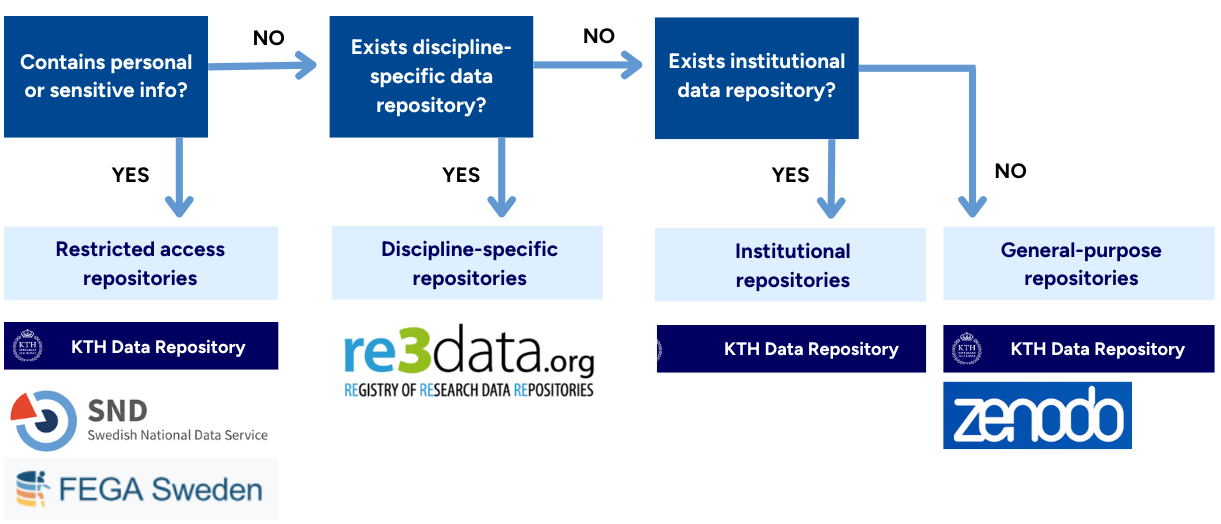
For some research areas, there are trusted and high-quality subject-specific data repositories where data can be stored. You can search for such repositories in the registry at re3data.org and learn more about the criteria for high-quality repositories that meet funders’ requirements in the report New guide on trusted repositories: Promoting open science and meeting grant requirements . In certain fields, journals also require that specific repositories be used. These repositories usually have guidelines for formats and documentation that are tailored to the subject domain. Data can also be published in dedicated data journals.
If there are no subject-specific repositories in your research area, there are several larger general repositories available for open data that ensure long-term preservation for at least ten years. KTH provides support in reviewing data descriptions for datasets deposited by KTH researchers to the KTH Zenodo Community and to the Swedish National Data Service (SND) repository, DORIS .
Zenodo can be a good option if you are working with open data and source code and your datasets do not contain information that can be linked to individuals. If you are instead working with tabular data or quantitative research methods, such as surveys or interviews, the SND service DORIS may be more suitable.
For other types of research outputs and methodologies – such as source code and machine learning models—there are additional services for sharing these openly. A general recommendation is to link between the different digital objects created in your research, so that all objects related to your published results can be found and disseminated. Note that not all services where digital objects are shared guarantee long-term preservation. This may cause problems if someone wants to review your research later on.
In repositories where a digital object is assigned a permanent identifier, such as a DOI, the organization behind the repository has committed to archiving the digital object. If you want to document the various digital objects used in your research, you are encouraged to use KTH Data Repository early in your research process. You can then choose which data you wish to make openly available.
To make your data reusable for further research, it is recommended that you follow the FAIR principles (Findable, Accessible, Interoperable, Reusable). There are also a number of ethical principles that provide guidance depending on the research context.
Funders’ and publishers’ requirements for the publication of research data
Many funders and publishers require that the data underlying published results be made available in accordance with the FAIR principles. Below is an overview of the requirements that major research funders place on open access and the sharing of research data.
Some publishers state that research data can be made available through their own solutions or those of their partners. In some cases, this may involve a considerable additional cost for authors, while in other cases, the data is only accessible to other researchers for a fee. We instead recommend publishing data through an openly accessible data repository that assigns permanent identifiers to research data.
You can find an overview of major publishers’ requirements for making research data available in the report An overview of publishers' guidelines for sharing research data .
KTH Data Repository – for documenting, archiving, and publishing your data at KTH
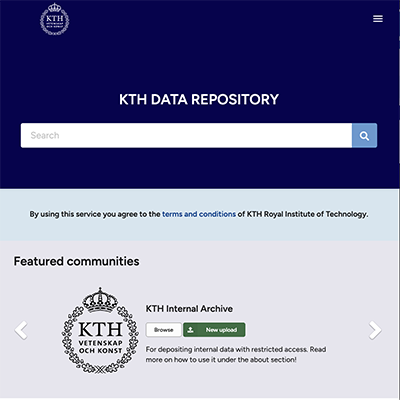
KTH Data Repository is a KTH service you can start using as soon as you begin collecting and documenting your data. It allows you to document and archive your data and, when appropriate, choose to publish all or part of your research project’s data. You can document different versions of your data and source code even before the data and results are published.
When submitting a manuscript for publication, journals may have different guidelines for how the underlying data should be provided. Peer reviewers often request access to the data supporting the manuscript’s results during the review process. From KTH Data Repository, you can share a “secret link” to your data. When the project ends, you can decide whether the data should be stored and shared internally only, or also published as open data. You can choose to publish some or all datasets from a research project.
Read more about how to use KTH Data Repository
Data published in the KTH Data Repository can be assigned a DOI and can then be found via external search services such as Google Dataset Search . Data published by KTH will soon also appear on the national research data platform researchdata.se and on DIGG’s open data portal for Swedish public sector data. Once your data has been deposited, you cannot make changes to the uploaded files. However, if you wish to document different versions of your data from various stages of processing, you can create multiple versions linked to the same dataset record.
Curious but unsure whether KTH Data Repository is the right place for your research data?
Try our sandbox environment first! There, you can log in and test the system’s features – upload, describe, and download test data either manually or via API. This allows you to get comfortable with how it works before deciding whether to document and deposit your actual research data in the live system. If you also want to try an allocated storage space for multiple datasets where you manage access within a limited group – your own community in the sandbox – contact us and we’ll help you set it up.
You can also contact researchdata@kth.se if you’d like a demo or wish to have a community with dedicated storage space in KTH Data Repository for your research project, research group, or department.
How should I handle data that cannot be published openly?
Data handling should consider information classification already at the collection stage. If confidentiality requirements apply, such data cannot be published openly. In some cases, data processing may result in an anonymized dataset that no longer requires protection against unauthorized access and can therefore be published. However, it’s important to consider risks such as re-identification. For quantitative data from interview or survey studies, you can find tools for statistically assessing re-identification risk for anonymized data at the Swedish National Data Service (SND) .
Even for sensitive data that cannot be made publicly available, it is important to document and archive the research data underlying your results. If you have used qualitative research methods and conducted interviews or surveys that include personal data, the Swedish National Data Service’s repository DORIS is a good alternative – it allows restricted access to datasets containing personal information. For researchers in the life sciences, sequence data can be deposited in the Swedish European Genome-Phenome Archive, FEGA Sweden , node.
Within the KTH Data Repository, you can also choose restricted access for data requiring basic confidentiality protection. However, if your data requires extended protection, you should first contact KTH Security and Safety Department .