Welcome to attend the fifth edition of Stockholm’s environmental humanities festival for film and text, Crosscuts.
For the 2026 edition of Crosscuts the theme is colonialism. We will explore how colonial systems, both historic and contemporary, have shaped and been shaped by relations between the human and more-than-human.
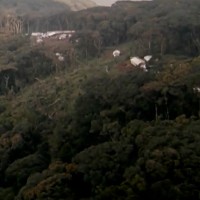
Our centerpiece film for this year will be the Swedish premier of Overburden, a feature length documentary that explores the past and present of the East Nimba Nature Reserve in Liberia. Home to some of West Africa’s most endangered species, the reserve is built on the grounds of an iron ore mine originally developed by the Liberian American Swedish Mining Company (LAMCO). Although that mine closed in 1990, the reserve faces new efforts to exploit the region’s rich iron ore deposits.
We have one night at the Stocholm University of Arts (SKH) and two nights of film and discussion scheduled at Filmhuset, Stockholm.
Wednesday 14 October, 2026
18.00: Let Our Mountains Live
At the Stockholm University of the Arts (SKH), screening of "Let Our Mountains Live" (100 minutes) followed by a conversation. Film is in Norwegian with English subtitles.
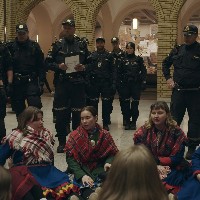
In "Let Our Mountains Live", one of Norway's most renowned documentary filmmakers, Håvard Bustnes, looks at the Fosen case and the state's ongoing human rights violations.
For over 20 years, Sami reindeer herders on Fosen, Norway, have been fighting against Europe's largest wind farm, built in the middle of their most important grazing areas. When the Supreme Court ruled that the farms violate Sami human rights in 2021, it gave hope that the wind turbines would be demolished. But the government still refuses to remove them. Sami youth respond by mobilizing in protest, and everything is at stake: the mountains, the culture, and the future.
Screening of Overburden (87 minutes) and Nimba (12 minutes) followed by a conversation. The film is in English with English subtitles
Overburden, directed by Sarita West, is a feature documentary set in the mist-shrouded Nimba Mountains on the Liberia–Guinea border, where rare wildlife and local communities reclaim a landscape scarred by mining. Today, this fragile recovery faces a new threat: a global steel company using conservation promises to brand a new mining venture as green.
We will also show Nimba, a documentary sent by SVT in 1958, made by the Swedish film director Gösta Werner, about the coperation Liberian-American-Swedish Mining Company (LAMCO) that mined and exploited NImba during the second half of the twentieth century.
Followed by a conversation with the documentary's creative producer Gregg Mitman and cast and doctoral student Shadrach Kerwillain with historian Per Högselius.
A session that delves into screendance, screening Cave Aqam, Ramita Seca & Birds of the Earth, curated by Davide De Lillis. Followed by discussion.
Cave Aqam
Cave Aquam explores the ecological and political consequences of travertine quarrying in central
Italy. The work takes place in the so-called Travertine Basin (Tivoli, Rome), where extractive sites
were first opened by the Romans, systematically reactivated under the Fascist regime, and are now
nearing exhaustion due to contemporary industrial extraction. Cave Aquam foregrounds water as a
transformative force that reclaims abandoned quarries and generates unforseen ecologies, raising
the question of how to engage with these contested landscapes today
Italy, 8 minutes, directed by Davide De Lillis
Ramita Seca
In Ramita Seca, La Colonialidad Permanente, Argentine artist and dancer Maximiliano Mamani
pays homage to the Aymara revolutionary Bartolina Sisa, reactivating Indigenous histories of
resistance. In the video, the figure of Bartolina Xixa—conceived as a drag persona—dances within
a landfill in the Quebrada de Humahuaca, drawing on the traditional form of the vidala to stage a
powerful gesture of embodied defiance. The work exposes the enduring structures of coloniality,
foregrounding those who bear the ecological and social costs of extraction while remaining
invisible.
Argentina, 5 minutes, directed by Maximilano Mamani
Birds of the Earth
Birds in the Earth uses the juxtaposition of classical ballet and Sámi cultural forms to raise
questions of land rights, visibility, and representation. In the film we follow two ballerinas as they
glide through the landscape and eventually arrive at the Parliament in Helsinki.
Screening of Son of the Spoil (47 minutes), followed by a conversation.
Cape Town signals health through order: manicured estates, policed natural landscapes, and an ordered geography of wealth. Son of the Spoil interrogates the instinct to preserve, asking if such rigid order is itself a pathology. The film proposes that what we experience as decay—disorder, transgression, and breakdown—is not the opposite of growth, but its vital precondition. This tension is explored through two intersecting lives. Neville, a bossiedoktor, harvests medicinal plants from protected land. Though his practice is illegal, the film argues it is more genuinely integrated into the natural order than the conservation frameworks that criminalize it. His relationship to the land is reciprocal—a form of ancestral knowledge that thrives in the cracks of the law. The Son is sixteen and caught in a cycle of wild rebellion, punishment, and consequence. While society reads his trajectory as one of failure, the film reframes his breakdown as a necessary fermentation. Like organic matter, the breaking down of a self is a process with an unknown outcome that should not be foreclosed. As the lens follows these two men, the filmmaker finds his own story already inside it—witnessing a parallel decay within his own family. By holding the camera on what usually repels us, Son of the Spoil becomes a deeply personal account of the intersection between indigenous knowledge, incarceration, and identity. It is a cinematic exploration of what becomes possible when we stop trying to protect everything from the messy, transformative process of becoming.