Fast Electron Physics
The Fast Electron Physics group studies the whole life cycle of fast electrons in plasmas, from birth, through acceleration and radiation, to termination of the plasma discharge. The group is led by Assistant Professor Mathias Hoppe.
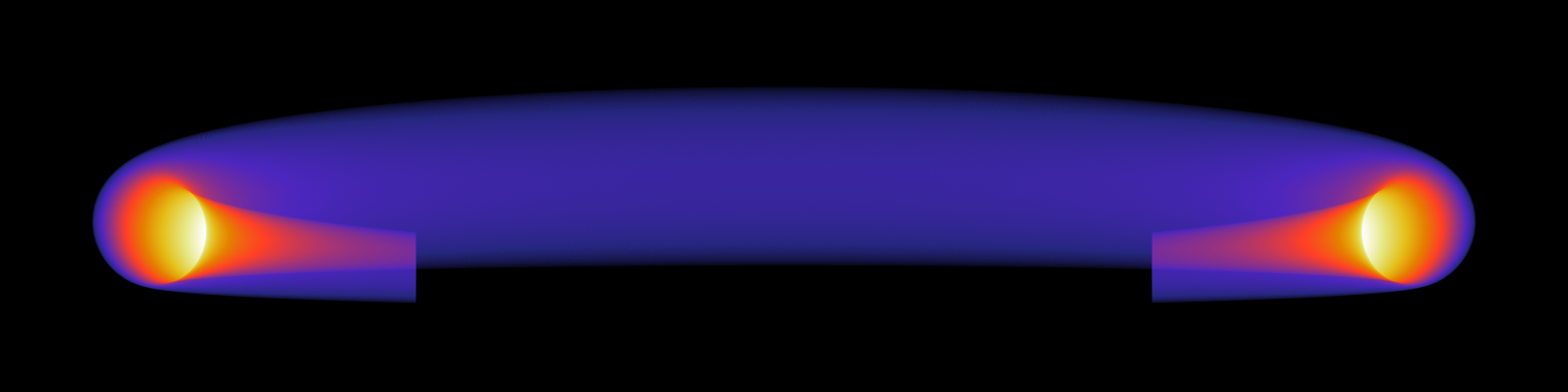
Fast electrons are ubiquitous in plasmas and typically arise in rapid transient events, such as during start-up or (emergency) shutdown of a fusion reactor. These electrons are typically undesired as they can reduce plasma performance and limit the efficiency of plasma heating. Their high energies further pose a particularly high danger to plasma-facing components, which could suffer severe melt damage if struck by the electrons. A fusion reactor must therefore try to avoid the generation of fast electrons as far as possible, as they can otherwise lead to reduced fusion power and costly maintenance shutdowns.
In the fast electron physics group we study various aspects of fast electrons using primarily analytical and numerical tools. We collaborate closely with researchers from across the world, and are deeply involved in international collaborations such as EUROfusion , ITER and ITPEA .
Our interests include, but are not limited to:
-
the physics of fast electron generation
-
integrated simulations of runaway electrons during tokamak start-up and disruptions
-
modelling of the radiation (cyclotron, synchrotron) emitted by fast electrons
At the core of our research lies the concept of runaway electrons, which is a phenomenon inherent to plasmas.
Runaway electrons
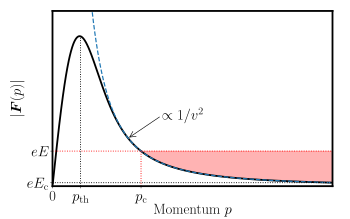
In a plasma, electrons typically lose energy through collisions with ions and other electrons. However, when a sufficiently strong electric field is applied, a subset of electrons can be continuously accelerated to high energies. The key lies in the velocity dependence of collisional drag: as electrons move faster, the friction they experience decreases, as shown in the figure to the right. Beyond a certain threshold, the electric force exceeds this drag, and electrons “run away,” gaining energy almost unhindered.
In the complex environments that is fusion plasmas, runaway electrons can arise in a number of circumstances. The first mechanism discovered by which runaway electrons can arise is referred to as the Dreicer mechanism, after the American scientist H. Dreicer. He considered the balance between electric field acceleration and collisional drag on electrons, and found that runaway electrons will diffusively "leak" into the runaway region. Later on, other mechanisms by which runaway electrons can arise in fusion devices have been discovered and include the (i) hottail mechanism, which occurs when the plasma is cooling rapidly, (ii) spatial transport of moderately fast electrons into regions of strong electric fields, (iii) Compton scattering of electrons into the runaway region by high-energy photons, and (iv) beta decay of tritium, which in certain situations can produce electrons whose momentum exceed the critical value.
The generation mechanisms described above are usually referred to as “primary” mechanisms, as they only require a sufficiently strong electric field to be present. There is however also another mechanism for runaway generation which is referred to as a “secondary” mechanism, and which can only commence if one or more runaway electrons already exist. This mechanism is often also referred to as the avalanche mechanism, and can be shown to yield an exponential growth in the number of runaway electrons. Furthermore, it is possible to show that the avalanche mechanism scales exponentially with the plasma current in a tokamak, meaning that future reactor-scale devices will be particularly prone to the generation of runaway electrons. The development of strategies for avoidance and mitigation of runaway electrons is one of the top priorities for next-generation tokamaks, such as ITER and SPARC . The fast electron physics group at KTH collaborates closely with many of these projects to support these efforts.
Our codes
A number of scientific codes have resulted from the work in our group, and are actively maintained and developed by our members. Many of our codes are widely used by international researchers and are consulted for the development of technology and scenarios for reactor-scale tokamaks.

DREAM The Disruption Runaway Electron Analysis Model is a fluid-kinetic framework for studying disruptions and the associated generation of runaway electrons. The term “fluid-kinetic” means that the code can be used to study both fluid approximations of the plasma, as well as treating the electrons kinetically, i.e. by calculating the velocity distribution of the electrons. The DREAM code is our most advanced tool for simulating runaway electrons, and is continuously developed by our team as well as colleagues at other universities and research institutes. DREAM is widely used by the international fusion research community and is available freely on GitHub .

SOFT The Synchrotron-detecting Orbit Following Toolkit is used to study the synchrotron radiation emitted by relativistic electrons. The theory behind the code relies on a number of symmetries and properties of the physical system which enable approximations that significantly reduce the computational cost, making SOFT a highly computationally efficient code while allowing quantitative comparisons with experiments. The code is widely used by the international research community for analysis of synchrotron radiation in present-day fusion experiments, and is freely available on GitHub .
STREAM The Start-up Runaway Electron Analysis Model is based on the DREAM code, but solves a 0D set of equations, suitable for modelling the early phase of a fusion plasma discharge. As with DREAM and SOFT, the STREAM code is freely available on GitHub .
YODA is a synthetic diagnostic framework for the study of electron cyclotron emission. It was developed specifically for the study of cyclotron emission from fast electrons, and therefore accepts an arbitrary numerical electron distribution function as input to the simulation.
Student (thesis) projects and PhD thesis in fast electron physics
Are you interested in carrying out a project on fast electron physics with our group? Contact Mathias for more information and for discussing possible project topics!
Members