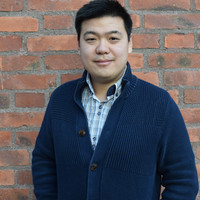
When you work in a technical university as a Count (see this link for explanations), sometimes you wonder if you are a teacher, a researcher, or both. Or none.
With a previous relatively long (8 years) experience in the industry, the term “research” is a bit subtle to me. Especially in an industrial environment of global dimensions with a strong R&D history, it is not easy to see how little academic groups can make a significant difference to the community. I make a quick example: in Helsinki, Finland, approximately 1200 people at ABB were (hopefully still are) working on electrical drives. Of these 1200 people, it was estimated that roughly 1/3 were involved in some form of R&D activities. What can an academic team of a professor + some Ph.D. students do compared to that? Especially when these 400 people have multiple years of experience and are, for the most part, highly competent… those who know me also know my deep respect for Finnish expertise in electrical machines and drives.
Despite this imbalance, there is perhaps always something we can contribute to on a small scale—an idea, a vision, an initiative —something that leads us to publish a good article, which a company then picks up, and things start rolling in the right direction. It has happened, and hopefully it will continue. But that is not what I want to talk about here.
What I want to talk about is the teacher’s perspective on this game. Leaving industry for academia is not very common, but when I did, it was for a clear goal: I wanted to influence how our scientific field was taught, at least at KTH. I began by managing the base course on electrical machines and drives. Due to an unforeseen and unwanted series of events, I am now also responsible for two additional courses: one on control for electrical machines and another on the design of electrical machines. In practice, my teaching duties start in August and end in June. The students who decide to follow all the courses in our field will essentially see me for an entire year, non-stop. And if they are not tired of that, I can offer them an individual project lasting one semester the following year. And of course, you can always perform your master’s degree project with me as supervisor or examiner. In short: two years of a master’s in Electric Power Engineering at KTH, and you can potentially never get rid of me.
I could start complaining about the load this is causing on me and shout at KTH for not employing any other faculty staff to help me out. My teaching spans from the Carter factor to sensorless control with high-frequency voltage injection, passing through finite-element analysis and Simulink schematics. Any professional in this field would tell you that it is a vast scope for this scientific field – apparently, only KTH does not get it 🙂
But KTH has inadvertently given me an excellent opportunity. Total responsibility over the courses also means that I can do exactly what I think is best for the students, avoiding content overlaps and flawlessly harmonizing the material from one course to the other. It takes years, and although I started many years ago, I am not yet at the end of this process, but I am pretty far along nonetheless. And every year, there is something to change, something to improve, something to include or exclude.
Why all these efforts?
… because I want my students to be the No. 1 students in this field, no matter where they go. Being a university or a company, there should be a recognition: this guy/girl studied electrical machines and drives at KTH. It should suffice as a business card.
And look, I am not getting upset with the students who, after a while, discover that this topic is not for them. The world is big; there is space for everyone. My rage is directed towards myself: I get upset when I do not deliver a good lesson or when I fail to teach specific details I should have. This is what makes me mad: having lost the opportunity to make you the number 1.
Passion and understanding of the difficulties involved in pursuing this education are my driving forces. Lectures are sacred and a place of joy and sharing. Not a place where you feel a stone hanging on a rope by your neck. Given that I am not getting any younger, and while the students are the scientists and leaders of tomorrow, I believe I am investing in the future of this community where we live. I hope to maintain the wonderful relationships I have built with some students over the years of teaching, for the remaining years of my life.
Is there any immediate satisfaction? Well, you can say so. Look at this, for example:
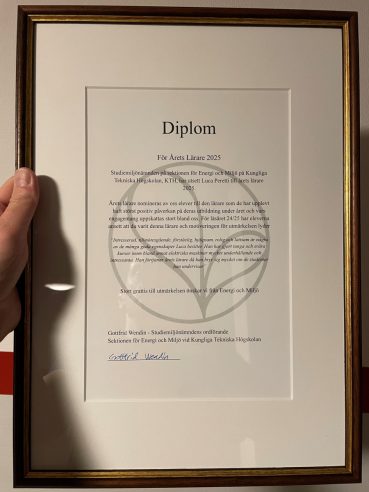
“Teacher of the year 2025” from the KTH student section on Energy and Environment. I leave the rest of the text untranslated, I can’t spill it all out 🙂 But you understand that these types of awards have the opposite effect on me; instead of relaxing, I will double down to make the courses even more appealing. Because I feel it is working.
My late father used to say: “If you want to teach one thing, you need to know at least three times as much”. Message received, Dad.