KTH Logo

Upcoming Final seminar: Streams, Steams, and Steels: A History of Nuclear and Non-Nuclear Risk Governance (1850-1990)

A warm welcome to another upcoming final seminar at the division!

Doctoral Student: Siegfried Evens, Doctoral Student, Division of History of Science, Technology and Environment
Supervisor: Per Högselius, Kati Lindström, Anna Storm
Opponent: Markku Lehtonen, Social Scientist, University Pompeu Fabra in Barcelona

Time: Tuesday 2023-06-13 13.15 – 15.00

Location: Big seminar room, Teknikringen 74D (floor 5), Division of History of Science

Language: English
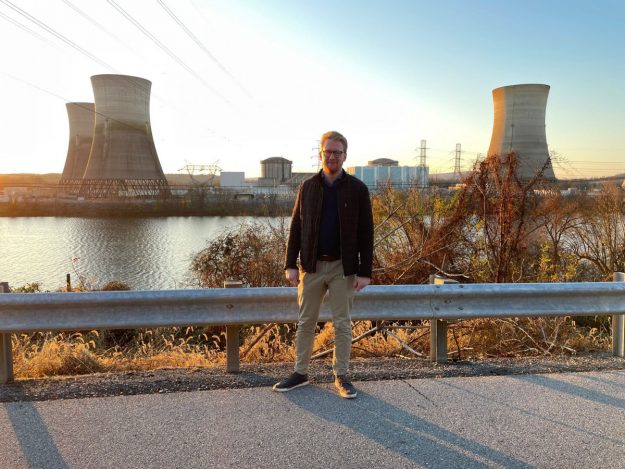
 

Siegfried Evens in front of the Three Mile Island Nuclear Power Plant in the USA.

Teaser

That is why this dissertation will focus on exactly that: the water that runs through our nuclear power plants. Water is so important and obvious to the safety of so many power plants not only nuclear ones that it barely goes unnoticed. Indeed, the history of nuclear power contains a striking paradox. Water is the key to a normal functioning nuclear power plant and to preventing nuclear accidents. Yet, up until now, the history of water is largely absent from the history of nuclear power, and especially nuclear risk. In contrast, there is a longstanding scholarly tradition of studying nuclear fission and radioactivity.

But this dissertation is about more than just water. By focussing on water streams for the analysis of nuclear safety, other relevant elements open up as well. While water streams are essential, there is no nuclear power plant in the world that generates electricity because of it. Electricity is generated because of the steam caused by the boiling of that water. The generation of steam is coupled to the science and engineering practice of thermalhydraulics a field with a long and important history, dating back to the early days of industrialisation and mechanical engineering.

As I will show, much engineering and political effort in the nuclear sector and outside of it has been devoted to the management of pressure and temperature in steam equipment, such as boilers and pipes. All of this was essential to prevent the pressure from mounting too high, causing catastrophic explosions. In turn, the management of all this water and steam is also very reliant on the material that this equipment is made of. And that material is steel. A very robust material, steel is wellequipped to
withstand the tremendous pressures and temperatures necessary to generate power. However, as
with almost any material, it can decay, crack, brittle, and break. A major theme in this dissertation will therefore be the continued effort to improve and regulate steel and the work of metallurgists and material engineers in doing so. Streams, steams, and steels; that is in many ways the essence of
this dissertation.

Excerpt from Siegfried’s final seminar text, pp. 12-13.
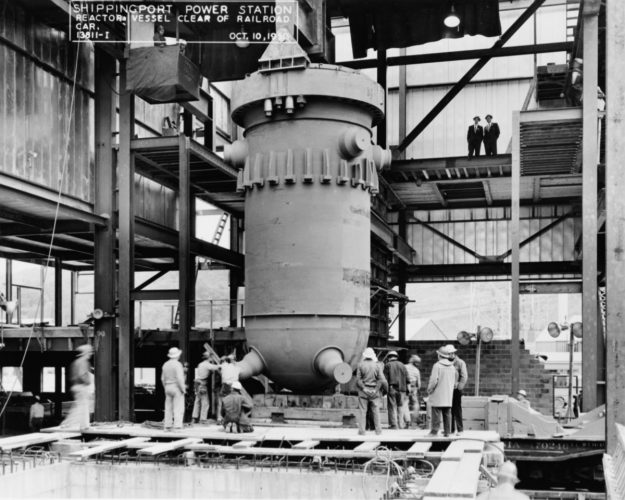
 

A pressure vessel at Shippingport Nuclear Power Station in the USA.

Mid-Seminar: The Qualitization of the Humanities: Changing Articulations of Research Quality

Please be warmly welcome to attend Klara Müller’s mid-seminar in doctoral education, here at KTH Campus on Monday April 24.

The Qualitization of the Humanities: Changing Articulations of Research Quality

“Placed at the intersection between research policy, STS and the history of humanities, the project aims to analyze quality articulations on both the micro-level and the macro-level of the humanities since the 1980s. This is done through a combination of various methodological approaches such as archival research, oral history and bibliometrics.”

Doctoral student: Klara Müller, Division of History of Science, Technology and Environment, KTH
Supervisor: Sverker Sörlin, KTH & Linus Salö, Stockholm University
Opponent: Vera Schwach, Doctor and Research Professor at NIFU, Nordisk Institutt for Studier av Innovasjon, Forskning og Utdanning

Time: Mon 2023-04-24 13.15 – 14.45
Location: the seminar room at the Division (Teknikringen 74 D, level 5)
Language: English

A new PhD at the division

Life moves on, a new term has started and we as a division are very glad to welcome our new PhD-student Erik Ljungberg, who works in the History of Media and Environment with a focus on AI and autonomous systems. We have asked him a few questions to introduce himself and you can read his answers below.


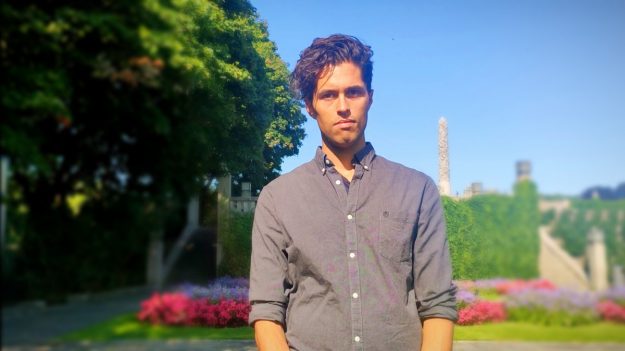
Profile picture of Erik Ljungberg


Given that you had to switch countries for your new position, how was your transition to KTH?

I have to say that KTH has made the transition very easy. With the opportunity to get an apartment within a short space of time through KTH Relocation, making the jump from Oslo to Stockholm has been pretty effortless. Although shifting COVID restrictions have made the process a little unpredictable at times.


Could you please tell us a bit about yourself and the topics you are working on, especially within your PhD?

I am a historian of knowledge and started at KTH as a PhD student in August. I am more or less associated with the Mediated Planet project, which looks at how data gathering practices, data access and data ownership shape environmental perception and politics. Though my project is also a bit freer to go in different, but related directions.  I have backgrounds in both history of knowledge, which was the discipline I wrote my M.A. thesis in at the University of Oslo, and cultural anthropology, which I did a second B.A. in while doing my masters. Specifically my M.A. thesis looked at the advent of phenology, or in other words the measurement of rhythms of nature, in British natural science in the 18th-century. Phenology is a fascinating endeavor to study from a history of knowledge perspective because the possibility of mapping seasonal variations among plants and animals only really came into being once there was a knowledge infrastructure capable of gathering and processing big amounts of data. Basically you had to make daily observations over several years. Particular ways of handling paper were really at the center of this process. But you also needed ways to structure the recorded data in purely visual terms in order to streamline the process of recording and reading data. So one of the things I highlighted in my research was the importance of the table as the condition of possibility for this kind of knowledge production, stressing the fact that knowledge is simultaneously material and cognitive.

My PhD project will maintain this media theoretical focus on how knowledge emerges through being circulated through socio-material infrastructures, but focuses instead on the role of AI and autonomous systems in environmental understanding. It is exceedingly likely that AI and autonomous systems will fundamentally change the way that human society monitors, models, and manages the Earth’s natural systems. What is interesting to me is placing this development within a longer history of shifting Earth-human relationships wherein mediation plays a crucial role. As the environment becomes increasingly dataified, a central question also revolves around usage and access to data. This becomes especially salient once the issue of monetization comes into the picture. Who should capitalize on the use of data that is public, free, and ubiquitous? Questions such as these are important to address as big tech companies currently stand a fair chance of developing a hegemony of expertise when it comes to these issues.


What is coming up right now? What do you aim for in the near future in terms of research, (side-)projects, or public outreach?

Right now I am making an outline of my project, and also simply trying to get an overview of the field, or several fields actually, that I will be working in. Otherwise, I have a couple of things on the agenda. I am working on a paper for the Nordical Journal for Eighteenth-Century Studies, and I had a paper accepted for one of the panels at the upcoming 4S conference. Also, I hope to have a blog up and running in the next months which can serve as a kind of outlet for some of the developments that are unfolding so rapidly within the field of AI and the environment.


Starting during the pandemic is challenging, although we all hope that regular work routines can be resumed during this term. What kind of impact has Covid-19 had on your work?

Actually I got a scholarship to go to London and spend time in the archives, but that proved unfeasable during the pandemic. Certainly my M.A. thesis suffered from this. On the other hand, since a lot of workshops and conferences have gone digital, it has been possible for me to take part in discussions that I never would have been able to if I had to fly. Hopefully the landscape of post-COVID academia will include a lot less flying, while still acknowledging our need to interact face-to-face.

*

Thank you, and “Välkommen!” Erik, it is good to have you with us!


PhD-Defence on Friday

On this Friday, 20 August 2021, at 4pm Stockholm Time PhD-Candidate Dmitry V. Arzyutov will defend his dissertation with the title “Reassembling the Environmental Archives of the Cold War”. Dima’s opponent is Assistant Professor Bathsheba Demuth from Brown University in Providence, USA (State of Rhode Island). We are looking forward together with his supervisors Peder Roberts (Stavanger), Per Högselius (KTH) and Julia Lajus (St. Petersburg) to this major event in our division’s PhD-education.

If you want to join check out the official announcement including the Zoom-link here.

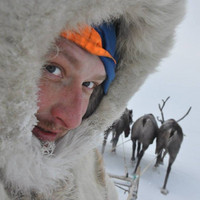
AbstractProfile picture of Dmitry Arzyutov

To what extent the environmental history of the Arctic can move beyond the divide between Indigenous peoples and newcomers or vernacular and academic ways of knowing? The present dissertation answers this question by developing the notion of an environmental archive. Such an archive does not have particular reference to a given place but rather it refers to the complex network that marks the relations between paper documents and human and non-human agencies as they are able to work together and stabilise the conceptualisation of a variety of environmental objects. The author thus argues that the environment does not only contain information about the past but just like any paper (or audio and video) archive is able to produce it through the relational nature of human-environment interactions. Through the analysis of five case studies from the Russian North, the reader is invited to go through various forms of environmental archives which in turn embrace histories of a number of disciplines such as palaeontology, biology, anthropology, and medicine. Every case or a “layer” is presented here as a contact zone where Indigenous and academic forms of knowledge are not opposed to each other but, on the contrary, are able to interact and consequently affect the global discussions about the Russian Arctic. This transnational context is pivotal for all the cases discussed in the dissertation. Moreover, by putting the Cold War with its tensions between two superpowers at the chronological center of the present work, the author aims to reveal the multidimensionality of in situ interactions with, for instance, the paleontological remains or the traces of all-terrain vehicles and their involvement into broader science transnational cooperations and competitions. As a result, the heterogeneous archives allow us to reconsider the environmental history of the Russian North and the wider Arctic and open a new avenue for future research transcending the geopolitical and epistemic borders of knowledge production.

Abstract på svenska

I vilken grad kan en miljhöhistorisk analys av Arktis undvika klyftan mellan ursprungsfolk och nykomlingar, samt mellan folkliga och akademiska form för vetenskap? Avhandlingen svarar på denna fråga genom att utveckla begreppet ”miljöarkiv.” Ett sådant arkiv hänvisar inte till en särskild plats, men heller till et komplex nätverk som samlar ihop förhållande mellan dokument i papper och båda mänskliga och icke-mänskliga aktörskap. Tillsammans stabiliserar och konceptualiserer de ett antal miljöobjekten. Författaren argumenterar därför att miljö omfattar inte bara information om förtiden men liksom andra form för arkiv (antingen papper-baserat eller elektronisk) kan reproducera förtiden genom att belysa interaktioner mellan människor och natur. Genom fem case studier från det nordliga Ryssland bjudas läsaren på en tur av fem olika miljöarkiv som omfattar olika disciplinära traditioner, t. ex. paleontologi, biolog, antropologi, och medicin. Varje case eller ”lager” presenteras här som kontaktzon var ursprungliga och akademiska form för vetenskap inte nödvändigtvis står i opposition, men tvärtom påverkar varandra, och därmed får inflytelse över diskussioner om det ryska Arktis även på global nivå. Denna transnationella kontext är avgörande för alla cases i avhandlingen. Genom att sätta det kalla kriget i analysens centrum (kronologisk sett), med fokus på spänningarna mellan stormakterna, hoppas författaren att belysa de flerdimensionella interaktionerna mellan t. ex. paleontologiska fynd och spår från bandfordon och hur dessa interaktioner var kopplad till bredare frågor kring multinationella samarbete och konkurrens. En så heterogen uppfattning av arkivet öppnar för nye perspektiv på miljöhistorien av båda det ryska Arktis och Arktis set i sin helhet, samt öppna för nya forskningsfrågor som överskrider nuvarande geopolitiske och epistemologiska gränser innanför kunskapsproduktion.


Good luck, Dima!


New PhD-student in the “Making Universities Matter”-project!

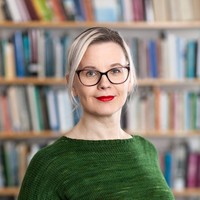
We have a new PhD-student at the division! While the pandemic is still disrupting usual work routines, we are very happy that new people can nevertheless join us. Starting a PhD under these conditions in a new work environment is all but easy. Therefore, the division’s blog wants to continue introducing new people to make them more visible and to facilitate collaborations. Thus, Klara Müller was so kind to answer the following questions to introduce herself.


Could you please tell us a bit about yourself and the field(s) you are working on? 

I am an historian of science and technology and started at KTH as a doctoral student in January 2021. I work within Making Universities Matter (MUM), a project devoted to studying how the blend of missions and tasks of universities has evolved over time.

I finished my Master’s degree in The History of Science and Ideas at Uppsala University in June 2020. Previous to my Master’s I did a dual Bachelor’s degree in Media History and The History of Science and Ideas at Lund University. I have also studied archival science and was an exchange student at Utrecht University in 2019. My broader research interests relate to the history of humanities, history of bureaucracy, university history and the history of computing. Besides my studies, I have a far-reaching interest in research- and education policy.

In my previous research, I have mainly focused on the history of the information infrastructure of hospitals, through studies on the media history of medical records and on computers in healthcare. My Master’s thesis “Computer Power and the Art of Medicine: The Introduction of Computer Technology in Swedish healthcare 1962 – 1968” examined how computers affected medical knowledge production. The study shows how physicians’ diagnostic assessment of patients was reformulated into binary language so that computers could interpret it, and discusses the implications this process had on which type of knowledge was created and used in medical practice.

My PhD project has a lot of similarities with my previous research interests, but focuses on a different topic – instead of medical knowledge, I am looking into knowledge created in humanities disciplines. This agenda can be grasped as research on the information infrastructure of knowledge in the humanities in Sweden from the latter half of the 20th century. Methodically, I will approach this object by studying how humanities research has been measured and valued, in relation to, for example, the introduction of bibliometrics. The overall purpose of the study is to investigate changes regarding what has been considered to be high-quality humanities research, in relation to processes such as digitalization, internationalization, bureaucratization and the expansion of higher education.


What do you work on right now? Is something in particular coming up?

I am currently working on my PhD project outline, trying to map out the field. I am also involved with the Division’s upcoming Biennial report, analysing publication data.

Since I am affiliated with the knowledge platform MUM, I get to participate in a lot of interesting research policy events. For example, MUM and Vinnova have organized a seminar on the latest research and innovation bill (more information can be found here).


Starting during the pandemic is challenging. What kind of impact do you feel that Covid-19 have on your work? 

Since I knew that I would begin during the pandemic I guess I was able to adapt my expectations. But of course, it is not easy to be new at a workplace without the possibility of being there physically, without meeting people in person. And the feeling of a fresh start is difficult to achieve when you have been in the exact same apartment every day of the work week since March 2020. And it is, of course, not easy to plan for future courses, conferences and potential archival work, because of the uncertain future. Covid-19 has also led me to think a lot about how crucial cultural and historical knowledge is to understand societal reactions to crisis.


Thank you, Klara! Let’s hope we can all soon meet in person again.