I received an invitation to go to Durham university to speak at a conference and engage with PhD students. I immediately considered it, but I also let my host know that having me over would probably cost more, as taking the train is more costly these days. And I like to take the train. The offer remained and I said yes.
Come spring and planning, I postponed this for too long. Perhaps due to the war, perhaps because of workload. It worked fine in the end, but in hindsight I would most likely have chosen a slightly different route back home.
Photo by Nina Wormbs
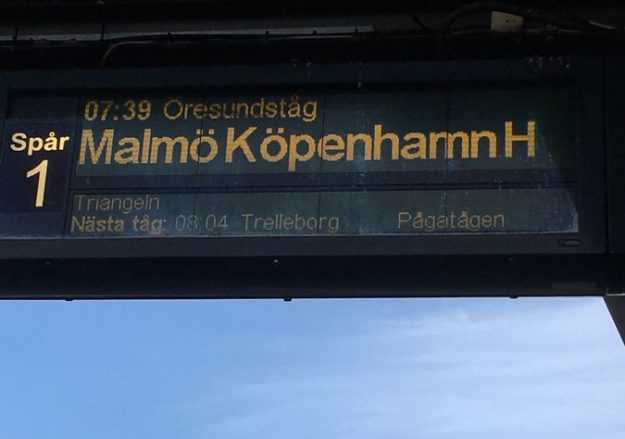
Stockholm – Durham is rather long. I discarded ferries early on since I now know – through an earlier mistake – know that they are not good from a CO2 perspective. I also decided not to sleep on the train. The reason was mainly Covid and the lack of flexibility if you want to have your own compartment. Thus I was left with travelling during the day and stopping on the way. Since I have family in Lund, that was a natural place for my first night.
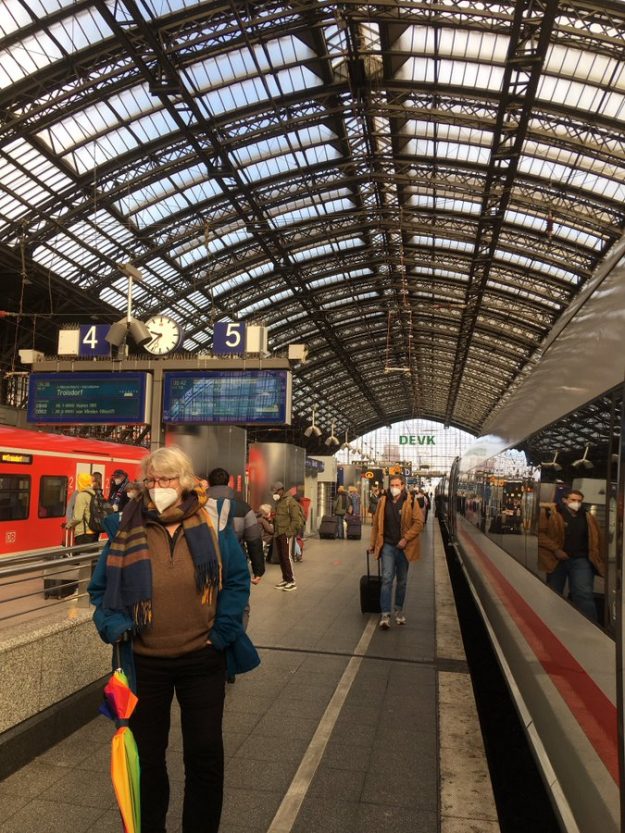
Köln. Photo by Nina Wormbs
That allowed me to make an early start on the travel across Germany for Köln. The trip had four legs: I changed trains in Copenhagen, Fredericia and Hamburg. This went smooth and without incidents. I arrived in Köln and had time for a long walk in the city and then dinner with a friend who also hosted me for the night. Great stop.
Next day I took the high-speed train to Brussels and then the Eurostar to London St Pancras. This gave me ample time in the afternoon and night in London and also the possibility for a long walk the next morning. Lovely as they say.
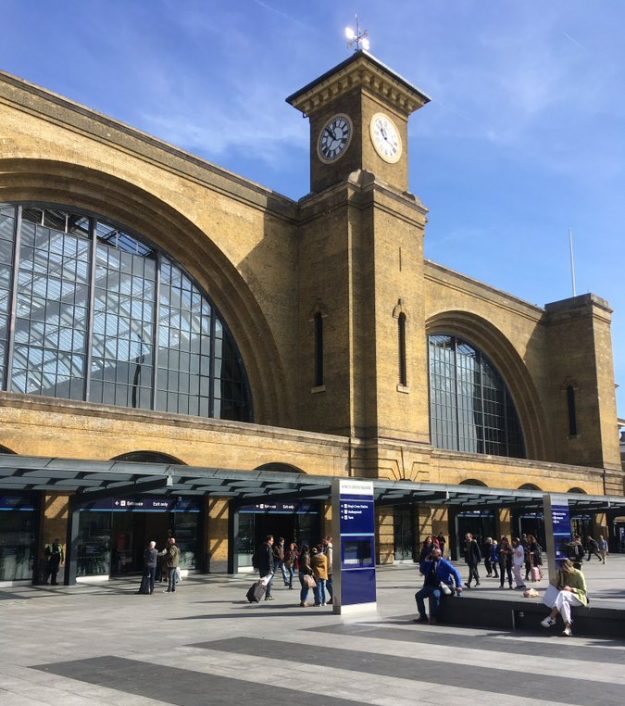
The train for Durham left from King’s Cross which is next to St Pancras. This train was also without incident and I arrived less than three hours later in a magnificent city. The river Wear makes a loop around a hill on which the old town with its castle and world heritage cathedral is built. It is to a high degree a university town, with most of the campus south of the inner city.
The conference and PhD spring school lasted four days and I left on the fifth. When I got around to make reservations, options were few due to Easter, and I ended up taking the Eurostar to Paris. That was a late train to start with, which also became delayed. Still, I managed to walk around and smell Paris before I went to sleep in a tiny little room on La Fayette.
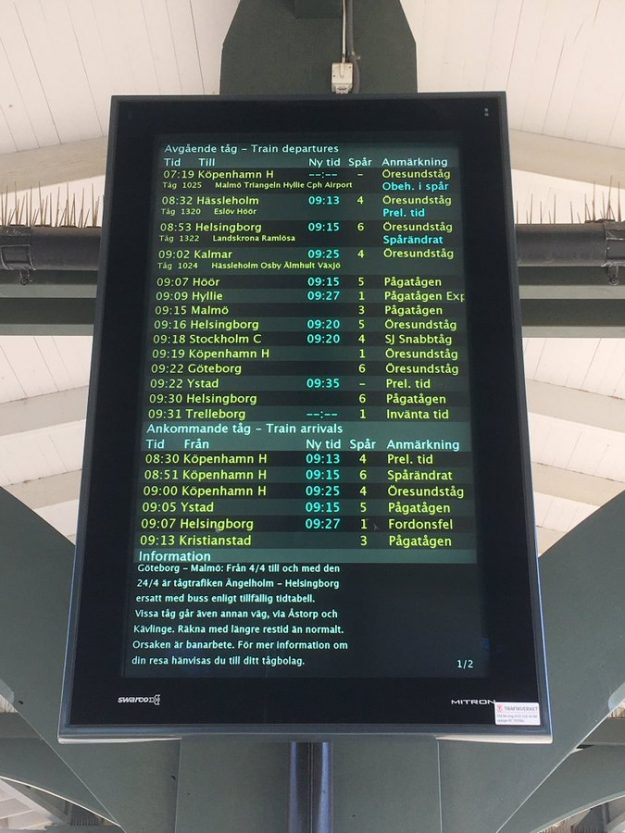
Easter Saturday started with a high-speed train to Köln via Brussels. No worries. In Köln I had time to buy lunch and walk a bit around the cathedral which is just outside of the station. However, the train to Hamburg turned out to be delayed and I could have missed my connection. The train waited, however, which was a relief. Normally the trip between Copenhagen and Lund is effortless, but during Easter construction work was undertaken and I had to take the bus between the airport and Hyllie. In the end it did not take longer actually, but was slightly more inconvenient. I was rather tired when I put my head on the pillow, after that 15 hour journey. I stayed on in Lund and eventually managed the last leg to Stockholm.
With this many trips, an interrail mobile pass is the cheapest option. The app mostly worked well and a mobile pass is really useful as it also has search functions, Q&A, community and is flexible. I made reservations on all trains, also those where I did not need to.
Stockholm – Durham can perhaps be done in two days. But it would be tough and you are vulnerable to delays. I only had two delays and only one was serious. With more travel days the risk diminishes of unexpected major changes to your itinerary.
And mobility becomes more travel and less transport.
Travelling by train should not be understood as an inferior alternative to the plane. Trains should not even try to compete with planes. Trains can offer something different, something unique, something which is sorely needed among professionals: time for yourself. This is the value of slow motion.
Am I nuts? So, I am travelling to London from Stockholm for a three-day work session… by train? It takes two days there and two days back, including an over-night hotel stay in Hamburg both ways. It costs my employer around €1,200 or at least three times the cost of a flight ticket. Seriously?
This incident of economic insanity of course has its background. It is called climate change. Our failure to meet the necessary reductions of GHG emissions is out in the open. We’re heading full speed towards 2 or 3 degrees of global warming. We know this; still the polluters keep polluting. Air travel is increasing fast on a global scale and I just don’t want to be part of that trend.
Air travel might only be contributing a few percent of the greenhouse effect. But our flying is emblematic of the carbon-fuelled lifestyles that are really the problem. After all, it is the most carbon-intensive activity (per time unit) you can undertake as a human being. A particularly sad state of affairs is that the scientific community that brought us all the undisputable facts about global warming, is at the same time one of the biggest emitters. Being a successful scholar means jetting all over the world between conferences, guest appearances, exchange visits and field work. This undermines our legitimacy badly. If scientists don’t follow their own advice, why should anyone else?
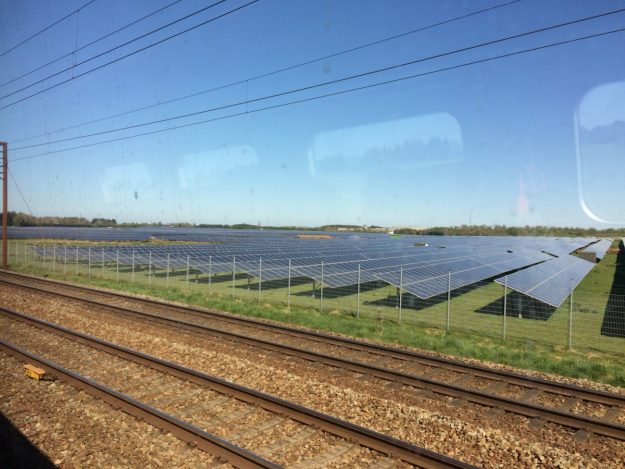
Climate friendly – an European solar park
Trains instead of planes. Some say that the train is not so much better for the climate than the aeroplane. This may be true in some exceptional cases, e.g. if planes running on renewable fuels are compared with coal-powered trains. But in the majority of cases, with current technology, the train is far better. No need for additional proof here, let’s just work with this fact for now. The question is then: is it possible to be a successful scholar without using the aeroplane? Or to succeed in any kind of international career for that matter?
Obviously, many physical meetings can be replaced with virtual meetings. Skype, Hangout and WhatsApp are examples of tools that already have changed how we interact and collaborate over distance. In preparing for this trip I have already used two of them. But they did not replace my trip. We will have more digital interaction, but there will still be instances we need to travel. Can the train really be an alternative for others than green fanatics? Simply put: what is the business case for attracting professionals to do long-distance travel by train?
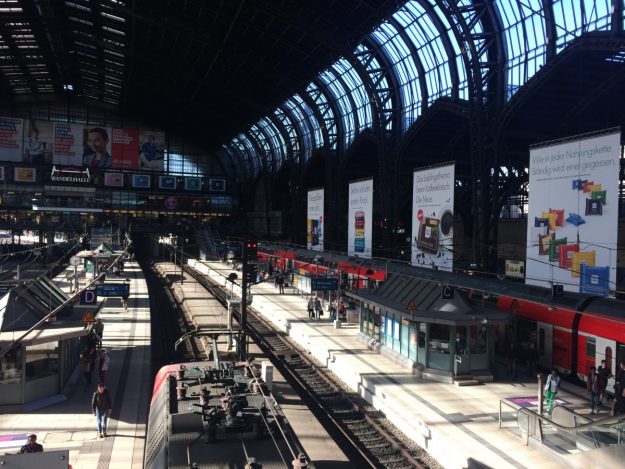
Hamburg Hauptbanhof
Capturing the value of slow motion. In a recent doctoral thesis at KTH, Stefan Tongur showed that when new technology enters the market, commercial actors often try to exploit them through already established business models. The problem is that the value offered by new technology– in Tongur’s case electrical road systems – cannot be captured using the old business models. On the other hand, commercial actors can pack existing technologies into new business models, thus capturing value brought about by changed value perception among the users. Netflix, Uber and RyanAir are well-known examples of this.
Railway technology is as old as industrial society itself. Today’s high-speed trains with air-conditioned coaches equipped with wi-fi and espresso machines are really just incremental innovations, mimicking both airplanes and the urban cafe. But the new and untapped value lies elsewhere. It lies in our insatiable desire for more time. In a world where we live our lives constantly online, surrounded by more and more time-saving devices, having enough time to do things slowly has become a luxury. The lack of time for reflection stands out as a problem every year in staff surveys at KTH. In our quest for organisational efficiency and instant needs fulfilment, the ”click society” offers no time for slow thinking, for concentrated work without distractions, or for just enjoying sensorial experience from our physical surrounding. Train travelling, with its fixed time tables and train changes offers a script for doing precisely this.
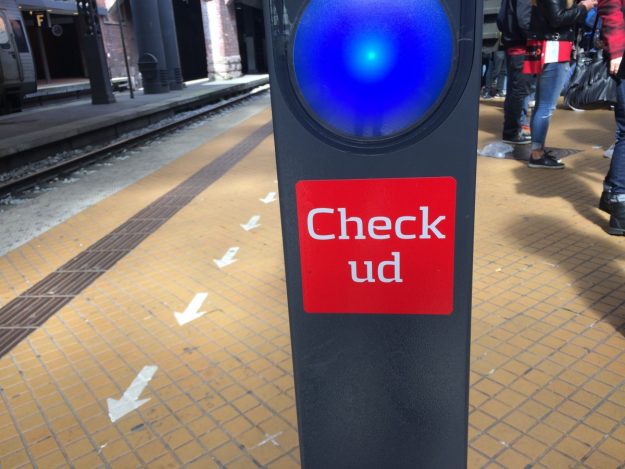
Checking out from the click society
The future of professional travel. With the right business models, railway technology doesn’t have to improve one bit to capture the value of slow motion. But today long distance trains seems to be nobody’s business. Large organisations such as universities must demand better services from their travel agencies, in terms of train booking and trip planning, along with personalised accommodation, and why not; suggestions on good restaurants and sights along the way.
Travelling by train should not be understood as an inferior alternative to the plane. Trains should not even try to compete with planes. Trains can offer something different, something unique, something which is sorely needed among professionals: time for yourself. This is the value of slow motion.
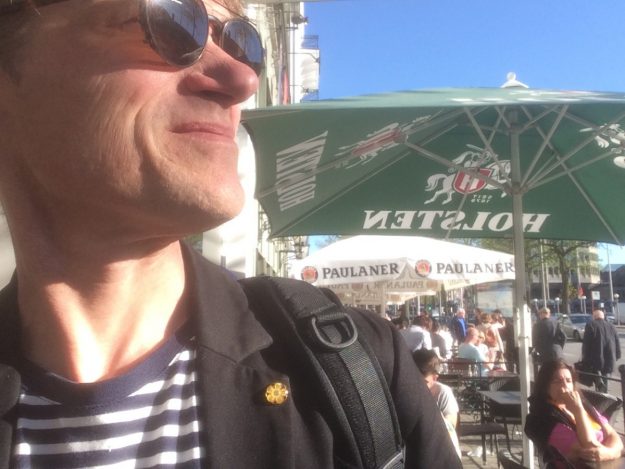
Enjoying Hamburg
As I am finishing this text I am on the EuroStar bound for London. The journey so far has not been without its hitches but on the whole it has been incredibly valuable. Two full days of undisturbed slow working, enjoying great scenery, everyday life and curious food at my stops in Copenhagen, Fredericia, Hamburg, Hannover (where I nearly missed the connection), Köln and Brussels. The trip generated a nice suite of photos on my Facebook page, and a string of surprised, envious or supportive comments. This is luxury after all.
This is the second time I travel long-distance by train. I will do it again, because it offers value that other parts of my professional life cannot. Perhaps it can inspire a colleague or two but they have to make their own decisions. The real challenge for me up ahead is that one trip per year I make for field studies in Uganda and Kenya. I managed to cut down from two or three annual trips by engaging local universities instead, which has added a lot of value. I hope one day to travel to Mombasa by cabin hire on a container ship, work for 6 months in the region and then glide back, in slow motion. Imagine the amount of work, and all the thinking I could do, in 6 weeks on a cargo carrier. Is that the future of professional travel? Who knows.
David Nilsson
Researcher, Division of History of Science, Technology and Environment


 David Nilsson