KTH Logo

Important interchange between education and research

It goes without saying that a university should offer education linked to research, as this can only strengthen the institution and help it to evolve. Our students have a right to knowledge that is up-to-date and relevant, and this can only be guaranteed if the education is closely linked to a scientific, research-based environment.

But the issue that’s generally neglected is what this research should be, and how the quality of research improves when there is a close link between it, education and students. Is it equally obvious that research should be linked to education, as it is that education should be linked to research? It’s never a bad thing to have young, questioning people around, but how does this bolster research, and how can the interchange between education and research be developed in a way that teachers, researchers and students need each other?

These matters were subjects for debate at the Royal Swedish Academy of Sciences last week, in which I participated, based on a recent report (in Swedish only) presented by the Academy. The report looks at how education and research can be closely integrated in further education in Sweden today – or rather, how this is currently not happening.

One suggestion in the report is that greater efforts in research should also be accompanied by efforts to develop the education environment. This is an interesting and innovative proposal, which would mean that research efforts should also work in favour of education, for example by linking the development of master’s programmes to research funding.

For a research-intensive university like KTH, this would be a positive development. It would mean that we have greater scope to create complete academic environments, and could also better benefit from the advantages that arise from expanded, successful research environments. One pivotal argument in linking education to research funding is that it is through education that we can most quickly ensure that the latest and most advanced research has an impact.

I look forward to continuing this discussion in other forums, and to have further opportunities to emphasise the importance of keeping research and education closely linked. In that context, it would of course be important to once again raise the issue of collective funding for research and education (as is the practice in many other countries, not least in the Nordics) so that the connection between research and education is emphasised also in the governance system. This is, after all, what makes us a university.


KTH’s ambassadors make a difference

KTH has some 175,000 alumni around the world – on important, exciting assignments which we hope are applying and refining the skills and knowledge they once learnt at KTH. It’s quite dizzying to think that all these people once studied something, at least 7.5 higher education credits, at KTH.

Our alumni network spans 32,000 people in 19 chapters worldwide. About 23 percent of KTH’s alumni now live and work abroad. According to a 2021 career survey at KTH, roughly one in five graduates have opted to live abroad in the past ten years. And the same survey shows this is a dream for many more.

The world has shrunk, while societal challenges are growing increasingly complex – which is to say that our former students are making great contributions around the world, and perhaps that home is now, far more than just 20 years ago, the place where people choose to work and make a career – regardless of country and continent.

This not only shows that our students are sought-after on the global labour market, but it also reflects KTH’s international status as a university.

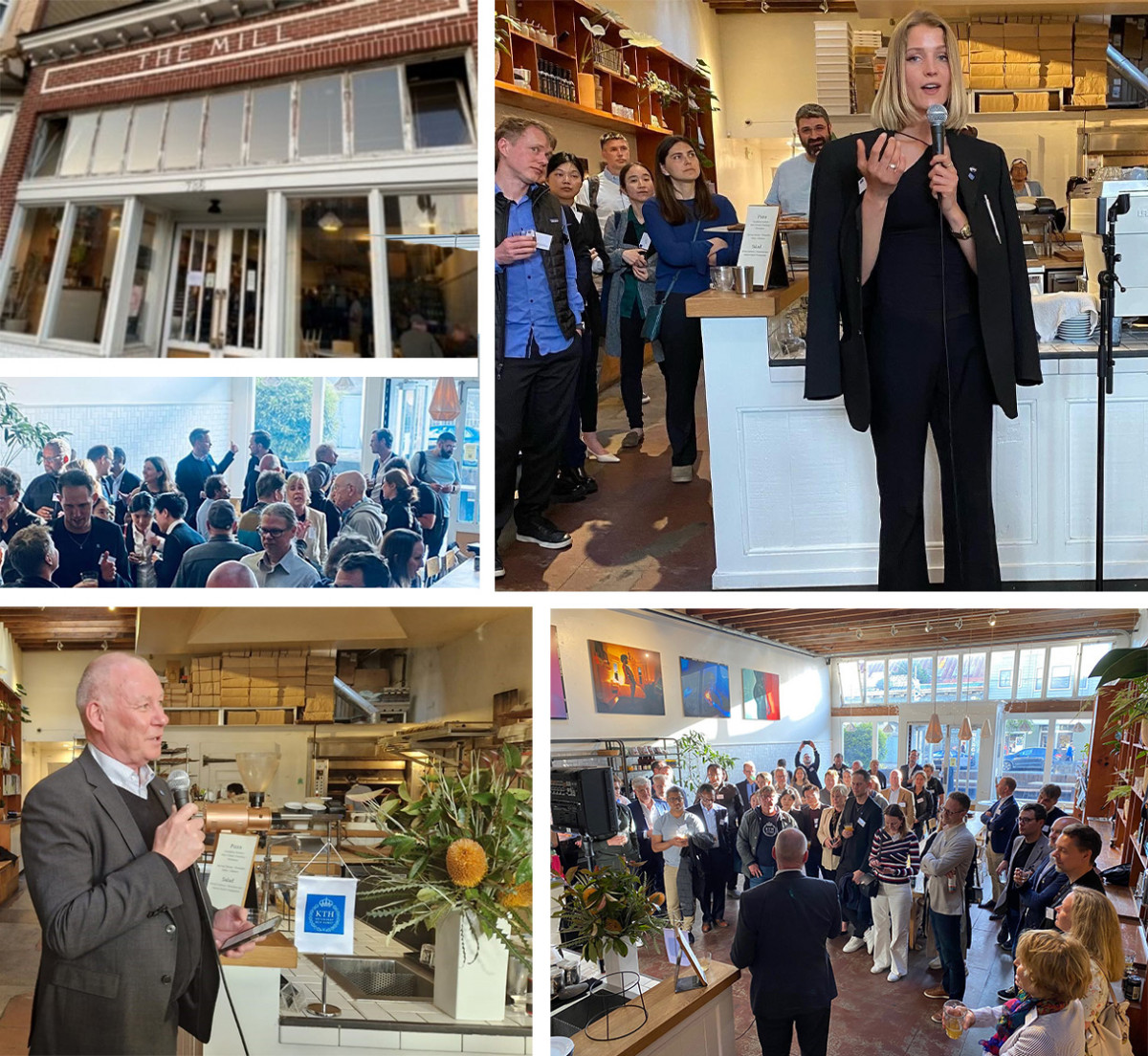
From the alumni event in the USA in May. (Photo: Linnea Dicksen)

In early May, a Swedish delegation visited the US and had the opportunity to meet alumni in San Francisco’s Silicon Valley, the Mecca of innovation. This is home to one of our two US chapters, the other one being in New York.

I felt proud and quite emotional to meet such dedicated and inspiring people, who were passionate about their alma mater. Many of the people we met now work for major tech corporations or global Swedish companies with operations in the US.


Good outlook for lifelong learning

New statistics show that lifelong learning at KTH appears to be a success, attracting a lot of applicants for the autumn semester.

KTH now provides almost 200 courses offering the latest knowledge in particular areas. Students can apply for these courses to update their knowledge and keep up with the competition, or simply to learn more and be inspired as their curiosity guides them. There is quite a variation between the different courses, with some attracting far more applicants than there are places, and others vice versa. The most popular course is programming in Python, BB1000, with 931 applicants for 100 places.

The autumn figures also show, for example, that KTH’s MSc Engineering programmes remain the most sought-after, even though there are slightly fewer applicants than last year. There are 4,995 applicants to these programmes and architecture this year, compared to 5,105 last autumn.

The gender distribution among applicants remains much the same as before, with just over 30% being female first-choice applicants. Interest in studying computer science engineering and electrical engineering is lower among women, while the proportion of female first-choice applicants to biotechnology and chemical engineering is slightly higher.

Lifelong learning entails ongoing professional development throughout an active career, whether in the form of short courses or longer programmes. Students may wish to enhance their knowledge in their current work area, or even move partly or wholly into a new field, give their career a boost and make themselves more attractive on the job market. KTH will continuously develop a range of options specifically tailored to this target group, who wish to go into, or return to, higher studies as mature students.

Sweden’s new student finance scheme for transition and retraining has vastly improved opportunities to study later on in life. The scheme is oversubscribed but will gradually be expanded over the coming years in an effort to achieve a better balance. For KTH too, this means that our lifelong learning offering is likely to increase in importance moving forward. It will also be important to strike a balance between upskilling and reskilling in the courses and programmes we offer.

We need to ask ourselves whether we should primarily strive to help people with an existing engineering degree, for example, to develop in their career, or enable those without a technical degree to start studying at more of an entry level. There are of course many opportunities for KTH to be an important player in this discussion as things develop.

KTH builds education programs for the future

Up until our 200th anniversary in 2027, the Future of Education change programme will characterise all education at KTH. It is a package of reforms based on a number of principles for revitalising our education programmes, encompassing aspects such as students’ abilities, pedagogy and campus environments.

One important lesson we learned during the pandemic is that we must build more flexible, student-centric lifelong learning, and lay an even better foundation for KTH to keep up with the competition. Higher education institutions took on the role of safety barrier to some extent during the pandemic, and overnight universities and colleges were forced to make changes to secure students’ education, partly using digital teaching and examination solutions. The key now is not to let things return to their original form but, through the Future of Education programme, to set our sights firmly forwards so that we can be open to a greater diversity of learning and education.

The new conditions for lifelong learning comprise another area that will place new demands on the education we offer in the years to come. We have to find new ways ahead both for pedagogy and for our range of courses and programmes, so that we can better reach the student groups who have already embarked on their careers.

The internationalization of our programmes also continues. We are already highly internationalized, accepting many students from other countries. It is important for the future evolution of our education that we apply the lessons we have learnt in this area.

Educational development, new forms for examination and new technology all bring fresh opportunities as well as new challenges moving forward. There is already a greater breadth of pedagogic models and forms for continuous learning in our programmes today, and it is important that we continue to make positive progress.

The Future of Education programme will include a number of change-oriented projects and will also be reviewed annually. Initiatives being launched in the near future include various kinds of development of our laboratory environments, forms for examination, our range of lifelong learning, extended recruitment, and development of our masters-level programmes, to name but a few.

Student democracy worth protecting

In the past few weeks, I have had the privilege to meet the newly elected Student Council of the KTH Student Union (THS). The Student Council is elected by the chapters and constitutes the very backbone of the democratic order on which THS is based.

Student involvement in the Student Union, chapters and associations is important to KTH. Not only is it the primary driver for student influence, it is also an important factor in creating a shared study and work environment for the students, one that’s both inclusive and enriching.

For more than ten years now, membership of a student union has been optional at state-run universities, having been mandatory for a long time. This means that student unions now have to actively recruit their members, and doing this obviously depends on having a well-run operation.

THS managed well in the transition to optional membership and today has a far-reaching field of operations beyond active student influence. This includes important reception activities, careers support, and a wide range of social and academic activities for students. It is good to know that THS is there as a close collaboration partner to KTH.

I have mixed emotions when I think back to student council meetings at my own alma mater, further north in Sweden, where our discussions were dominated by political debate and argument well into the small hours. At the time student union politics was strictly party political, and the council’s work was governed accordingly. Discussing matters that were relevant to university studies was far more uncommon.

Student Union Council work at KTH today seems to be quite different, with a clear focus on promoting academic success and developing KTH’s and the Union’s operations.

Positive collaboration is a guarantee of quality development in KTH’s operations in general, and education in particular. Like all other universities, KTH supports its Student Union with more than we receive in state grants. That is problematic.

A student union should be independent of the university in which it operates. A well-intentioned proposal is therefore being submitted to the government: why not double national funding for student influence from SEK 55 million to SEK 110 million? Government funding for student influence must increase to levels equivalent to before mandatory student union membership was abolished.

This will benefit everyone.