
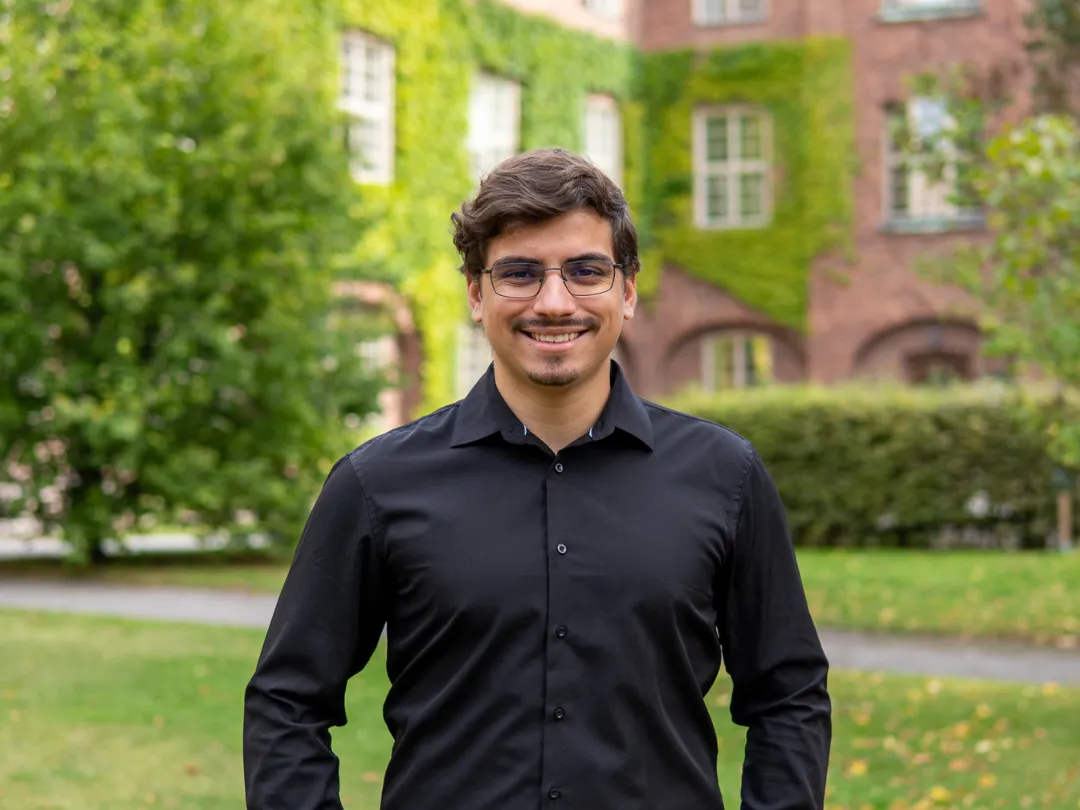
Igor
Igor is from Rio de Janeiro, Brazil. Before joining KTH, he earned a bachelor’s degree in Mechanical Engineering from the Federal University of Rio de Janeiro and spent a year as an exchange student at Lund University. He is currently pursuing a master’s degree in Aerospace Engineering at KTH, within the Aeronautics track. Outside the classroom, he is involved in ÆSIR, KTH's rocketry association, and SeedAir, a project developing fixed-wing aircraft for aerial reforestation. In his free time, he enjoys photography, hiking, and reading about aerospace history.
Why did you choose this master’s programme at KTH?
During my bachelor’s studies, I joined my university’s rocketry team, where I worked on developing small rockets from design to testing. Being involved in the full project lifecycle showed me how engaging aerospace engineering is when you work with complete, complex systems, and it confirmed my decision to pursue a career in aerospace.
At the same time, my exchange year in Sweden exposed me to a different approach to engineering education, with a strong balance between theory, practical application, and close interaction with students and industry. That experience made me want to return for my master’s studies. KTH was a natural choice, particularly the Aerospace masters and the Aeronautics track, which aligns with my interests in fluid dynamics, propulsion, and aircraft systems while still offering hands-on, project-based learning. I am also motivated by the long-standing collaboration between Brazil and Sweden in aerospace, and I hope to contribute to strengthening these links in the future.
What are the best aspects of your programme?
The strongest part of the programme, for me, is how much it focuses on actually applying what you learn. Many of the courses are built around projects and assignments that put theory into practice, making the content much more engaging and closer to real engineering work. On top of that, the large number of guest lectures from industry and study visits are really valuable; they give a direct view of how the concepts we study are used in practice and what current challenges look like in aerospace.
Another big advantage is the flexibility of choosing courses. You’re not locked into a rigid path, so you can really shape the programme around what you want to focus on. In my case, that means diving deeper into aerodynamics, propulsion, and fluid mechanics within the Aeronautics track, but also taking a couple of space courses to bridge the gap between aeronautics and space technology. Overall, it feels like a programme that lets you learn by doing, while still giving you freedom to choose your own direction.
How is student life in Stockholm?
Student life in Stockholm at KTH is one of the aspects I enjoy most about studying here. There is a strong culture of student involvement, where students actively shape university life through THS, the student union. The reception period organised by THS and the chapters is a great entry point into this environment, making it easy to meet people, get oriented, and quickly feel part of the KTH community. With students coming from all over the world, the atmosphere is open, international, and collaborative from the start.
Beyond the academic setting, student life is strongly driven by student-led organisations and projects. Through ÆSIR and SeedAir, I have been able to continue working on aerospace projects outside the classroom, collaborating with students from different disciplines on hands-on engineering challenges. Larger initiatives such as Formula Student and MIST offer similar opportunities to work on complex systems in a team environment. At the same time, there is space for other interests as well, from creative clubs like KNEPP (photography) to outdoor activities and roles as teaching assistants or lab assistants, which further deepens both technical and social engagement at KTH.
How would you describe your time at KTH so far?
Electric is probably the best word to describe my time at KTH so far. It has been a constant mix of hands-on engineering, challenging coursework, and an incredibly active student environment that makes it easy to stay engaged both inside and outside the classroom.
A big part of my experience has been student projects. In ÆSIR, I’ve been involved in hybrid rocket engine development and testing, where you really get to see theory come alive in hardware. With SeedAir, I’ve spent weeks on wind tunnel testing campaigns, working through everything from setup to data analysis. On top of that, many courses include large project components, which make you apply what you learn continuously rather than just in exams. Beyond that, study visits like the one to the astronaut training facility within the Human Spaceflight courses, along with guest lectures from industry, give a very real sense of how aerospace works outside academia. Outside of studies, I’ve had a big part of my experience in student projects. In ÆSIR, I’ve been involved in hybrid rocket engine development and testing, where you really get to see theory come alive in hardware. With SeedAir, I’ve spent weeks on wind tunnel testing campaigns, working through everything from setup to data analysis. On top of that, many courses include large project components, which make you apply what you learn continuously rather than just in exams. Beyond that, study visits like the one to the astronaut training facility within the Human Spaceflight courses, along with guest lectures from industry, give a very real sense of how aerospace works outside academia. Outside of studies, I’ve also enjoyed exploring Stockholm and working with people from all over the world, which makes the whole experience feel both intense and very global.