KTH Supreme – Sustainable Protein Materials Engineering

KTH Supreme aims to establish a collaborative platform for the design of advanced protein materials, generating the knowledge needed to address fundamental challenges and enable novel technologies. Potential applications include environmentally friendly alternatives to synthetic, fossil-based polymers, functional materials for sustainable technology, and biomedical materials.
Why proteins
Proteins are unique polymers that can be precisely engineered at the level of their smallest building blocks. In nature, proteins are found in advanced materials with remarkable properties and functionality. By mastering these design principles, protein materials can be developed with the potential to redefine boundaries and address global challenges. They can be used in biomedical applications, as key elements in new green technologies, as sustainable alternatives to synthetic polymers, and in materials with novel functionality. The unique design of protein materials allows materials to be customised for specific needs, enabling rapid prototyping and commercialisation of innovative products. They are also locally adaptable: in Sweden, the agricultural and forestry sectors generate many protein-rich side streams that could be utilised. In other regions, production from local resources can stimulate economic development in underprivileged areas.
Data generation with AI-tools
The recent devleopment of AI and machine learning are have opened a competely new avenue to explore the unlimited design possibilities of proteins. This approach, however, depends on access to high-quality experimental data. The multidisciplinary team of KTH Supreme aims to enable a transition to AI-assisted design of protein-based materials by high-throughput experiments to map how protein architecture affects critical material parameters. This marks a shift in scientific approach, with a focus on robust data generation rather than searching for the “best” solution to a single problem.
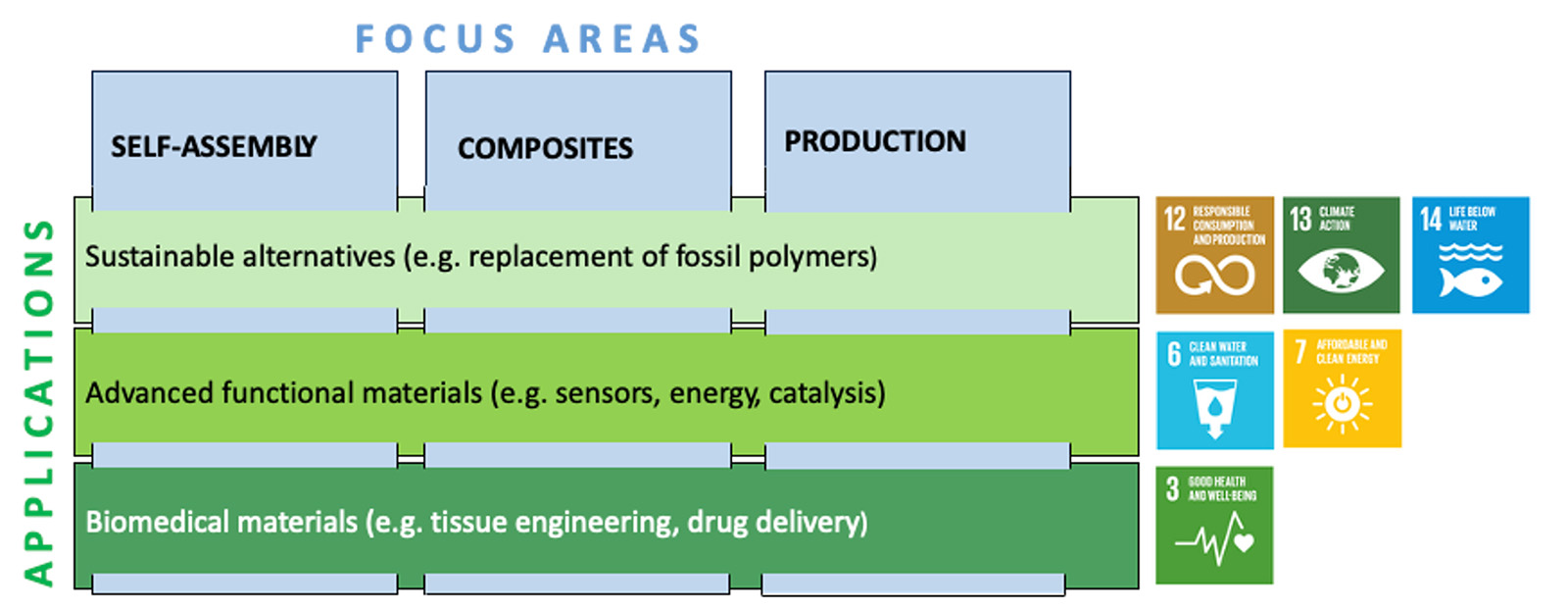
Focus areas for KTH Supreme:
- Self-assembly: how protein molecules organise into specific nano- or microscale structures.
- Composites: how proteins can be utilised as connectors or scaffolds in materials built from cellulose, traditional polymers, or inorganic components.
- Production & circularity: how efficiently proteins can be produced in heterologous expression systems or extracted from agricultural resources.
KTH contribution
Protein materials is an inherently interdisciplinary field, bridging biotechnology, chemistry, and materials engineering. KTH Supreme will foster collaboration across two research areas were KTH already hosts leading environments: advanced biobased materials and molecular biotechnology. Combined with KTH’s leading position in AI-driven research, KTH should become an international node for research and education about protien-based solution for the green transition.
Research team
The team covers multiple perspectives in protein-based materials research, including design of hierarchical materials via self-assembly, recombinant protein production (including spider silk), processing of natural proteins into functional materials, and the application of metabolic engineering, synthetic biology, and systems biology for CO₂ fixation. They also have extensive experience in coordinating national research networks and leading large-scale research initiatives.