MSc Medical Engineering
The master's programme in Medical Engineering covers the broad and interdisciplinary field of Medical Engineering, exploring the merits and limitations of the technologies used in clinical and preclinical applications. Students choose a specialisation in Computer Science, Electronics or Physics, and further specialise in Biomechanics, Health Systems or Imaging. Professionals with experience in both technology and medicine face vast career opportunities.

Medical Engineering at KTH
The master’s programme in Medical Engineering will give you expertise in the merits and limitations of the technology currently used in clinical and preclinical applications. You will also acquire the knowledge needed to develop future medical technologies.
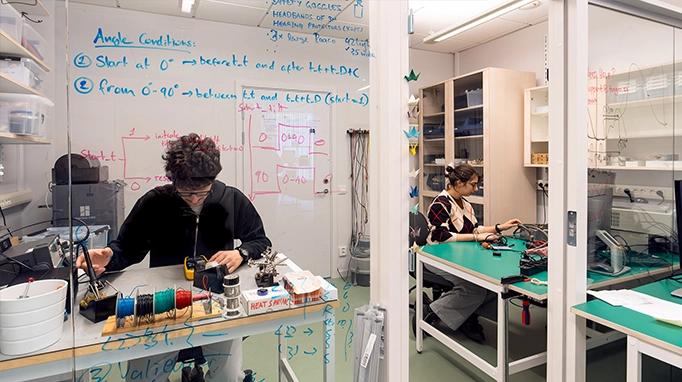
Medical Engineering is a broad and interdisciplinary field. The programme is divided into three tracks to help you choose a coherent study plan that fits your background knowledge and aspirations. The tracks are Computer Science, Electronics, and Physics. In addition to the track, you will choose one of three specialisations in different Medical Engineering application areas: Biomechanics, Health Systems, and Imaging.
Biomechanics focuses on the analysis of human movement and the interaction between the body and technology. Imaging focuses on technologies used to create and analyse medical images for diagnosis and treatment. Health Systems focuses on the planning, management and optimisation of healthcare systems through technology, data analysis, logistics and decision support. The eight possible combinations of track and specialisation are presented in the following table:
| Computer Science | Electronics | Physics | |
|---|---|---|---|
| Biomechanics | X | X | X |
| Health Systems | X | X | |
| Imaging | X | X | X |
The Computer Science track develops your ability to use state-of-the-art computer science tools in Biomechanics, Imaging, Logistics, and healthcare management. Computer simulations of brain damage from car crashes, automatic segmentation of lesions in medical images using neural network-based algorithms, and optimised workflow design in a hospital ward through computer simulations are a few examples of applications in this track across the different specialisations.
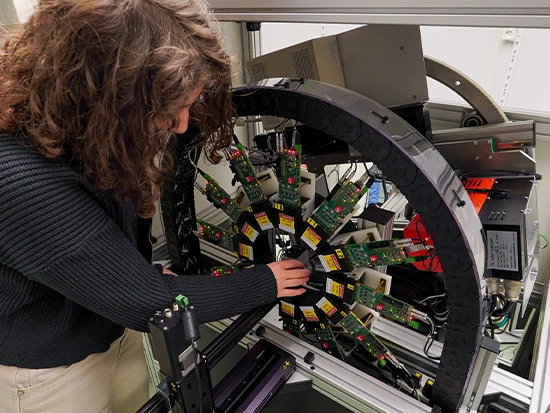
The Electronics track centres on using state-of-the-art electronic tools in Biomechanics, Imaging, Logistics, and healthcare management. Designing and producing sensors that track and measure human movement, efficiently reading out and processing signals from an imaging detector, or studying the behaviour of staff and patients using electronic devices, are typical applications in this track across the different specialisations.
The Physics track develops your ability to use state-of-the-art tools from Physics or Mathematics in Biomechanics or Imaging. Modelling of human movement, optimisation of imaging protocols, or the design of new imaging systems are examples of applications in this track across the different specialisations.
This is a two-year programme (120 ECTS credits) given in English. Graduates are awarded the degree of Master of Science. The programme is offered at KTH Campus and KTH Flemingsberg in Stockholm by the School of Engineering Sciences in Chemistry, Biotechnology and Health (at KTH). The school has many relevant research collaborations with the globally recognised Karolinska Institutet and Karolinska Universitetssjukhuset. Students are strongly encouraged to spend at least a semester at another university (in Sweden or abroad) through an exchange programme.
Programme structure and progression
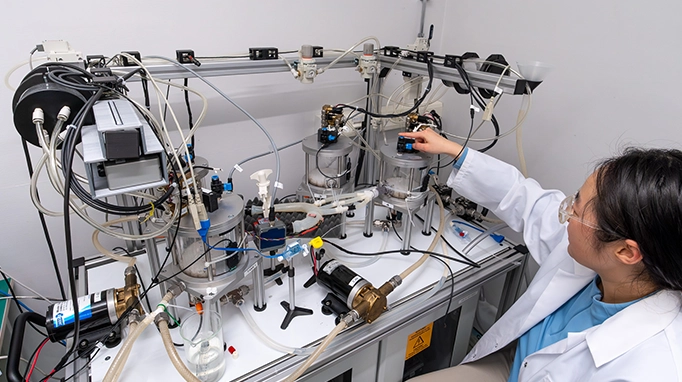
During the first year of the programme, students from all tracks and specialisations take mandatory courses in Statistics, Simulations, Signal Processing and Theory and Methodology of Science. Also, all students take a series of Project Carrier course where the theory and practice from the four mandatory courses are applied in projects specific to the chosen track and specialisation. Please note that the Project Carrier course accounts for 50% of the first year, indicating that the programme focuses on applying advanced engineering tools in real-world practice.
The second year of the master's is devoted to elective courses within the track and specialisation and the final degree project. Students are also required to take one course from a list of conditionally elective courses selected by our faculty. In the final semester, students will complete a degree project. The degree project has a twofold scope. It is used to examine the programme learning outcomes, ensuring that you have acquired all the necessary knowledge to become a professional in Medical Engineering. The degree project should also be considered the first step toward either an academic career or industry work. It can therefore be completed at an industrial company, a hospital or an academic institution in Sweden or abroad. Faculty in the Biomedical Engineering and Health Systems department regularly offer opportunities to conduct research projects in their laboratories.
Courses in the programme
The courses in the programme cover topics such as medical imaging and image analysis, implants and biomaterials, medical information systems, biomechanics, healthcare logistics, patient safety.
Courses in the master's programme in Medical Engineering


Future and career
Healthcare is becoming increasingly dependent on technologically advanced tools, and an ageing population requires technical aids. Economic and demographic changes are demanding structural reforms in society and healthcare. This demand requires professionals with an understanding of both technology and medicine.
The master's programme in Medical Engineering trains your ability to produce and develop medical technology as part of a project group, in private companies or in healthcare. A broad professional role allows working in areas such as technical development, sales, or administrative project management, depending on competence and personal interest.
The labour market mainly consists of small enterprises specialised in specific products, and the expanding field also offers good possibilities to start one's own business. Graduates of the programme have had their first occupation as diverse as PhD students, engineering consultants, programmers for companies in various technical fields, support engineers, quality control engineers, or sales consultants for clinical-related companies. Prominent research centres that have hired our former students include ETH, EPFL, UCL, CERN, and KI. The list of large companies contains Siemens, Philips, GE, Elekta, Maquet, Johnson & Johnson, SAAB, and Skandia, among others. Examples of small and medium-sized companies that consistently hire the programme's graduates include Elekta, RaySearch, Episurf, HotSwap, Sectra and Tobii. Hospitals and public organisations with an interest in healthcare are also typical employers of our former students.




Sustainable development
Graduates from KTH have the knowledge and tools for moving society in a more sustainable direction, as sustainable development is an integral part of all programmes. The three key sustainable development goals addressed by the master's programme in Medical Engineering are:


In the programme, you will learn how the human body functions under normal and abnormal conditions, and what techniques are available for preventing, diagnosing, and treating various diseases. We offer courses on the economic and social aspects of technology, as well as on ethical issues surrounding technology and healthcare. We also offer courses in anatomy/physiology, economics and entrepreneurship, ergonomics and sustainable development.
You will learn how to communicate with medical staff and look at technological solutions from the perspective of clinical practitioners. Specific courses in medical technology aim to develop technical solutions that address technical, medical, economic, and social aspects.
During your degree project you will typically work on developing healthcare technology that is used or manufactured (for example, in hospitals or industry). You can also choose to work on developing healthcare in developing countries and ensuring that care is organised in an economically and socially sustainable way.
Faculty and research
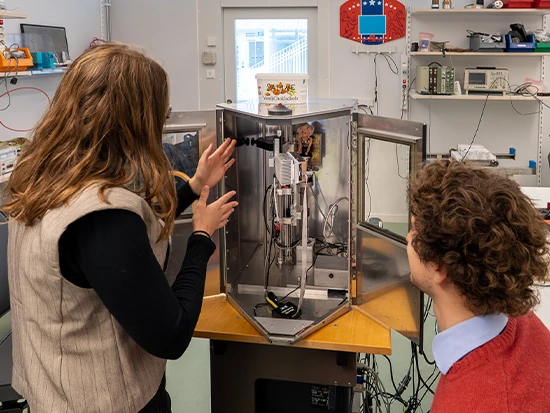
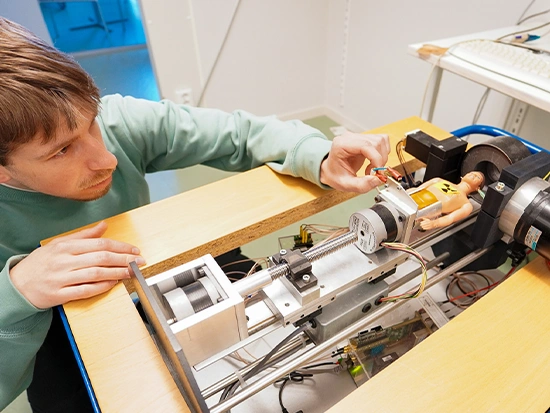
The research at the KTH School of Engineering Sciences in Chemistry, Biotechnology and Health covers many different areas of biomedical engineering. Some examples are Medical Imaging, Neuronics, Healthcare Logistics, Structural Biotechnology and Environmental Physiology. Students can participate in several ongoing research projects as interns or during the degree project course. Our master's programme graduates and PhD students have been hired by prestigious institutions such as MIT, Stanford University, ETH Zurich and CERN.
Read more about CBH's research